


















Lesson 31 of 47 · Diet, Disease and Evidence
Chapter 7 overview: diet, disease and evidence
A guide to how nutrition science links diet to disease: study designs, heart disease, blood pressure and diabetes evidence, and how to judge claims. Includes a lesson map.
Few topics generate as many headlines as the link between food and health. One week coffee protects the heart; the next it harms it. Eggs are bad, then fine; fat is the villain, then sugar. Readers could be forgiven for thinking nutrition science is just a pendulum. In fact, behind the noise is a body of evidence that has settled some questions firmly (trans fats are harmful, a diet rich in plants and fiber helps, too much sodium raises blood pressure) and left others genuinely open. This chapter gives you the tools to see the difference.
Educational information only. This chapter explains research on diet and disease for populations. It is not medical advice, and people with a diagnosed condition should follow the guidance of their own health professionals.
What you will learn
- Why nutrition research is harder than testing a drug.
- How to rank study designs and spot common biases.
- What the best evidence says about dietary patterns, blood pressure, heart disease and diabetes.
- How to evaluate a claim, a headline or a fad diet critically.
Why nutrition research is hard
A pharmaceutical trial compares a pill with a look-alike placebo that people take for a clear period. Food research has none of those luxuries:
- Exposure is hard to measure. People forget and misreport what they ate. Studies often compare self-reported intake with biological measures (urinary nitrogen for protein, doubly labeled water for energy) and find systematic under-reporting.
- You cannot blind a diet. Nobody can eat a "placebo Mediterranean diet" without knowing it.
- Diets are bundles. Raising one nutrient lowers another, so effects are rarely separable.
- Effects are slow. Chronic diseases take decades, while trials last months or a few years.
- People who eat differently also live differently. Those who eat more vegetables tend to smoke less, exercise more and earn more, which makes confounding a constant danger.
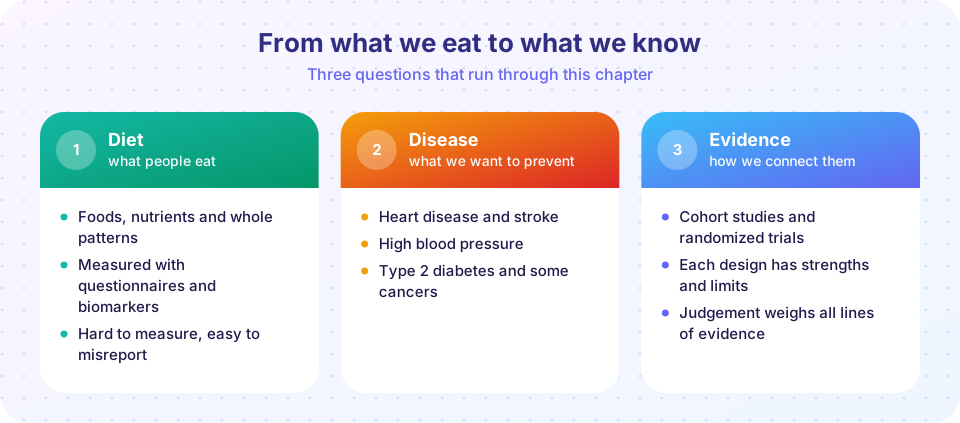
The questions
The designs
The pitfalls
The verdict
What each lesson covers
- Study designs and bias: the hierarchy of evidence, how cohorts and trials work, confounding, and how to read risk numbers.
- Diet and cardiometabolic disease: fats, sodium, fiber, dietary patterns, blood pressure, type 2 diabetes and the landmark trials (DASH, PREDIMED, the Diabetes Prevention Program).
- Claims, fads and supplements: how to appraise a headline, where fads come from, what supplement trials found and why multiple comparisons mislead.
- Chapter review: a summary and ten questions.
A word about uncertainty
Beginners often feel that uncertainty means failure: if scientists are not sure, why listen to them? In fact, honest uncertainty is a feature of good science. A statement such as "replacing saturated fat with polyunsaturated fat probably lowers heart disease risk, with moderate certainty" tells you both what to do and how much to trust the advice. Compare it with confident claims in advertisements, which almost never include any measure of doubt.
Nutrition science deals with uncertainty in three ways: it grades the quality of evidence, it looks for agreement among different kinds of studies, and it updates when new data arrive. By the end of the chapter you will be able to describe all three and to apply them to claims you meet in daily life.
Try it
A quick demonstration of why single headlines mislead: this simulation draws many small "studies" of a food that truly has no effect, and shows how often chance alone gives a result that looks like an effect. The point returns in the lessons ahead.
Press Run (or Ctrl + Enter) to see the console output here.
No output.
Check your understanding
Quick check · 4 questions
of 4 answered You scored / 4 · perfect!
-
1. Which is NOT one of the difficulties of nutrition research?
Foods are bundles of nutrients, which makes single effects hard to isolate. -
2. What is confounding?
For example, vegetable eaters often also exercise and smoke less. -
3. Why are results from chronic-disease trials difficult to obtain?
Long latency makes it hard to test outcomes directly. -
4. In the simulation above, a food has no effect. What fraction of studies appear to show one by chance?
A 5 percent significance threshold means about one in twenty null studies crosses it.
Summary
- Nutrition research faces measurement, blinding, bundling, latency and confounding problems.
- Good conclusions come from weighing several kinds of evidence, not a single study.
- The chapter ahead covers designs, major diet-disease links and how to judge claims.
Next: Study designs and bias
Track your progress
Create a free account to tick off lessons and pick up where you left off on any device.
of Nutrition Science lessons completed