


















Lesson 47 of 47 · Projects and Practice
Further study: where to go after nutrition science
Plan your next steps in nutrition: related tracks on this site, career paths, trustworthy sources to follow, and a study routine for keeping your knowledge current.
You now have the foundations of nutrition science: how energy is measured and spent, how needs change across life, how researchers judge claims about diet and disease, and how food systems and policies shape what people eat. Nutrition is a field that keeps moving, so the end of a course is really the start of a habit: reading, questioning and practicing. This final lesson maps the neighboring subjects that deepen your understanding, outlines some career paths and gives you a plan for staying current without being swept away by every headline.
What you will learn
- Which related tracks on this site extend each part of the course.
- What kinds of careers use nutrition science.
- Which sources to trust and how to keep up with the field.
- How to plan a realistic study routine.
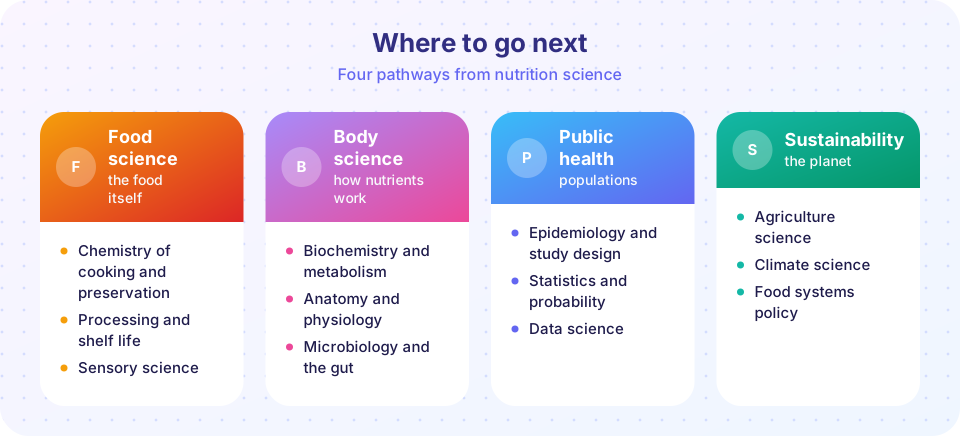
Four directions
1. The food itself: food science. Nutrition tells you what the body needs; food science explains how food is made, preserved and tested, from the chemistry of cooking to shelf life and sensory evaluation. Start with the Food Science track. It also supports the safety ideas from the food safety lesson.
2. The body: biochemistry, physiology and microbiology. The chapter on energy used metabolism at a high level. To see how glucose, fat and amino acids are actually processed, study Biochemistry; for the organs that digest, absorb and regulate, Anatomy and Physiology; and for the gut microbes and food-borne pathogens, Microbiology.
3. Populations and evidence: public health, statistics and data. The evidence chapter introduced designs and biases, but real research needs deeper tools. Public Health and Epidemiology covers study design, risk and surveillance; Statistics and Probability covers confidence intervals, p-values and regression; and Data Science shows how to analyze large datasets with code, extending the Python practice in the projects.
4. The planet: agriculture and climate. To go deeper into the sustainability lesson, explore Agriculture Science and Climate Science.
The food
The body
The evidence
The planet
Careers that use nutrition science
- Registered dietitian or nutritionist. Counsels individuals and groups, often in hospitals, clinics and sports. Requirements and titles vary by country, and in many places "dietitian" is a protected title requiring a degree, supervised practice and registration.
- Public health nutritionist. Designs and evaluates programs: school meals, supplementation, community interventions and policy.
- Researcher. Runs trials and cohort studies at universities or institutes; needs strong statistics.
- Food technologist or product developer. Works on reformulation, fortification and safety.
- Food safety and regulatory specialist. Applies HACCP and law in industry or government.
- Sports and exercise nutrition, clinical nutrition, nutrition communication and policy advocacy.
These are general descriptions; check the qualifications recognized in your own country.
Trustworthy sources
- Primary sources: peer-reviewed journals and systematic reviews, such as the Cochrane Library.
- Authoritative bodies: the WHO and FAO, national dietary guideline committees, national health agencies and reputable professional associations.
- Data: the FAO's State of Food Security and Nutrition reports, national food composition databases and global burden of disease estimates.
- Habits for judging a source: check who funds it, whether it names its evidence and whether it admits uncertainty, using the checklist from the claims lesson.
A study routine
Learning sticks when it is spaced and active. A modest plan beats a heroic one:
- Revise the cheat sheet and glossary weekly.
- Practice one project a month: analyze your own typical day, plan a menu for a family member, or appraise a headline.
- Read one primary paper or one report summary every two weeks and write a five-sentence appraisal.
- Teach a friend one idea from the course. Explaining is the best test of understanding.
- Update: guidelines and evidence change, so check the latest national guidelines every few years.
Press Run (or Ctrl + Enter) to see the console output here.
No output.
Reading a paper in fifteen minutes
Reading a research paper from beginning to end is slow and unnecessary for a first pass. A fast method uses six steps:
- Read the title and abstract to learn the question, design and main result.
- Look at the figures and tables, especially the main results table. Find the absolute numbers, not only the ratio.
- Read the methods briefly to see who was studied, how exposure and outcome were measured and what the authors adjusted for.
- Read the limitations in the discussion. Good papers state them candidly.
- Check the funding and conflicts of interest statement.
- Write your appraisal in a few sentences, as in the fourth project.
With practice, this takes about fifteen minutes and you will learn to tell strong from weak papers quickly. Some journals publish plain-language summaries, and the Cochrane Library offers reviews with summaries for non-specialists.
A twelve-week plan
A realistic way to consolidate the course is to spread practice over a quarter. In weeks 1 to 4, redo the projects with your own data: analyze three of your own days, plan a week of meals, and review each chapter's quiz. In weeks 5 to 8, read and appraise four papers on topics from the evidence chapter, such as the DASH trial, the Diabetes Prevention Program, PREDIMED and a review of fiber and health, and write a short appraisal of each. In weeks 9 to 12, choose one neighboring track from the list above and complete its first chapters, noting where its ideas connect to what you have learned here. At the end, reread the cheat sheet and see what you can now explain that you could not before.
Check your understanding
Quick check · 3 questions
of 3 answered You scored / 3 · perfect!
-
1. Which track would best deepen your understanding of how glucose and fat are processed in cells?
Biochemistry covers metabolic pathways in detail. -
2. Which direction helps you design and judge studies of diet and disease?
Study design and quantitative methods are the tools of nutrition epidemiology. -
3. What is a good habit for staying current?
Appraising sources keeps knowledge accurate.
Summary
- Food science, body sciences, public health with statistics, and agriculture with climate are the four natural next steps.
- Many careers use nutrition, from clinical dietetics to research and policy.
- Trust primary sources and authoritative bodies, appraise claims and keep a regular study routine.
Congratulations on finishing the second half of this course. Return to the Nutrition Science course page to review any chapter.
Track your progress
Create a free account to tick off lessons and pick up where you left off on any device.
of Nutrition Science lessons completed