


















Lesson 18 of 47 · Vitamins and Minerals
Water-soluble vitamins: the B complex and vitamin C
Learn what the eight B vitamins and vitamin C do, the deficiency diseases they prevent, the best food sources, and who needs B12 or folic acid.
The nine water-soluble vitamins include some of the most famous names in nutrition history: scurvy, beriberi and pellagra were once among the greatest killers of sailors, prisoners and poor populations. Each was shown to be a deficiency disease, and curing them launched the science of nutrition.
Today these deficiencies are rare in countries that fortify flour and have varied diets, but they remain in famine zones and in particular groups. Meanwhile new questions have appeared: folic acid before pregnancy, B12 for vegans and older adults, and vitamin C beyond scurvy.
What you will learn
- The main role of each B vitamin and of vitamin C.
- The classic deficiency diseases and who is at risk today.
- Why folate and B12 get special attention.
- How cooking and storage affect these vitamins.
Key terms
- Coenzyme: a small molecule, often derived from a vitamin, that an enzyme needs to function.
- DFE (dietary folate equivalents): the unit for folate: 1 µg DFE = 1 µg food folate = 0.6 µg folic acid taken with food.
- Intrinsic factor: a protein from the stomach needed to absorb vitamin B12.
- Megaloblastic anemia: anemia with abnormally large, immature red cells, caused by lack of folate or B12.
- Collagen: the main structural protein of skin, tendons, bones and blood vessels.
The B vitamins that release energy
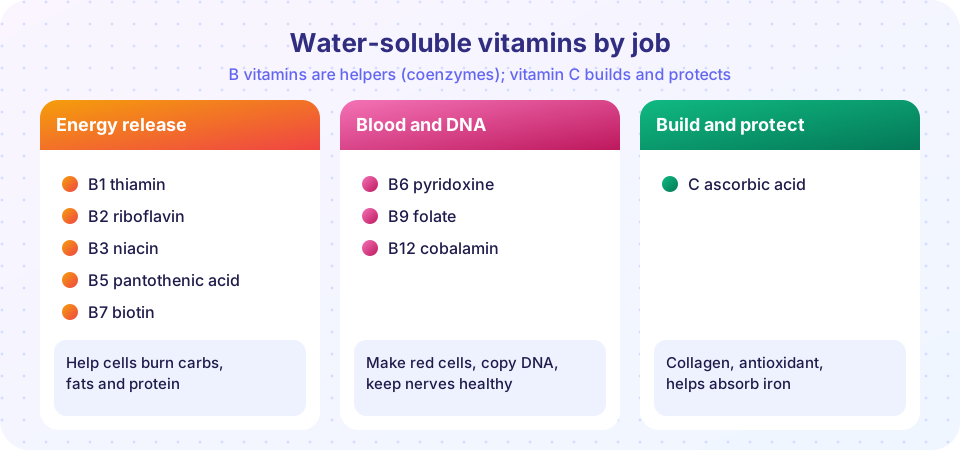
Thiamin (B1) is needed to convert carbohydrate to energy, especially in nerves and the heart. Deficiency is beriberi: nerve damage and weakness (dry), or heart failure and swelling (wet). It arose where polished white rice was the staple, because milling removes the bran. In heavy alcohol use, thiamin deficiency can cause Wernicke-Korsakoff syndrome, a brain disorder. Sources: whole grains, pork, legumes, nuts and fortified flour and cereals. RDA 1.2 mg (men), 1.1 mg (women).
Riboflavin (B2) forms the coenzymes FAD and FMN, which carry electrons in energy metabolism. It is yellow-green and sensitive to light, which is why milk is sold in opaque cartons. Deficiency causes cracked lips and mouth corners and a sore tongue. Sources: milk, eggs, meat, mushrooms and fortified cereals. RDA 1.3 / 1.1 mg.
Niacin (B3) forms NAD and NADP, coenzymes in hundreds of reactions. Deficiency is pellagra, the "four Ds": dermatitis, diarrhea, dementia and death. It spread among poor populations who relied on maize, in which niacin is bound and unavailable; traditional nixtamalization (soaking maize in lime water) releases it, which is why Mesoamerican peoples did not suffer. The body can also make niacin from the amino acid tryptophan (about 60 mg tryptophan per 1 mg niacin). RDA 16 / 14 mg NE (niacin equivalents). Supplement doses above 35 mg cause flushing; doses used to treat high cholesterol can harm the liver.
Pantothenic acid (B5) is part of coenzyme A, central to fat and carbohydrate metabolism. The name comes from the Greek for "everywhere", because it occurs in nearly all foods; deficiency is almost unknown. AI 5 mg.
Biotin (B7) helps enzymes that add carbon dioxide in fat and glucose metabolism. AI 30 µg. Deficiency is rare, though raw egg white contains avidin, which binds biotin. Note that high-dose biotin supplements can distort some laboratory tests, including those for thyroid hormones and heart attack markers, and have led to regulatory warnings.
B vitamins for blood and nerves
Vitamin B6 (pyridoxine) acts in more than 100 enzymes, mainly in amino acid metabolism, in making neurotransmitters and in building hemoglobin. Sources: poultry, fish, potatoes, chickpeas, bananas. RDA 1.3 mg for adults to age 50. Large supplemental doses (over 100 mg a day for long periods) can cause nerve damage, so the UL is 100 mg.
Folate (B9) carries single carbon units used to make DNA and to divide cells. Folate is crucial where cells divide fast: bone marrow, the gut lining and the early embryo. A lack causes megaloblastic anemia and, in pregnancy, neural tube defects such as spina bifida. Natural food folate is found in leafy greens (the name comes from folium, leaf), legumes, citrus and liver. Folic acid, the synthetic form in supplements and fortified foods, is absorbed better (use DFE to compare). Adults need 400 µg DFE; those planning pregnancy are advised to take 400 µg of folic acid daily from before conception through early pregnancy, and the RDA in pregnancy is 600 µg DFE. Women at high risk are given higher doses by doctors. Many countries fortify flour with folic acid, which has reduced neural tube defects by a quarter to a half. The UL of 1,000 µg applies to synthetic folic acid because large doses can mask the anemia of B12 deficiency.
Vitamin B12 (cobalamin) is required for DNA synthesis and for maintaining the myelin sheath around nerves. It is made only by microorganisms and is found naturally in animal foods: meat, fish, eggs, dairy, plus fortified foods and supplements. Absorption is complicated: stomach acid frees it from food proteins, intrinsic factor binds it, and the ileum absorbs the complex. Deficiency causes anemia and nerve damage (numbness, memory problems) that can be irreversible if not treated. The liver stores several years of supply, so deficiency develops slowly. At risk: vegans (need fortified foods or a supplement), older adults (reduced stomach acid), people with pernicious anemia (no intrinsic factor), after some stomach and bowel surgeries, and long-term users of certain acid-reducing drugs and metformin. RDA 2.4 µg.
Vitamin C
Vitamin C (ascorbic acid) is needed to make collagen: it helps enzymes attach hydroxyl groups to proline, a step that gives collagen its strength. Without it, collagen is weak and the symptoms of scurvy appear: bleeding gums, bruising, poor wound healing, joint pain and fatigue, within one to three months of very low intake. Scurvy killed millions of sailors; James Lind's 1747 trial pointed to citrus. Vitamin C also acts as an antioxidant, aids synthesis of some hormones and neurotransmitters, and improves the absorption of non-heme iron from plant foods, which is why eating peppers with beans helps.
Most animals make their own vitamin C; humans, other primates and guinea pigs lost the gene. Sources: citrus fruit, kiwi, strawberries, peppers (red peppers are richer than oranges), broccoli, tomatoes and potatoes. Vitamin C is destroyed by heat and leaches into cooking water, so raw or lightly steamed foods retain more. RDA 90 mg (men) and 75 mg (women), with 35 mg extra for smokers; UL 2,000 mg (above this, diarrhea and stomach upset).
Does vitamin C prevent colds? Reviews of many trials show that regular supplements do not reduce how many colds ordinary people catch, though they slightly shorten colds (about 8 percent in adults) and help in people under extreme physical stress such as marathon runners. Taking it after symptoms start has not been shown to help.
Cooking and storage
Water-soluble vitamins are lost by leaching into cooking water and by heat (vitamin C, thiamin, folate), and light destroys riboflavin. To keep them: steam or microwave vegetables briefly, use the cooking water in soups, cut vegetables as late as possible, and store them cool and dark. Frozen vegetables, frozen soon after harvest, can match or beat "fresh" produce that spent a week in transit.
Common misconceptions
- "B vitamins give you energy." They help release energy from food. In people who are not deficient, extra B vitamins do not boost energy.
- "Vitamin C prevents colds." Evidence shows little preventive effect in the general population.
- "Water-soluble means harmless." Large supplement doses of B6 and niacin can be toxic, and folic acid can mask B12 deficiency.
- "Vegans get enough B12 from seaweed, tempeh or unwashed vegetables." Reliable intake requires fortified foods or supplements.
Try it
First a game that matches classic cases with the vitamin; these are descriptions of historical deficiency diseases, not diagnostic tools. Then a folate calculator.
Press Run (or Ctrl + Enter) to see the result here.
Program input · what you'd type while the program runs
Type the answers before you press Run, one per line. Each time the program reads a line (with input()), it gets the next line from this box.
Check your understanding
Quick check · 5 questions
of 5 answered You scored / 5 · perfect!
-
1. Which vitamin deficiency causes pellagra?
Pellagra results from niacin (and tryptophan) deficiency, historically in maize-dependent diets. -
2. Why do vegans need a reliable source of vitamin B12?
Plants do not make B12 reliably, so vegans need fortified foods or supplements. -
3. What role does vitamin C have in collagen formation?
Vitamin C is a cofactor for the hydroxylation steps that stabilize collagen. -
4. What does folic acid taken before and in early pregnancy help prevent?
Adequate folate lowers the risk of neural tube defects such as spina bifida. -
5. How does vitamin C affect iron?
Vitamin C reduces iron to a form that is better absorbed and counters inhibitors like phytates.
Summary
- B vitamins are mostly coenzymes: B1, B2, B3, B5 and B7 release energy; B6, B9 and B12 support blood, DNA and nerves.
- Classic deficiencies: beriberi (B1), pellagra (B3), scurvy (C), megaloblastic anemia (B9, B12), plus neural tube defects (folate).
- B12 is found naturally only in animal foods, so vegans need fortified foods or supplements, and older adults absorb it poorly.
- Vitamin C builds collagen, protects cells and improves iron absorption.
- Cooking and light destroy these vitamins; steam, use the water, and eat raw produce too.
Next: Minerals in the body
Track your progress
Create a free account to tick off lessons and pick up where you left off on any device.
of Nutrition Science lessons completed