


















Lesson 13 of 47 · Carbohydrates, Fats and Proteins
Fats and fatty acids
Understand triglycerides and fatty acids, the differences between saturated, unsaturated and trans fats, omega-3 and omega-6, cholesterol and lipoproteins.
Fat has had a rough reputation. For decades, "low fat" was the headline of dietary advice, and many food products swapped fat for sugar and flour. Later came the swing the other way: butter and coconut oil were celebrated, and the idea of a "fat phobia" took hold. Reality, as so often in nutrition, lives between the slogans: fat is essential, and the kind of fat is what matters.
This lesson explains the chemistry that separates saturated, unsaturated and trans fats, why two fatty acids are essential, what cholesterol and lipoproteins really are, and what the evidence says about replacing one fat with another.
What you will learn
- What triglycerides, phospholipids and sterols are.
- How saturated, monounsaturated, polyunsaturated and trans fatty acids differ, and what omega-3 and omega-6 mean.
- The role of LDL, HDL and dietary cholesterol.
- What guidelines and trials say about replacing saturated with unsaturated fat.
Key terms
- Triglyceride: glycerol with three fatty acids attached; the main form of fat in food and in body fat.
- Fatty acid: a chain of carbon atoms with an acid group at one end, saturated or unsaturated.
- Cis and trans: the geometry around a double bond; cis bends the chain, trans leaves it nearly straight.
- Lipoprotein: a particle of fat and protein that carries lipids in the blood; LDL and HDL are examples.
- Omega-3 / omega-6: families of polyunsaturated fatty acids named by the position of the first double bond counted from the methyl end.
The family of lipids
Triglycerides make up about 95 percent of the fat in the diet and in your body fat. A molecule of glycerol holds three fatty acids, which may be all the same or different. Phospholipids, such as lecithin, have a water-loving head and fat-loving tails, so they form membranes of all cells and emulsify fat in food. Sterols, of which cholesterol is the most famous, form membranes and are the raw material for bile acids, vitamin D and steroid hormones. Plants make their own sterols, which slightly reduce cholesterol absorption.
Fatty acids: length and saturation
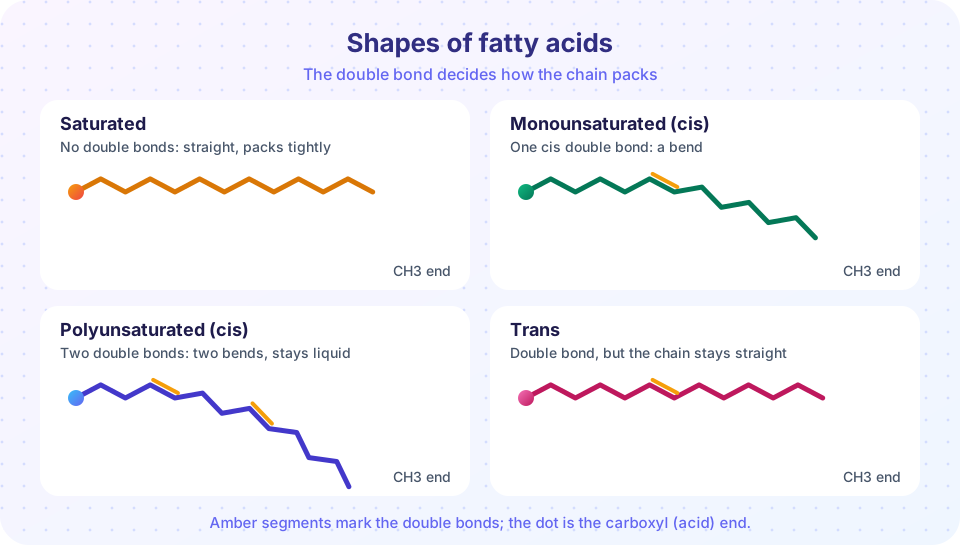
Fatty acids are chains of 4 to 24 carbons. Saturated fatty acids have no double bonds; they are "saturated" with hydrogen. Their straight chains pack tightly, so they tend to be solid at room temperature: butter, lard, the fat in meat, and the tropical oils coconut and palm. Monounsaturated fatty acids (MUFA) have one double bond, like oleic acid in olive oil, rapeseed (canola) oil, avocado and many nuts. Polyunsaturated fatty acids (PUFA) have two or more, as in sunflower, soybean and corn oil, walnuts, seeds and fish. Each cis double bond puts a kink in the chain, so the oils are liquid.
No food is made of one type. Olive oil is mostly monounsaturated but contains around 14 percent saturated fat; butter is mostly saturated but contains monounsaturated fat too. The numbers in the activity below show real mixes.
Omega-3 and omega-6
Count from the methyl (omega) end of the chain: if the first double bond is at carbon 3, it is an omega-3; at carbon 6, an omega-6. The two essential fatty acids are linoleic acid (omega-6), in vegetable oils, nuts and seeds, and alpha-linolenic acid (ALA, omega-3), in flaxseed, chia, walnuts and rapeseed oil. Adequate intakes for adults (US) are about 12 to 17 g linoleic acid and 1.1 to 1.6 g ALA per day. The body can convert ALA to the long-chain omega-3s EPA and DHA, but the conversion is inefficient (a few percent). EPA and DHA come directly from oily fish (salmon, sardines, mackerel, herring) and algae oil; DHA is a major structural fat in the brain and the retina. Many guidelines advise eating oily fish once or twice a week. Fish oil supplements have not shown clear heart benefits in healthy people in large trials, though prescription-strength products help some patients with very high triglycerides.
Trans fats
Trans fats form when liquid vegetable oils are hardened by partial hydrogenation, which was widely used for margarines, fried foods and baked goods. The trans double bond straightens the chain. Trans fats raise LDL cholesterol and lower HDL, and are linked to higher heart disease risk. Small amounts occur naturally in dairy and meat from ruminants, but the evidence of harm relates to industrial trans fat. The WHO has called for the elimination of industrially produced trans fat, and a growing number of countries have banned it or capped it at 2 g per 100 g of fat. Check the ingredient list for "partially hydrogenated oils".
Cholesterol, LDL and HDL
Cholesterol is not a fat in the sense of energy, and not a villain: every cell membrane needs it. The liver makes about 1 g per day, much more than the typical 200 to 300 mg from the diet. Because it does not dissolve in blood, it travels inside lipoproteins. LDL (low-density lipoprotein) carries cholesterol from the liver to tissues; when LDL particles are abundant they can lodge in artery walls and contribute to atherosclerosis, the plaque build-up behind most heart attacks and strokes. HDL carries cholesterol back to the liver. High LDL is a causal risk factor for heart disease, established by genetics, trials of lipid-lowering drugs and many cohort studies. For HDL the story is more complicated: raising HDL with drugs did not reduce events, so it is a marker more than a target.
How much does dietary cholesterol matter? For most people, blood cholesterol responds modestly to cholesterol in food, and responses vary (some people are "hyper-responders"). Because foods high in cholesterol (such as fatty meat) are often high in saturated fat, the two used to be confused. The 2015 US Dietary Guidelines dropped the old limit of 300 mg a day, though advice still says to eat as little as is practical within a healthy pattern. Eggs, which are high in cholesterol but low in saturated fat, are fine in moderation for most people.
Which fat should you eat?
The strongest evidence concerns saturated fat. Raising it increases LDL cholesterol. WHO and US guidelines advise less than 10 percent of energy from saturated fat, and the American Heart Association suggests aiming nearer 5 to 6 percent for people who need to lower LDL. The key finding from reviews of trials is that what replaces saturated fat matters: replacing it with polyunsaturated fat (and, to a smaller extent, with monounsaturated fat or whole grains) lowers cardiovascular risk, while replacing it with refined carbohydrates and sugar does not. This is why advice focuses on foods: more olive oil, nuts, fish and vegetable oils, less butter, fatty processed meat, and pastries. Studies of individual saturated-fat foods give mixed results: fermented dairy such as yogurt and cheese appears neutral or modestly beneficial in several cohorts, while processed meats are linked to harm, so the food matrix and the rest of the diet matter.
Total fat matters less than type. The AMDR allows 20 to 35 percent of energy. Because fat is energy dense (9 kcal/g), a diet very high in fat can make it easy to overeat, but populations eating up to about 40 percent of energy as fat, mostly from olive oil, nuts and fish, as in the traditional Mediterranean diet, have had low rates of heart disease.
Common misconceptions
- "Eating fat makes you fat." Surplus energy from any source can be stored; fat also helps you feel full. Fat's energy density means portion size matters.
- "Cholesterol in food is the main cause of high blood cholesterol." Saturated and trans fat usually influence LDL more than dietary cholesterol does.
- "Coconut oil is a health food." It is about 80 to 85 percent saturated fat and raises LDL more than unsaturated oils.
- "Low-fat products are healthier." Many replace fat with sugar or starch; read the label.
Try it
The first demonstration plots the fatty-acid composition of common fats and oils. The second is a swap calculator that shows how replacing one spread with another changes the saturated fat of a meal. Values are rounded typical figures.
Press Run (or Ctrl + Enter) to see the result here.
Program input · what you'd type while the program runs
Type the answers before you press Run, one per line. Each time the program reads a line (with input()), it gets the next line from this box.
Check your understanding
Quick check · 5 questions
of 5 answered You scored / 5 · perfect!
-
1. What makes unsaturated oils liquid at room temperature?
Each cis double bond bends the chain, preventing tight packing, so the fat stays liquid. -
2. Which are the two essential fatty acids?
Linoleic (omega-6) and alpha-linolenic (omega-3) acids cannot be made by the human body. -
3. Why are industrial trans fats harmful?
Trans fats worsen the cholesterol profile and are linked to higher heart disease risk. -
4. Replacing saturated fat with which option is associated with lower cardiovascular risk?
Substituting polyunsaturated fat lowers LDL and risk; replacing with refined carbohydrate shows no benefit. -
5. Where does most of the body's cholesterol come from?
The body makes about 1 g a day, much more than the 200 to 300 mg typical from food.
Summary
- Fats in food and body are mostly triglycerides; phospholipids and sterols are structural and hormonal.
- Saturated, mono- and polyunsaturated, and trans fatty acids differ in double bonds and shape, and every food contains a mixture.
- Linoleic and alpha-linolenic acids are essential; EPA and DHA come from fish and algae.
- LDL cholesterol is a causal risk factor for heart disease; trans and saturated fat raise it, while polyunsaturated fat lowers it.
- Aim for under 10 percent of energy from saturated fat, and mostly choose unsaturated fats from plants and fish.
Next: Proteins and amino acids
Track your progress
Create a free account to tick off lessons and pick up where you left off on any device.
of Nutrition Science lessons completed