


















Lesson 35 of 47 · Diet, Disease and Evidence
Chapter 7 review: diet, disease and evidence
Review study designs, confounding, absolute versus relative risk, diet and heart disease, DASH, PREDIMED, the DPP and how to judge claims, with a ten-question quiz.
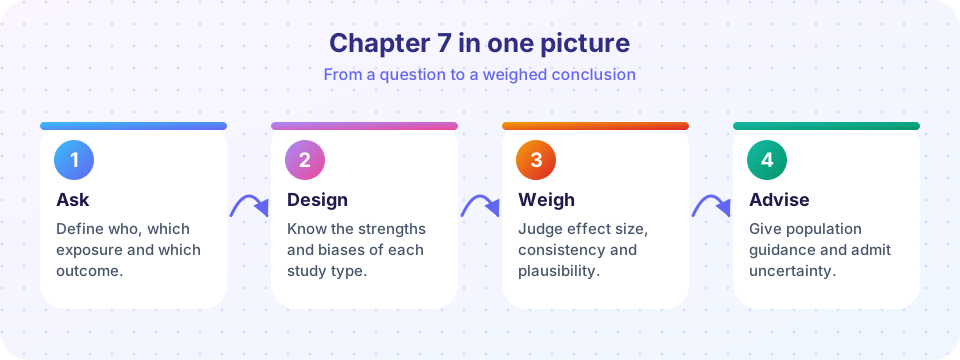
This chapter taught a skill as much as a set of facts: how to move from a question about food and health to a defensible conclusion. The summary below places the chapter's landmark studies, biases and rules of thumb in one view, followed by a quiz that mixes all three lessons.
What you will learn
- The landmark studies and the lesson each taught.
- The biases and statistical pitfalls to check for first.
- A short list of the best-supported diet-disease statements.
Recap table
| Topic | Key ideas |
|---|---|
| Study designs | Ecological, case-control, cohort, RCT, meta-analysis; each has typical biases |
| Confounding | A hidden factor linked to exposure and outcome; HRT looked protective in cohorts but not in the WHI trial |
| Absolute vs relative risk | Relative risk needs the baseline; NNH = 1 / absolute increase |
| Heart and blood pressure | Trans fat harmful; replace saturated with unsaturated fat; sodium raises BP; DASH lowers BP; fiber is protective |
| Patterns | PREDIMED: Mediterranean diet with olive oil or nuts, about 30% fewer major events; DIETFITS: low-fat and low-carb similar |
| Type 2 diabetes | DPP: lifestyle cut incidence by about 58% vs placebo, metformin by about 31% |
| Claims and fads | Checklist; multiple comparisons; ATBC, CARET and SELECT showed harm from high-dose supplements |
Key terms to know: cohort, RCT, systematic review, confounding, reverse causation, residual confounding, relative risk, absolute risk, NNH, DASH, PREDIMED, glycemic index, multiple comparisons, p-hacking, placebo effect.
Best-supported statements (as of this writing)
- Industrial trans fats are harmful and have been eliminated by regulation in many countries.
- Lowering sodium and eating more fruit, vegetables and potassium lowers blood pressure.
- Higher fiber and whole grain intake is associated with lower cardiovascular disease, type 2 diabetes and colorectal cancer.
- Replacing saturated fat with unsaturated fat from plants reduces cardiovascular events.
- Healthy dietary patterns (Mediterranean, DASH, healthy plant-based) are associated with better outcomes.
- In prediabetes, weight loss and physical activity can prevent most progression to diabetes.
- High-dose isolated antioxidant supplements do not prevent disease and sometimes cause harm.
Common mistakes to avoid
- Taking one headline as settled science.
- Confusing "statistically significant" with "important".
- Treating relative risk as absolute risk.
- Judging a diet by its anecdotes rather than its trials.
A worked example
A news story says that a drink raises the risk of a disease by 25 percent. Walk through the chapter's questions. First, what is the baseline risk? Suppose it is 4 in 1,000 over ten years; then a 25 percent increase means 5 in 1,000, one extra case per 1,000 people, and the number needed to harm is 1,000. Second, what was the design? If a cohort study, ask about confounding: people who drink a lot of it may smoke more or exercise less. Third, was the exposure measured well, and was the result replicated? Fourth, does a plausible mechanism exist, and do trials of the exposure agree? Only after these steps does the headline become a calibrated statement: perhaps "a small association, uncertain whether causal".
Try it
Use the calculator to turn a headline into numbers: give it a baseline risk and a relative risk and see what the claim means for 1,000 people.
Press Run (or Ctrl + Enter) to see the console output here.
No output.
Check your understanding
Quick check · 10 questions
of 10 answered You scored / 10 · perfect!
-
1. Which design best protects against confounding by chance assignment?
Randomization balances both measured and unmeasured factors on average. -
2. In the confounding simulation, why did supplements look protective?
Lifestyle drove both supplement use and low disease risk. -
3. A disease has a baseline risk of 4 in 100 and a relative risk of 1.25. The exposed risk is...
4 x 1.25 = 5 in 100. -
4. What is the DASH diet designed to lower?
DASH means Dietary Approaches to Stop Hypertension. -
5. Which result came from the Diabetes Prevention Program?
Rates were 4.8, 7.8 and 11.0 cases per 100 person-years. -
6. What did ATBC and CARET show for beta-carotene in smokers?
Both trials suggested harm. -
7. Which problem arises when 20 foods are tested against one outcome?
At the 5 percent level, about one in twenty null tests looks significant. -
8. What is residual confounding?
Statistical adjustment cannot remove what was not measured well. -
9. Which advice is best supported for reducing cardiovascular risk?
These measures have consistent evidence from trials and cohorts. -
10. Why is PREDIMED's retraction and republication instructive?
Science corrects itself; the central finding held.
Summary
- Judge the design, the biases, the absolute effect and the replication.
- The best-supported advice is consistent across many kinds of evidence.
- Healthy skepticism is a tool, not cynicism.
Track your progress
Create a free account to tick off lessons and pick up where you left off on any device.
of Nutrition Science lessons completed