


















Lesson 27 of 47 · Nutrition Across the Lifespan
Nutrition in pregnancy, lactation and infancy
Learn how nutrient needs change in pregnancy and lactation, what guidelines say about weight gain, folate and food safety, and how infants move from milk to family foods.
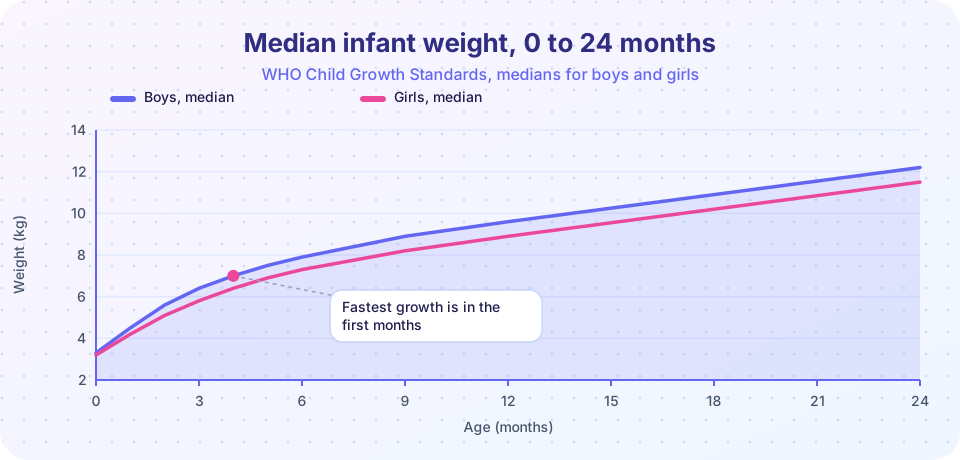
In nine months, a single cell becomes a baby of about 3 to 3.5 kilograms, with a placenta, extra blood volume and stores of fat to support breastfeeding. Over the following year, that baby roughly triples its weight. No other time in life comes close to this speed of growth, which is why the recommendations for pregnancy, lactation and infancy differ so much from those for other adults. This lesson explains what changes, where the guidance comes from and where the evidence is still being refined.
Educational information only. Pregnancy and infant feeding are areas where individual medical conditions, allergies, cultural practices and local laws matter. Use this lesson to understand the science, and ask a midwife, doctor or registered dietitian about your own situation.
What you will learn
- How much extra energy and which nutrients pregnancy and lactation require.
- What the guidelines say about gestational weight gain and why folate matters before conception.
- The main food safety issues in pregnancy.
- How infant feeding progresses from milk to complementary foods, and what is known about allergy prevention.
Key terms
- Gestational weight gain: the total weight a woman gains during pregnancy, including the baby, placenta, fluid, uterus, breast tissue and maternal stores.
- Neural tube defect: a serious malformation of the brain or spinal cord (such as spina bifida) that arises in the first weeks of pregnancy.
- Folate / folic acid: a B vitamin. Folic acid is the form used in supplements and fortified foods.
- Exclusive breastfeeding: only breast milk, with no other food or drink except medicines and vitamin drops.
- Complementary foods: foods other than milk introduced to a baby's diet, from about six months.
Energy in pregnancy
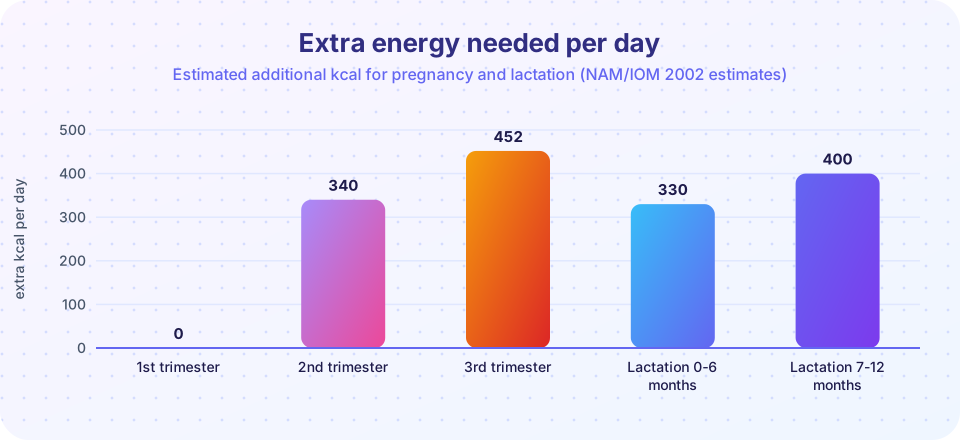
The 2002 US/Canada estimates (National Academy of Medicine, formerly IOM) say that no extra energy is needed in the first trimester, about 340 kcal per day extra in the second and about 450 kcal per day extra in the third. These are modest amounts: the second-trimester addition is about a glass of milk and a banana. The theory is that the mother's metabolism rises and her body stores some fat early on, which is used later. Individual needs vary with starting weight, activity and how the body adapts, so appetite and weight-gain tracking are better guides than strict counting.
Weight gain
The 2009 Institute of Medicine guidance recommends total gain ranges by pre-pregnancy body mass index (BMI):
| Pre-pregnancy BMI | Total gain (kg) | Rate in 2nd and 3rd trimester (kg/week) |
|---|---|---|
| Under 18.5 | 12.5-18 | 0.51 (0.44-0.58) |
| 18.5-24.9 | 11.5-16 | 0.42 (0.35-0.50) |
| 25.0-29.9 | 7-11.5 | 0.28 (0.23-0.33) |
| 30 or more | 5-9 | 0.22 (0.17-0.27) |
For all groups, first-trimester gain is expected to be small, about 0.5 to 2 kg in total. Gaining much more or much less than the range is linked with higher risks for mother and baby, such as gestational diabetes, large or small babies and cesarean delivery, but individual cases vary and a clinician decides what is right.
Nutrients that matter most
Pregnancy raises the need for many nutrients, some by a large fraction (see the chart below).
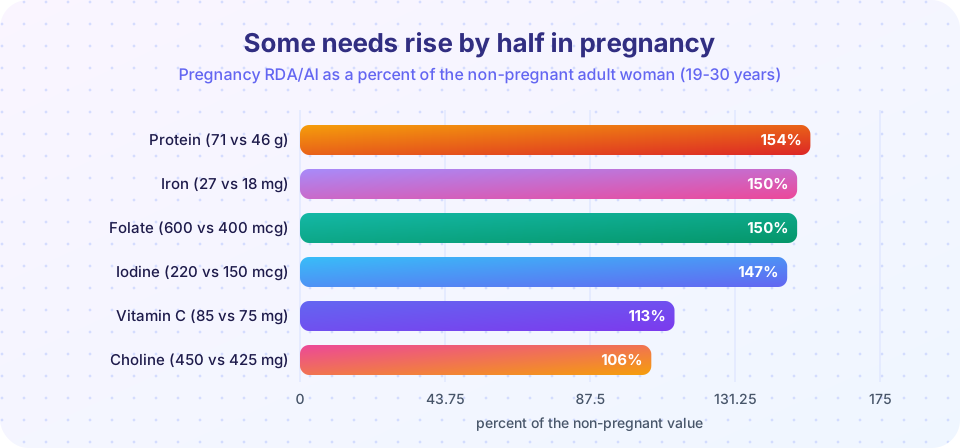
- Folate. Folate is needed for cell division and DNA synthesis. The neural tube closes at about 4 weeks after conception, often before a pregnancy is recognized, so recommendations cover people who could become pregnant: 400 micrograms of folic acid a day from supplements or fortified foods, on top of food folate. The 1991 British Medical Research Council Vitamin Study showed that high-dose folic acid (4 mg) in women with a previous affected pregnancy cut recurrence by about 70 percent. Later, mandatory fortification of grain products with folic acid in the United States (from 1998) and other countries was followed by a fall in neural tube defects of roughly a quarter to a third in several population studies. The RDA in pregnancy is 600 micrograms of dietary folate equivalents.
- Iron. Blood volume expands by about 40 to 50 percent, and the baby builds iron stores. The RDA is 27 mg a day, and iron-deficiency anemia is common worldwide. Absorption increases in pregnancy, and some women need a supplement.
- Iodine (220 micrograms) for fetal brain development. Mild deficiency is still found in some high-income countries, and iodized salt, dairy and fish are the main sources.
- Choline (450 mg) and DHA, an omega-3 fat found in oily fish, for brain and eye development.
- Protein: the RDA rises to 71 g a day (about 1.1 g per kg), mostly in the second half.
- Vitamin A is needed, but very high intakes of preformed vitamin A (retinol), including from high-dose supplements, can cause birth defects; the upper limit is 3,000 micrograms a day.
Food and drink safety
- Alcohol: no safe level has been established; the safest choice is to avoid it. Heavy exposure can cause fetal alcohol spectrum disorders.
- Caffeine: the American College of Obstetricians and Gynecologists says moderate intake, under 200 mg a day (about one 350 ml cup of coffee), is not thought to cause miscarriage or preterm birth.
- Listeria, a bacterium that can cross the placenta, is why guidelines advise avoiding unpasteurized dairy and soft cheeses, cold deli meats unless heated until steaming, and smoked fish unless cooked.
- Fish: fish is a good source of DHA and iodine, but some large predatory fish (shark, swordfish, king mackerel, tilefish) contain more mercury than is advisable. Authorities such as the US FDA advise choosing low-mercury fish two to three times a week.
- Food hygiene: thoroughly cooked eggs and meat and washed produce avoid Salmonella and Toxoplasma.
Lactation
Producing milk costs energy and nutrients. Estimates suggest about 330 kcal/day extra in the first six months (the total cost of around 500 kcal partly covered by stored fat) and about 400 kcal/day in the second six months. Needs for protein, iodine, choline, vitamin A and others also rise. Maternal diet changes the amounts of some vitamins in milk (for example B vitamins and iodine) and the types of fats in milk, but total milk volume and macronutrients are fairly well protected.
Breast milk and formula
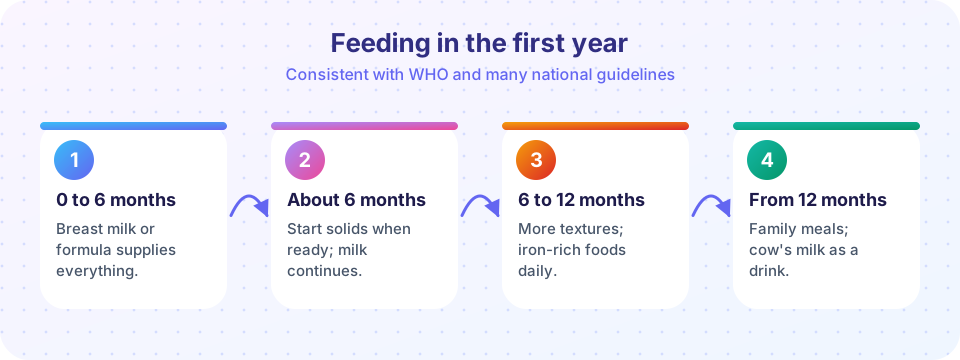
The WHO recommends exclusive breastfeeding for about six months, followed by continued breastfeeding alongside other foods up to two years or beyond. Breast milk supplies energy, fat, protein, and also antibodies and other bioactive compounds, and breastfeeding is associated with fewer infant gut and ear infections. For mothers, it is associated with lower rates of breast and ovarian cancer. Most evidence for benefits comes from observational studies, so confounding is possible, but the consistency of the results and the known mechanisms make the overall case strong.
Breastfeeding is not always possible or chosen, and infant formula is a safe, tightly regulated, nutritionally complete alternative. It must be prepared as directed (water of safe quality, correct dilution) and homemade or diluted versions are dangerous. Breastfed infants need a vitamin D supplement (typically 400 IU or 10 micrograms daily, depending on national advice), and all newborns are offered vitamin K at birth to prevent bleeding.
Moving to solid foods
Around six months, babies need more iron and energy than milk alone can provide. Their iron stores from birth are running low, and breast milk is low in iron. Signs of readiness include sitting with support, good head control, interest in food and loss of the reflex that pushes food out with the tongue. Principles of complementary feeding:
- Start at about six months, not before four months, and keep milk feeds going.
- Include iron-rich foods every day: meat, fish, eggs, beans, lentils, iron-fortified infant cereals.
- Widen tastes and textures gradually, moving from smooth purees to lumpy foods and finger foods. A window of about 6 to 10 months seems important for accepting lumpy textures.
- Practice responsive feeding: watch for hunger and fullness cues and do not force.
- Avoid added salt and sugar, honey before 12 months (a rare risk of infant botulism), and choking hazards such as whole nuts, whole grapes, popcorn and large chunks.
- Wait to give cow's milk as a main drink until 12 months, because it is low in iron and has too much protein and minerals for young kidneys; small amounts in cooking are fine.
Allergies: a change in advice
For years, parents were told to delay peanut and egg until later. The LEAP trial (Du Toit and colleagues, 2015) randomized more than 600 high-risk infants (with severe eczema or egg allergy) to eat peanut regularly from 4 to 11 months or to avoid it until age 5. In the main group, peanut allergy at five years affected roughly 14 percent of avoiders and about 2 percent of eaters, a large reduction. Follow-up studies of other allergens have been mixed, but guidelines now advise introducing allergenic foods such as peanut and egg in an age-appropriate form from about six months, without delay, and with medical advice for infants who have severe eczema or a known food allergy.
Common misconceptions
- "Eating for two means doubling your food." Extra energy is about 15 to 20 percent in late pregnancy. Nutrient quality matters more than quantity.
- "Only breastfed babies thrive." Breastfeeding has benefits, but formula-fed infants grow and develop well when formula is prepared correctly.
- "Waiting longer to introduce peanut prevents allergy." Evidence now points the other way for most infants.
Try it
The first demonstration plots the IOM recommended weight-gain band for an example BMI category and lets you try your own numbers. The second shows how closely the WHO median weights follow each other for boys and girls. Both are educational tools, not clinical advice.
Press Run (or Ctrl + Enter) to see the result here.
Program input · what you'd type while the program runs
Type the answers before you press Run, one per line. Each time the program reads a line (with input()), it gets the next line from this box.
Press Run (or Ctrl + Enter) to see the result here.
Program input · what you'd type while the program runs
Type the answers before you press Run, one per line. Each time the program reads a line (with input()), it gets the next line from this box.
Check your understanding
Quick check · 6 questions
of 6 answered You scored / 6 · perfect!
-
1. How much extra energy per day does the second trimester need, according to the 2002 US/Canada estimate?
Only about 340 kcal in the second trimester and about 450 in the third; none in the first. -
2. Why is folic acid advised before conception?
Neural tube closure occurs about 4 weeks after conception, so adequate folate is needed beforehand. -
3. Which food category does pregnancy guidance advise avoiding because of Listeria?
Listeria can grow in refrigerated ready-to-eat foods and cross the placenta. -
4. Why do infants need iron-rich foods from about six months?
Stores from before birth deplete around 4 to 6 months, so food sources become necessary. -
5. What did the LEAP trial find?
High-risk infants who ate peanut regularly had much less peanut allergy at age five. -
6. Which is NOT recommended for infants under 12 months?
Honey carries a small risk of infant botulism.
Summary
- Extra energy in pregnancy is small and begins in the second trimester; some nutrients (iron, folate, iodine, protein) rise by half.
- Folic acid should be adequate before conception; food safety rules reduce Listeria, mercury and alcohol risks.
- Exclusive breastfeeding is advised for about six months; formula is a safe alternative.
- Complementary foods start around six months with iron-rich foods and early allergen introduction.
Track your progress
Create a free account to tick off lessons and pick up where you left off on any device.
of Nutrition Science lessons completed