


















Lesson 5 of 47 · Getting Started
Chapter 1 review: getting started
Review what nutrition science is, how food claims are tested, and how reference intakes and labels work, then test yourself with a ten-question quiz.
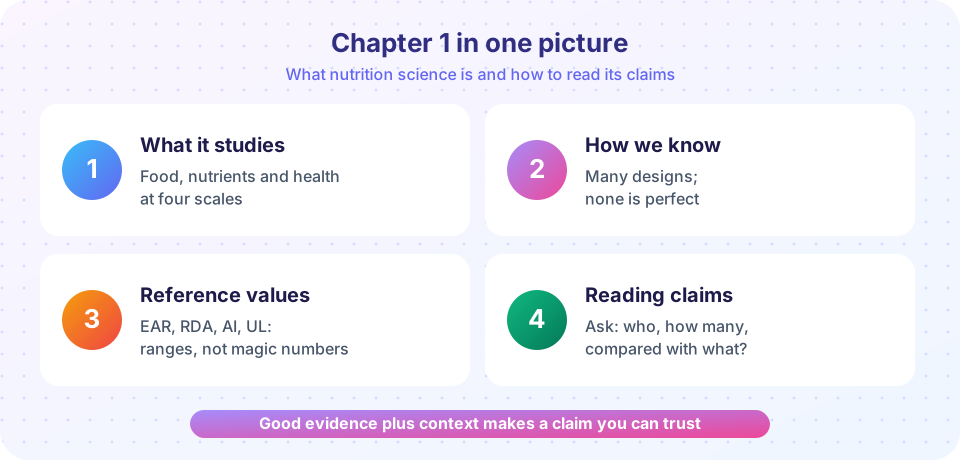
You have now met the whole landscape: the four scales of nutrition, the main study designs, the traps that catch even careful researchers, and the numbers (EAR, RDA, AI, UL, %DV) that turn science into guidance. This review pulls the pieces together so that Chapter 2 can start from solid ground.
What you will learn
- How the ideas of chapter 1 connect into one method for judging food claims.
- Which terms and numbers you should now be able to recall without looking.
- Where you are still unsure, using a quiz and flashcards.
Key terms
- Dose-response: how the effect of a nutrient changes with the amount; usually U-shaped.
- Confounding: a hidden third factor that distorts an association.
- Relative and absolute risk: a ratio of risks, and the actual difference in risks.
- DRI family: EAR, RDA, AI, UL and AMDR.
- %DV: the share of a Daily Value that one serving provides.
Chapter in one table
| Lesson | Core idea | One question to ask |
|---|---|---|
| What is nutrition science? | Food and health studied at four scales, with a dose that matters | At which scale is this claim being made? |
| How we know | Designs differ in strength; confounding and bias are everywhere | What kind of study is it, and compared with what? |
| Reference intakes and labels | EAR, RDA, AI, UL describe ranges; labels use one DV for everyone | Is this a target, a limit, or a rough guide? |
Putting the pieces together
Imagine a headline: "Eating blueberries every day cuts heart disease risk by 20 percent." Run it through chapter 1.
Scale and design. Blueberries might act on blood vessels at the molecular scale, but a heart disease claim is a population claim, so you look for cohort studies or trials. A daily-blueberries trial lasting three months can measure blood pressure, not heart attacks. If the study is a cohort, ask about confounding: blueberry eaters may exercise more, smoke less and have higher income.
Size. A "20 percent" cut is a relative figure. If the baseline risk is 5 in 100 over ten years, a 20 percent relative reduction is one fewer case per 100, an absolute reduction of one percentage point.
Dose and context. How many blueberries? In place of what? A handful added to a diet already rich in fruit may do little.
Reference values. Blueberries do not supply a nutrient with a UL, and they contribute some fiber, vitamin C and vitamin K; the claim is about bioactive compounds with no RDA, so a "recommended amount" does not exist.
The honest summary might be: "Observational studies find a modest link between berry intake and heart health; trials show small improvements in blood pressure; blueberries are a fine part of a varied diet." That sentence is less exciting and far more reliable.
Common misconceptions
- "Chapter 1 teaches me what to eat." It teaches how to evaluate what you are told. The next chapters supply the nutrient content.
- "Weak evidence means the claim is false." It means the claim is uncertain. Absence of strong evidence is not evidence of absence, and the right response is often "unclear".
- "If I memorise the DRI numbers I understand nutrition." The numbers change as evidence grows. Understand what each number means and how it is derived.
Try it
The first demonstration is a "claim checker": answer a few yes/no questions about a made-up claim and see how many red flags it raises. The second is a deck of flashcards for the key terms.
Press Run (or Ctrl + Enter) to see the result here.
Program input · what you'd type while the program runs
Type the answers before you press Run, one per line. Each time the program reads a line (with input()), it gets the next line from this box.
Check your understanding
Quick check · 9 questions
of 9 answered You scored / 9 · perfect!
-
1. Which pair describes the EAR and RDA correctly?
The EAR is the median requirement and the RDA is set about two standard deviations higher. -
2. Which study design is most prone to recall bias?
Case-control studies ask people who already know their diagnosis about past diet. -
3. A study reports that a food increases risk by 50 percent. What should you ask first?
Relative changes can be large when absolute risk is tiny. Absolute numbers show the importance. -
4. People who take vitamin supplements also exercise more. In a cohort study this makes the supplements look better than they are. What is this called?
Exercise is linked both to supplement use and to better health, so it confounds the comparison. -
5. Which scale of nutrition science deals with farming, prices and labels?
The food system scale covers production, processing, markets and policy. -
6. On a label, 4 percent DV of saturated fat per serving means
5 percent DV or less counts as low. -
7. Why do trials of diet often measure blood pressure or LDL cholesterol rather than heart attacks?
Surrogate markers change sooner and need fewer participants, although they are not the final outcome. -
8. What does an Adequate Intake tell you?
AIs are set from observed intakes or experiments when an EAR cannot be derived. -
9. Which statement about the pyramid of evidence is best?
The pyramid is a guide. A well-run cohort study can be more convincing than a poorly run trial.
Summary
- Nutrition science asks questions at four scales; always ask which scale a claim lives at.
- Evidence comes in layers, and each design has typical weaknesses: confounding, bias, short duration, surrogate outcomes.
- Absolute numbers matter more than headline percentages.
- DRIs give ranges and targets, labels give a quick rule of thumb with %DV.
- Chapter 2 starts at the beginning of the food chain inside you: nutrients, digestion and water.
Track your progress
Create a free account to tick off lessons and pick up where you left off on any device.
of Nutrition Science lessons completed