


















Lesson 37 of 47 · Food Systems and Policy
Food safety, regulation and reading food labels
Learn the main foodborne hazards, how temperature controls bacteria, the WHO Five Keys, HACCP and Codex, and how to read nutrition labels, claims and front-of-pack signs.
The best diet in the world is no use if the food makes you ill. Unsafe food is a major, often overlooked, global health problem: the World Health Organization estimated in 2015 that foodborne diseases cause about 600 million illnesses and 420,000 deaths a year, with children under five carrying about 40 percent of the burden. Most of these illnesses are preventable by habits you can learn in an afternoon and by regulation that most people never see. A second layer of protection is information: labels that tell shoppers what is in the food. This lesson covers both.
What you will learn
- The main biological, chemical and physical hazards in food.
- How temperature controls bacterial growth and what the "danger zone" is.
- How HACCP and Codex Alimentarius organize food safety worldwide.
- How to read the parts of a food label and what front-of-pack systems do.
Key terms
- Hazard: something in food that can cause harm, such as a pathogen, a toxin or a piece of glass.
- Pathogen: a microorganism that causes disease.
- HACCP: Hazard Analysis and Critical Control Points, a system for finding and controlling risks at key steps.
- Codex Alimentarius: the international food standards body run by FAO and WHO.
- ADI (acceptable daily intake): the amount of a substance, such as an additive, that can be eaten daily for a lifetime without appreciable risk.
Hazards in food
Biological hazards are the commonest cause of illness:
- Salmonella (poultry, eggs, produce) and Campylobacter (poultry, raw milk) cause diarrhea and fever.
- Escherichia coli O157:H7 (undercooked ground beef, contaminated produce) can cause bloody diarrhea and kidney failure.
- Listeria monocytogenes grows even in refrigerators and is dangerous in pregnancy, for newborns and for older adults (see the pregnancy lesson).
- Norovirus spreads from infected food handlers and contaminated shellfish.
- Clostridium botulinum produces a deadly toxin in improperly canned low-acid food and, rarely, in honey for infants.
Chemical hazards include natural toxins (aflatoxins, made by molds on maize and peanuts, are linked to liver cancer in regions where storage is poor), environmental contaminants (mercury in some fish, arsenic in rice), pesticide and veterinary drug residues, and substances formed in cooking such as acrylamide. Physical hazards include glass, metal fragments and bone.
Temperature: the danger zone
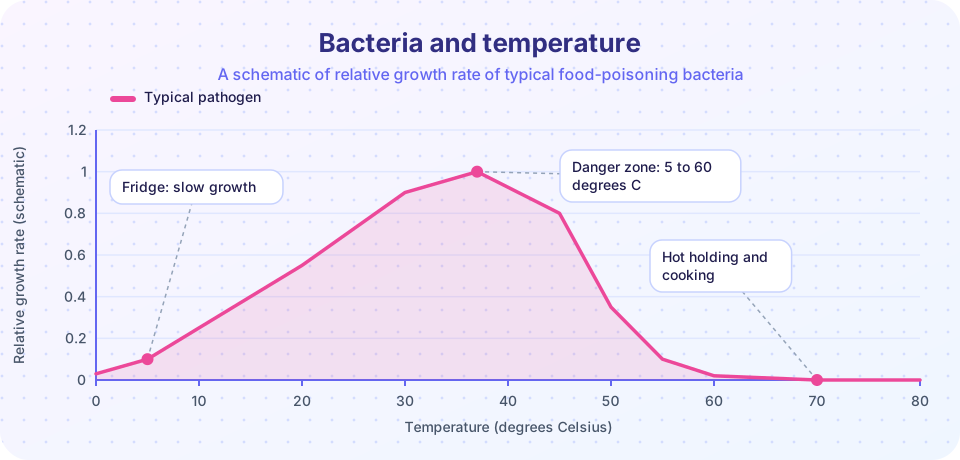
Bacteria multiply by splitting in two. Under ideal conditions, E. coli can double about every 20 minutes. That seems harmless until you do the arithmetic: one cell becomes more than 16 million in 8 hours. Growth depends on temperature, and the range roughly between 5 and 60 degrees Celsius (about 40 to 140 degrees Fahrenheit) is the danger zone. Fridges slow growth but do not stop it; cooking above about 70 degrees Celsius at the core kills most pathogens, though it does not destroy every toxin.
Press Run (or Ctrl + Enter) to see the result here.
Program input · what you'd type while the program runs
Type the answers before you press Run, one per line. Each time the program reads a line (with input()), it gets the next line from this box.
Real growth is slower than this idealized curve (food is not a perfect broth, and bacteria need time to adjust), but the principle explains rules such as the two-hour rule (do not leave perishable food at room temperature for more than two hours, one hour in hot weather) and quick cooling of leftovers.
The Five Keys
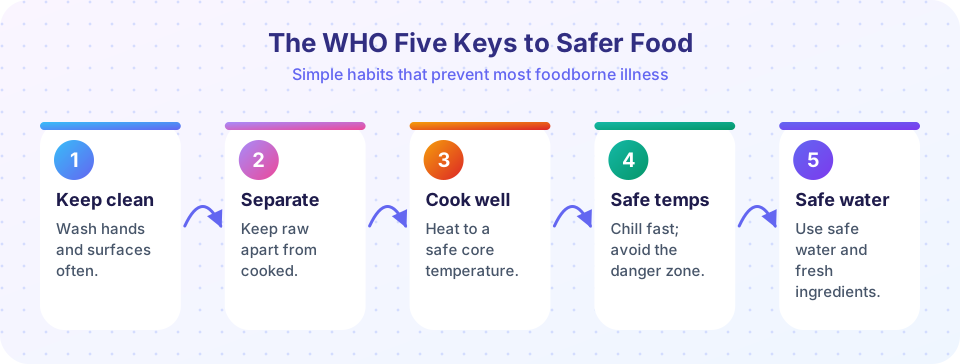
The WHO's Five Keys to Safer Food, used in more than a hundred countries, boil safe handling down to:
- Keep clean: wash hands before handling food and after the toilet; clean surfaces and equipment.
- Separate raw and cooked: use separate boards and utensils; store raw meat below ready-to-eat food.
- Cook thoroughly: heat to a core temperature of at least 70 degrees Celsius (US guidance: 74 degrees for poultry and leftovers, 71 for ground meat, 63 for whole cuts of beef and pork, with a rest).
- Keep food at safe temperatures: refrigerate quickly (at 5 degrees Celsius or below, 4 in US guidance), keep hot food above 60 degrees, and thaw in the fridge or microwave.
- Use safe water and raw materials: choose fresh, pasteurized and uncontaminated ingredients; wash fruit and vegetables.
Press Run (or Ctrl + Enter) to see the console output here.
No output.
Rules behind the scenes
HACCP. In the 1960s, the Pillsbury company worked with NASA to make sure food for astronauts was safe, and the result was a system that looks for where hazards can occur and watches those points rather than only testing the final product. HACCP's seven principles are: analyze hazards, identify critical control points (such as cooking or chilling), set critical limits (such as 74 degrees at the core), monitor, define corrective actions, verify the system, and keep records. It is mandatory in many countries for meat, seafood, juice and increasingly for all food businesses.
Codex Alimentarius. Established by FAO and WHO in 1963, the Codex Commission sets international standards for food, from hygiene practice to maximum residue limits and additives. Its standards are the benchmark referenced in world trade rules.
Additives and contaminants. Additives (preservatives, colors, sweeteners, emulsifiers) are evaluated by bodies such as the Joint FAO/WHO Expert Committee on Food Additives. The ADI is derived from the highest dose with no observed adverse effect in animal studies, divided by a safety factor of usually 100 to allow for differences between species and between people. Many additives have E-numbers in the EU. Regulations also set limits for contaminants and require traceability so that contaminated batches can be recalled.
Allergens. Food allergies affect a small but growing share of people, and about nine foods cause most severe reactions: milk, eggs, peanuts, tree nuts, fish, crustacean shellfish, wheat, soy and sesame (the US list since 2023; the EU list is longer). Labeling laws require these to be declared, but "may contain" warnings are voluntary in many places.
Reading a food label
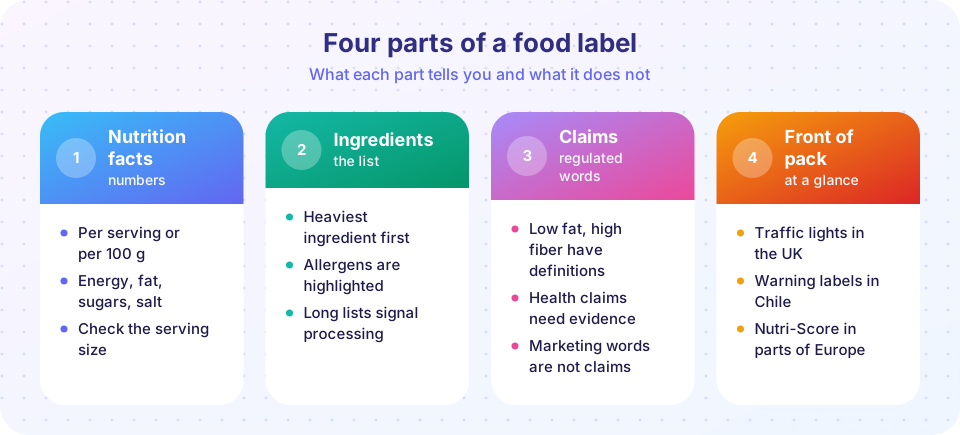
- Nutrition facts. Required in the US since 1994 (updated 2016 to show added sugars) and in the EU since 2016, usually per 100 g or per serving. Check the serving size, which may be smaller than the amount you actually eat, so energy per package may be double. Percent daily values are based on reference diets of about 2,000 kcal.
- Ingredient list. Ingredients appear in descending order of weight, so sugar high on the list matters. Allergens are emphasized. Sugar may appear under many names (syrup, dextrose, maltose, fruit juice concentrate).
- Claims. Terms such as "low fat", "high in fiber" or "reduced sugar" are legally defined in many countries (for example, the EU defines "source of fiber" as at least 3 g per 100 g). "Health claims" must be backed by evidence and approved by authorities such as the European Food Safety Authority. Words like "natural", "wholesome" or "superfood" are marketing and usually have no standard meaning.
- Front-of-pack labels. Systems that summarize nutrition include the UK's traffic lights (red, amber and green for fat, saturates, sugars and salt), Nutri-Score (A to E, used in France and several other European countries) and warning labels such as Chile's black "high in" octagons, introduced in 2016 with limits on marketing to children. A study of Chilean household purchases found that the volume of sugary drinks bought fell by about a quarter after the law, though the policy had several parts that worked together.
Date marks are also worth understanding: "use by" is about safety (do not eat after it), while "best before" is about quality (still safe afterward if stored correctly). Confusion over them is a driver of household food waste.
Common misconceptions
- "If it smells fine, it is safe." Most pathogens do not change smell, taste or look.
- "Rinsing raw chicken removes germs." It spreads droplets around the kitchen; cooking is what kills them.
- "Natural means safe, additive means harmful." Safety depends on dose and evidence, not origin; both natural and synthetic substances can be harmful in excess.
- "Low fat on the label means healthy." Check sugar, salt and the whole picture.
Check your understanding
Quick check · 6 questions
of 6 answered You scored / 6 · perfect!
-
1. Roughly what range is the temperature danger zone?
Bacteria grow quickly between refrigerator and hot-holding temperatures. -
2. What does HACCP focus on?
It is a preventive system built around critical control points. -
3. What does 'use by' on a label indicate?
'Best before' is about quality; 'use by' is about safety. -
4. Why does the ingredient list order matter?
A food with sugar first is mostly sugar. -
5. A bacterium doubles every 20 minutes. About how many cells come from one after 2 hours?
Six doublings give 2^6 = 64 cells. -
6. Which organization sets international food standards?
Codex standards are the international benchmark for food safety and labeling.
Summary
- Foodborne disease is common and preventable; the Five Keys and temperature control cut the risk.
- HACCP, Codex and national regulators protect the food supply behind the scenes.
- Labels have four layers: nutrition facts, ingredients, claims and front-of-pack signs. Each has strengths and limits.
Track your progress
Create a free account to tick off lessons and pick up where you left off on any device.
of Nutrition Science lessons completed