


















Lesson 2 of 46 · Getting Started
Why invest at all? Inflation and purchasing power
Learn why idle cash slowly loses buying power, how nominal and real returns differ, and why investors accept risk in exchange for a higher expected return.
Imagine you hide $100 in a drawer and find it again in 30 years. The note is unchanged: still a hundred dollars. But what it buys has changed, because prices rose while it sat there. The loss does not feel like a loss because nothing visible happened. This quiet erosion is the reason most people need to invest, and it is the first idea of the course.
What you will learn
- What inflation is and how it erodes purchasing power.
- The difference between a nominal return and a real return, and how to calculate the real one exactly.
- Why savings can feel safe and still lose buying power.
- Why investors are paid, on average, for taking risk.
Key terms
Inflation: the general rise in prices over time, usually reported as a percentage per year.
Purchasing power: how much a sum of money can buy.
Nominal return: the return measured in plain money, before adjusting for price changes.
Real return: the return after removing inflation; it measures the change in buying power.
Risk premium: the extra expected return an investor demands for holding a risky asset instead of a safe one.
Inflation in plain words
Inflation means that, on average, the same basket of goods costs more next year than this year. Statistics offices measure it by tracking the prices of a large basket of everyday goods and services (food, rent, transport, clothes, energy) and publishing the percentage change, usually called the consumer price index, or CPI. A rate of 3% a year means the basket that cost $100 now costs $103 a year from now.
Inflation rates differ greatly by country and by decade. Some economies have had years near zero; others have seen double or triple digits. Central banks in many countries aim for a low, steady rate, often around 2%, but they do not always hit it. For planning, a modest assumption such as 2% to 3% is common, and the lessons here use 3% because it makes the arithmetic clean.
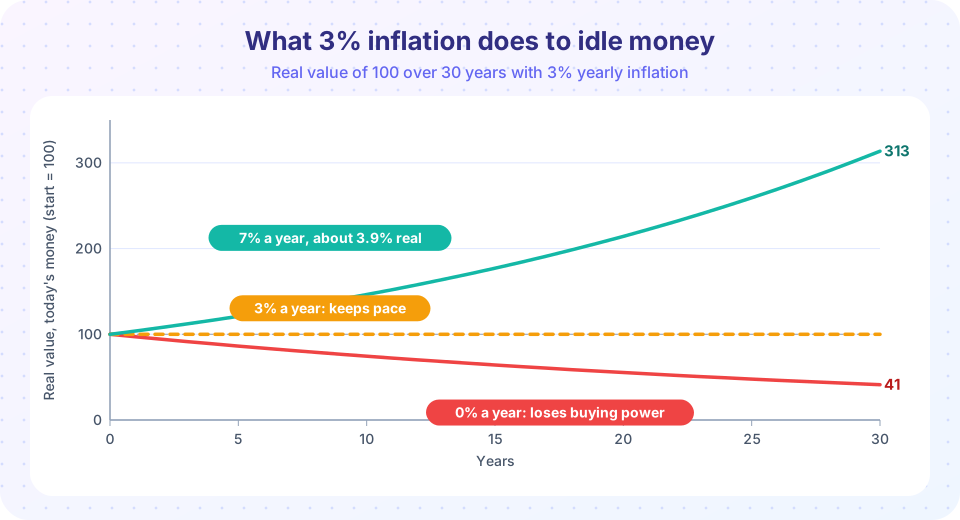
Because prices compound just like savings do (a price rising 3% a year is 3% above last year's price, not above the original), the loss of buying power builds up quickly. After one year at 3%, your $100 buys what $97.09 bought. After 10 years it buys about what $74 bought. After 30 years, as the picture shows, about $41. The formula for the buying power of a fixed sum is:
real value after n years = amount / (1 + inflation)^n
So $100 divided by 1.03 raised to the 30th power is about $41.20. Your note still says 100, but it has lost nearly 60% of what it can do.
Nominal versus real returns
Suppose a savings account pays 1% a year while inflation is 3%. Your balance grows, so in nominal terms you are ahead. But prices grow faster, so in real terms you are behind. To compare properly, use the exact real-return formula:
real return = (1 + nominal) / (1 + inflation) - 1
For 1% nominal and 3% inflation this gives 1.01 / 1.03 - 1 = -0.0194, so about -1.94% a year. You lose almost 2% of buying power every year while your statement shows growth.
A popular shortcut says real return is approximately nominal minus inflation: 1% - 3% = -2%. That is close, and it is fine for quick thinking. Use the exact formula when rates are high or when you compound over decades, because the small difference accumulates.
Here is another case. A diversified investment earns 7% a year on average over a very long period while inflation runs at 3%. The exact real return is 1.07 / 1.03 - 1 = 3.88%, so buying power grows by about 3.9% a year. Over 30 years that is a factor of about 3.1: the third line in the picture, ending near 313. This is the case for investing in one chart. The same $100 can end up buying 41 or 313 depending on what you did with it.
Is cash "safe"?
Cash and bank deposits are safe in one sense: the number in your account does not fall, and deposits are often insured up to a limit in many countries. That protects the nominal value. It does not protect purchasing power. If the interest paid is lower than inflation, you lose buying power with certainty. A fair summary is that cash has almost no price risk and has inflation risk, while stocks have large price risk and, over long periods, have historically had better inflation protection. "Historically" is the careful word: nothing guarantees it will happen again.
Cash still has a vital role. It is the right home for money you need soon, for an emergency fund and for anything you cannot afford to see fall at the wrong moment. Lesson 3 of this chapter returns to this, because the right question is never "cash or investments?" but "which money needs which job?"
Why do risky assets pay more?
If risky assets paid the same as safe ones, nobody would hold them. To attract money, a company needs to offer investors a higher expected return than a government bond that is almost certain to pay. The extra expected return is the risk premium. You can think of it as a wage for tolerating uncertainty.
Two things about the premium are easy to forget.
- It is expected, not guaranteed. On average, a risky asset pays more. In any particular year, or even in a decade, it can pay far less than the safe asset, and sometimes loses money. If the premium were guaranteed, the asset would not be risky.
- It is paid for risk you cannot avoid. Chapters 3 and 4 will show that the market pays you for risk you cannot diversify away, but not for risk that you could have avoided by owning many assets.
So the case for investing is a three-part argument. Inflation erodes idle money. Risky assets offer, on average, higher returns than inflation. And you can reduce unneeded risk by spreading your money, which later chapters teach.
A short history lesson, without the numbers
Many long-run studies of stock and bond markets in different countries have looked at returns after inflation. They tend to find that stocks earned a clearly positive real return over very long periods, that bonds earned less, and that cash earned close to zero, sometimes below it. They also find that every one of those results hides painful stretches: years of falling prices, and in some countries periods of war, crisis or inflation so severe that investors lost most of their wealth. We will not quote exact percentages here, because they depend on the country, the dates and the method, and a number copied without context misleads. The lasting lesson is the direction of the pattern: higher expected return, higher uncertainty.
Common misconceptions
"If my balance is going up, I'm winning." Only if it rises faster than prices. Compare returns with inflation, not with zero.
"Inflation is just a number in the news." It compounds in your own life: rent, food and tuition. Long goals such as retirement are measured in future prices, so ignoring inflation understates how much you will need.
"Investing is only for people who can pick winners." The case for investing comes from the risk premium and from compounding, not from stock picking. Chapter 8 shows that simple, low-cost diversified approaches are a reasonable default for most people.
Try it
The first block computes real returns exactly and with the shortcut, so you can see when the shortcut fails.
Press Run (or Ctrl + Enter) to see the result here.
Program input · what you'd type while the program runs
Type the answers before you press Run, one per line. Each time the program reads a line (with input()), it gets the next line from this box.
The second block draws how the buying power of a fixed $100 shrinks at different inflation rates.
Press Run (or Ctrl + Enter) to see the result here.
Program input · what you'd type while the program runs
Type the answers before you press Run, one per line. Each time the program reads a line (with input()), it gets the next line from this box.
Check your understanding
Quick check · 5 questions
of 5 answered You scored / 5 · perfect!
-
1. Prices rise 3% a year. A bank pays 1% on your savings. What happens to your buying power?
Real return is about 1% - 3% = -2% (exactly -1.94%). Your balance grows, but prices grow faster. -
2. What is the exact formula for real return?
Dividing the growth factors removes inflation exactly. The subtraction shortcut is only an approximation. -
3. What is a risk premium?
A premium is paid on average and in expectation. Since it is not guaranteed, the asset is genuinely risky. -
4. With 3% inflation, roughly what does 100 held in a drawer buy after 30 years?
100 / 1.03^30 is about 41. Prices compound just like savings do, so the loss builds on itself year after year. -
5. Which money is best kept in cash?
Cash protects the nominal value over short periods. Short-term needs should not depend on market prices.
Summary
- Inflation compounds, so idle money loses buying power: at 3%, 100 buys about 41 worth after 30 years.
- Real return = (1 + nominal) / (1 + inflation) - 1; "nominal minus inflation" is a rough shortcut.
- Cash protects nominal value, not purchasing power, and is best for near-term needs.
- Risky assets pay a risk premium on average, never with a guarantee.
Track your progress
Create a free account to tick off lessons and pick up where you left off on any device.
of Investing and Markets lessons completed