


















Lesson 40 of 46 · Behavior, Costs and Strategy
Strategy: Passive Investing, Dollar-Cost Averaging and Rebalancing
Compare passive and active investing, dollar-cost averaging and lump sums, and learn rebalancing rules with simulations that show what each choice does.
A strategy is a set of rules decided in advance. It answers practical questions: how much of my money goes into stocks and how much into bonds, how do I buy, when do I adjust, and what do I do in a crash? Having rules matters for the reason the last lessons gave: a plan made calmly protects you from your own reactions. This lesson covers the central choices (asset allocation, passive versus active management, how to invest a sum of money over time, and rebalancing) and tests each with a simulation.
Educational information only. The examples below illustrate how strategies behave on invented or simulated numbers. They are not a recommendation, and the right mix for any person depends on goals, time horizon, income stability and tolerance for losses.
What you will learn
- How asset allocation sets the broad risk of a portfolio.
- The arithmetic argument for low-cost passive investing and the case for active management.
- What dollar-cost averaging does compared with investing a lump sum.
- How to rebalance, with calendar and threshold rules, and what it does and does not achieve.
Key terms
Asset allocation: how a portfolio is divided among asset classes such as stocks, bonds and cash.
Index fund: a fund that holds the securities of a market index at low cost.
Dollar-cost averaging (DCA): investing equal amounts at regular intervals.
Rebalancing: trading to bring a portfolio back to its target weights.
Drift: the change in portfolio weights as asset prices move.
Asset allocation
The first decision is how much risk to take, and in practice that means how much of the portfolio to hold in stocks and how much in safer assets such as bonds and cash. Stocks have historically offered higher average returns and much larger swings. A portfolio of 80 percent stocks can fall far more in a bad year than one with 40 percent stocks. Allocation depends on three things:
- Time horizon. Money needed in two years should not depend on the stock market; money for retirement in 30 years has time to recover from downturns.
- Ability to bear losses, the financial capacity: stable income, an emergency fund and other assets make larger swings affordable.
- Willingness to bear losses, the psychological tolerance: an allocation you abandon in a crash does more harm than a more cautious one you keep.
Rules of thumb such as "hold your age in bonds" are crude starting points, not advice. Target-date funds automate the idea: they hold more stocks when the target year is far away and gradually shift toward bonds.
Passive and active investing
An index fund buys a broad market and holds it, charging very little. An active fund tries to beat the market by picking securities or timing the market. William Sharpe's 1991 article "The Arithmetic of Active Management" gives a simple argument. Before costs, the average return of all investors in a market equals the market return, so for each investor who beats the market another must lag it. Active investors collectively pay higher costs than passive ones. So after costs, the average active investor must earn less than the average passive investor.
The argument is about averages. Some active managers do beat the market, sometimes for years. The difficulty is identifying them in advance: past outperformance has been a weak guide to future performance, and the periodic SPIVA scorecards from S&P Dow Jones Indices report that large shares of active funds in many categories trail their benchmarks over 10 to 20 years. Active management can still make sense in less efficient corners, or for people who value a particular approach and accept the cost. For a typical long-term saver, a diversified low-cost index fund is a sound default and has the benefit of needing few decisions.
Lump sum or dollar-cost averaging?
You receive 12,000. Should you invest it all today or put in 1,000 a month for a year? Dollar-cost averaging spreads the entry. Its appeal is emotional: if the market falls right after you invest, you will have only part of your money in it, and you avoid the regret of investing everything just before a drop. Also, most people really do invest from income, month by month, which is DCA by default.
Statistically, investing the lump sum immediately has tended to come out ahead. Studies of historical data (for example, analyses by Vanguard on US, UK and Australian markets) found lump-sum investing beat 12-month DCA roughly two-thirds of the time, because markets rise more often than they fall, so the money waiting in cash misses growth on average. The gap in typical outcomes was modest, and DCA had a smaller worst case when markets fell early. The third example below simulates this on random returns with an upward drift.
The conclusion is not that DCA is wrong. If it lets you actually invest rather than wait for a perfect moment, it is better than staying in cash. If you hold a large sum now and can tolerate the risk, investing it according to your allocation has usually been better.
Rebalancing
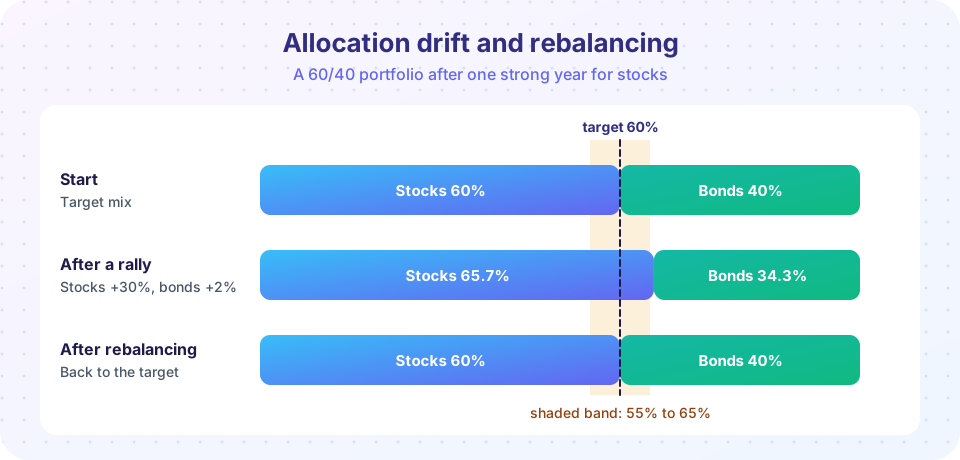
Suppose you start with 60 percent stocks and 40 percent bonds, and stocks gain 30 percent while bonds gain 2 percent. Starting with 10,000, the stocks become 7,800 and bonds 4,080. The portfolio is 11,880 with 65.7 percent in stocks, riskier than you chose. Rebalancing restores the plan: sell about 672 of stocks and buy 672 of bonds, bringing the mix back to 60/40.
Methods:
- Calendar rebalancing. Check once a year (or twice) and trade back to target. Simple and cheap.
- Threshold (band) rebalancing. Trade only when an asset class is more than, say, 5 percentage points from target. It reacts to large moves and ignores small ones.
- Cash-flow rebalancing. Direct new contributions to the underweight asset, or draw withdrawals from the overweight one, avoiding sales and their taxes.
What rebalancing does is control risk: it keeps the portfolio near the risk level you chose. It does not reliably increase returns. In a long uptrend, never rebalancing can produce a higher return because it lets the stocks, with their higher average return, grow to dominate, at the price of higher risk. The key is consistency, not optimization. Rebalancing also has costs: spreads and, in taxable accounts, capital gains tax, which is another reason to use cash flows or tax-advantaged accounts where you can.
Putting a strategy in writing
A short investment policy statement can fit on one page.
- Goals and horizon. What is the money for and when will you need it?
- Target allocation and the funds you will use.
- Contribution rule. How much, how often, automatically.
- Rebalancing rule. Calendar or bands.
- Behavior rules. For example, "I will not sell during a fall of less than 30 percent unless my goals change" and "I will wait 30 days before any change."
- Review. A scheduled yearly review of goals, not of the market.
Common misconceptions
"Passive investing means giving up." It is an active decision to accept the market return at minimum cost; the work moves to saving, allocating and sticking with the plan.
"DCA guarantees a better price." It averages your purchase price; it does not beat the market on average and, when prices trend up, usually lags a lump sum.
"Rebalancing boosts returns." Its main job is to keep risk at the level you chose.
Try it
First, a rebalancing calculator: enter the target weights and the year's returns, and it prints the trades needed.
Press Run (or Ctrl + Enter) to see the result here.
Program input · what you'd type while the program runs
Type the answers before you press Run, one per line. Each time the program reads a line (with input()), it gets the next line from this box.
Second, a simulation: 500 random 30-year worlds, comparing a 60/40 portfolio rebalanced each year with one that is never rebalanced. Returns are random draws from invented distributions (stocks: 8 percent mean, 16 percent volatility; bonds: 4 percent mean, 6 percent volatility).
Press Run (or Ctrl + Enter) to see the result here.
Program input · what you'd type while the program runs
Type the answers before you press Run, one per line. Each time the program reads a line (with input()), it gets the next line from this box.
Third, dollar-cost averaging against a lump sum over 12 months on simulated monthly returns with an upward drift.
Press Run (or Ctrl + Enter) to see the result here.
Program input · what you'd type while the program runs
Type the answers before you press Run, one per line. Each time the program reads a line (with input()), it gets the next line from this box.
Check your understanding
Quick check · 5 questions
of 5 answered You scored / 5 · perfect!
-
1. A portfolio targets 70% stocks and 30% bonds. After a rally it is 78% stocks and 22% bonds. A threshold rule with a 5-point band says to
The stock weight is 8 points above target, outside the band, so you sell stocks and buy bonds. -
2. Sharpe's arithmetic of active management says that, after costs,
Before costs the average active dollar earns the market return; active management costs more, so its average after-cost return is lower. -
3. Historically, how has a 12-month dollar-cost averaging plan compared with investing a lump sum immediately?
Because markets have risen more often than they fell, money waiting in cash tended to miss growth. -
4. What is the primary purpose of rebalancing?
Rebalancing offsets drift so the mix keeps the risk you chose. -
5. Which is a good reason to choose a more cautious allocation than the maximum you could afford?
Your willingness to bear losses matters; a plan you abandon in a downturn does more harm.
Summary
- Asset allocation sets most of a portfolio's risk and should reflect horizon, capacity and willingness to bear losses.
- Low-cost passive investing is a strong default because active investors, as a group, must earn less after costs.
- Lump-sum investing has beaten DCA about two-thirds of the time historically, but DCA is far better than staying in cash.
- Rebalancing by calendar or bands controls risk; a written policy turns these choices into rules.
Next: Chapter review
Track your progress
Create a free account to tick off lessons and pick up where you left off on any device.
of Investing and Markets lessons completed