


















Lesson 1 of 46 · Getting Started
Course map: how this investing course works
See the nine chapters of the Investing and Markets course, who it is for, what you need to know first, and how to study it with live calculators.
Investing is the act of putting money to work today in the hope of having more of it, or more useful money, later. That sounds simple, and the first step really is simple. The hard part is understanding what you are buying, what can go wrong, and why professionals argue so loudly about prices. This course walks you through the ideas in a fixed order, from your first account to building and testing a portfolio, using small invented companies and short Python programs that run in your browser.
Educational information only. This course explains how markets and investments work. It does not tell you what to buy, sell or hold, and nothing here is personal financial, tax or legal advice. Every example uses invented companies and round numbers, and past results never guarantee future results. Investments can lose value, including all of the money you put in. For decisions about your own money, talk to a licensed professional in your country.
What you will learn
- Who this course is for and what you should already know.
- What each of the nine chapters covers and why they come in this order.
- How to use the interactive calculators to learn by changing numbers.
- A first taste of the central idea of the whole subject: money grows through time, and risk is the price of growth.
Key terms
Asset: something you own that has value, such as a share, a bond, a house or cash.
Security: a tradable financial asset, such as a stock or a bond.
Return: the gain or loss on an investment, usually written as a percentage of what you put in.
Risk: the chance that the result differs from what you expected, in either direction.
Portfolio: the whole collection of assets you hold.
Who this course is for
The course is written for curious learners from about 16 upward, and for adults who want to understand their pension, savings or investment account instead of treating it as a black box. You do not need a finance degree. You need to be comfortable with percentages, with reading a simple chart and with the idea of an average. Wherever a formula appears, it comes with a worked example using small numbers, and the Python code is short enough to read in one sitting.
We use an international view. Country rules differ a great deal: the names of tax-advantaged accounts, the taxes on gains, the protections for savers and even how stock exchanges are regulated. So the course teaches the ideas that apply everywhere and points out where you must check local rules. Money is written in dollars as a convenient example; the maths works the same in euros, pounds, rupees or yen.
The nine chapters
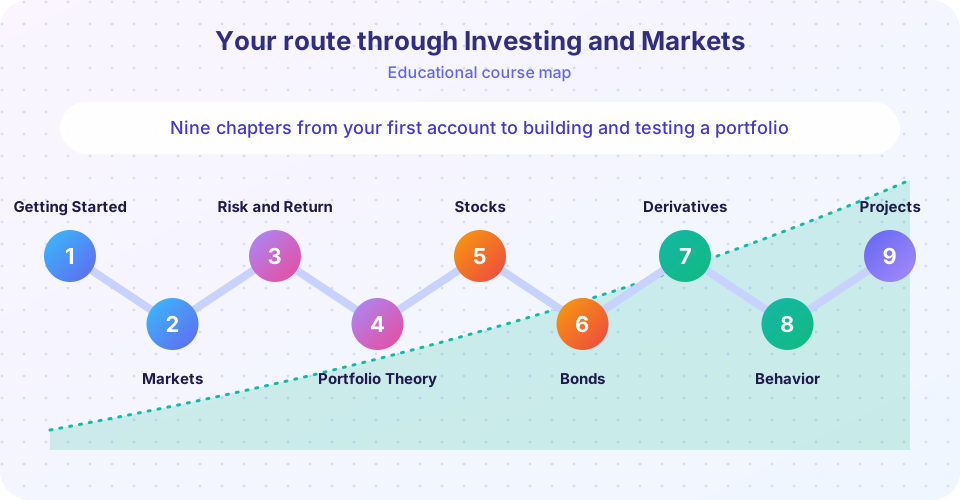
Think of the course as a staircase. Each step needs the one below it.
Foundations
Risk and portfolios
Valuing assets
Advanced and human
Practice
Chapters 1 to 4, the first half, build the vocabulary and the mathematics of risk. Chapter 1 explains why investing exists at all and how compounding turns time into your strongest ally. Chapter 2 shows the actual markets and instruments, and how an order becomes a trade. Chapter 3 defines return and risk precisely, so that "this is risky" becomes a number you can compute. Chapter 4 combines several assets into a portfolio, which is where the famous Nobel-prize-winning ideas live: the efficient frontier and the capital asset pricing model.
Chapters 5 to 9 apply those tools. You will learn how analysts estimate what a company is worth, how bond prices move when interest rates change, what options and futures are for, how your own psychology and costs shape results, and finally you will run your own simulations in a set of projects.
How to study each lesson
Every lesson has the same shape so you always know where you are. It starts with what you will learn, then key terms, then the explanation with a picture. After that you meet common misconceptions, a few interactive "Try it" blocks, and a short quiz. A summary ends the lesson and points to the next one.
Three habits make the course work much better:
- Change the numbers. Every code block runs in your browser. Alter the rate, the years or the weights and predict the result before you press Run. A wrong prediction is the fastest teacher.
- Say the idea aloud. After each summary, explain the lesson in one sentence to an imaginary friend. If you cannot, reread the first picture.
- Do the quiz without peeking. The explanations after each answer matter more than the score.
A first look at the central idea
Here is the whole subject in miniature. Suppose you save $300 each month. You can leave it in a drawer, or you can invest it and earn an assumed 6% a year on average. The drawer gives you a plain sum. Investing gives you the sum plus growth on the growth. The difference becomes enormous with time, which is why Chapter 1 spends so long on it.
But the 6% is an average and nobody can promise it. Some years will pay far more and some will lose money. Chapter 3 shows how to measure that bumpiness, and Chapters 4 and 8 show how to live with it. The trade-off between growth and bumpiness is the core of everything that follows.
Common misconceptions
"Investing is gambling." Gambling creates risk that did not exist, and the average player loses. Owning a share of a profitable business, or lending to a stable borrower, earns a payment for putting money at risk. Risk is real in both cases, but the expected payment is only positive in investing.
"You need a lot of money to start." Many brokers let you buy small amounts or fractions of shares and funds. What you need is time, regular contributions and low costs.
"Experts can predict the market." Chapter 8 shows how rarely anyone beats the market after costs, and why that is not a failure of intelligence.
Try it
The first block is a savings calculator. It shows how much a monthly contribution grows at different assumed yearly rates. The rates are assumptions for illustration, not forecasts.
Press Run (or Ctrl + Enter) to see the result here.
Program input · what you'd type while the program runs
Type the answers before you press Run, one per line. Each time the program reads a line (with input()), it gets the next line from this box.
The second block lets you drag sliders. It is a demonstration of the same formula.
Move the return slider to 0% and watch the bar fill completely: with no growth, everything you end up with is what you paid in. At higher rates, the pink part, the growth, takes over the longer you wait.
Check your understanding
Quick check · 4 questions
of 4 answered You scored / 4 · perfect!
-
1. Which statement best describes risk in this course?
Risk is uncertainty about the outcome. It includes better than expected results as well as worse ones, which is why we later measure it with volatility. -
2. Why does the course teach returns and risk before valuing individual stocks?
Valuation discounts future cash flows at a required return, and that rate comes from the risk-return ideas of Chapters 3 and 4. -
3. In the savings calculator, what happens at a 0% yearly return?
Without growth there is nothing on top of your deposits, so the final value is exactly the sum of what you paid. -
4. Which is the best description of this course?
The course explains concepts and tools. It never recommends specific purchases and never promises returns.
Summary
- The course has nine chapters: foundations, markets, risk, portfolio theory, stocks, bonds, derivatives, behavior and projects.
- It is education, not personal advice, and every number is an invented example.
- Learn by running and changing the code, predicting before you press Run.
- The central trade-off is growth against uncertainty; everything else is built on it.
Track your progress
Create a free account to tick off lessons and pick up where you left off on any device.
of Investing and Markets lessons completed