


















Lesson 7 of 46 · Financial Markets and Instruments
Stocks and exchanges: what you own and how it trades
Learn what a share represents, how dividends and market capitalization work, and how an exchange order book sets prices, with a live matching engine to experiment with.
A share of stock is a small slice of ownership in a company. If a business is divided into one million shares and you own 1,000, you own one-thousandth of everything the company owns and earns, after its debts are paid. That sounds abstract until you see where the price comes from: a continuous auction run by an exchange, in which every buyer names the most they will pay and every seller the least they will accept. This lesson explains the slice and the auction.
What you will learn
- What owning a share gives you, and what it does not.
- How dividends, capital gains and total return fit together.
- How market capitalization measures company size.
- How an order book, the bid, the ask and the spread produce a price.
Key terms
Share (stock, equity): a unit of ownership in a company.
Dividend: a payment of part of the profits to shareholders.
Market capitalization: share price times the number of shares outstanding.
Bid and ask: the highest price a buyer offers (bid) and the lowest price a seller wants (ask).
Spread: the difference between the ask and the bid.
What a share gives you
Shareholders are the residual claimants of a company. That means they are paid last: suppliers, employees, lenders and tax authorities come first, and shareholders get whatever is left. When a firm does well, what is left is large and the shares become more valuable. When it does badly, it can be little or nothing. In exchange for this risk, shareholders have three rights:
- A share of profits, paid out as dividends or kept in the business to grow it.
- A say in decisions, usually one vote per share at the annual meeting for electing the board and approving major actions. Some companies issue several share classes with unequal voting rights.
- Limited liability. If the company fails, you can lose the money you paid for the shares, but creditors cannot come after your house or savings. This protection is one of the great inventions that made large-scale investing possible.
Common shares are the type most people mean by "stock". Preferred shares usually pay a fixed dividend and rank ahead of common shares in a payout, but normally carry no vote. They behave like a hybrid of a share and a bond.
Where returns come from
A shareholder earns in two ways. First, the dividend if the company pays one. Second, a capital gain: the price moves from what you paid to what you sell for. Together they make the total return:
total return = (ending price + dividends - starting price) / starting price
Suppose you buy a share at $40. Over the year it pays $1.20 in dividends and ends at $43. Your total return is (43 + 1.20 - 40) / 40 = 10.5%, made of a 3% dividend yield and a 7.5% price gain. Dividend yield is the yearly dividend divided by the price, a handy way to compare income, but never the whole story. Many fast-growing companies pay no dividend at all and reinvest profits; investors hope the reinvestment makes the price rise.
Companies sometimes split shares. In a 2-for-1 split, each share becomes two and the price halves, so your total value is unchanged. A split is like cutting a pizza into more slices; it does not make the pizza bigger.
Market capitalization
To compare the size of companies, look not at the price but at the market capitalization, or market cap: price times shares outstanding. A company with 200 million shares at $20 is worth $4 billion, bigger than one with 10 million shares at $100 ($1 billion), though the second share has the higher price. Analysts group companies loosely into large caps, mid caps and small caps, but cut-offs vary by index provider and era.
Market cap is the value the market gives the equity today. It is not the same as what the company would fetch in a sale, and it is not the same as the money the firm holds. It rises and falls with the price, so a hype-driven jump increases it without a single extra product sold.
How an exchange sets a price
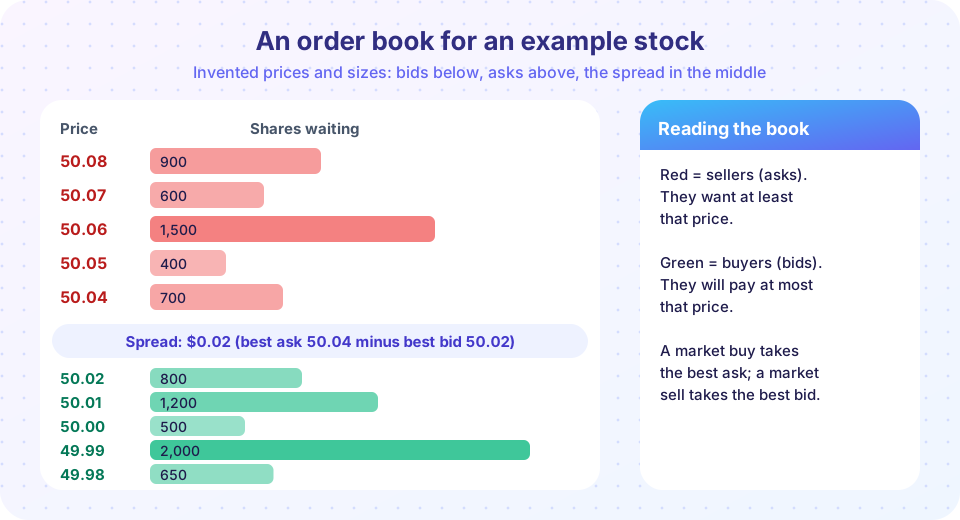
A stock exchange runs an order book: a list of all buy and sell orders waiting for a match, sorted by price. Look at the picture. The red rows are asks, offers to sell: 700 shares at $50.04, 400 at $50.05 and so on. The green rows are bids, offers to buy: 800 shares at $50.02, 1,200 at $50.01 and so on. All the sellers want at least their ask; all the buyers will pay at most their bid.
The best (lowest) ask is $50.04 and the best (highest) bid is $50.02, so the spread is $0.02. The two sides do not trade with each other until someone gives way. If you must buy now, you lift the ask and pay $50.04. If you must sell now, you hit the bid and receive $50.02. The spread is therefore a cost of trading, paid every time you cross it. For heavily traded shares it can be a cent; for obscure ones it can be several percent.
The "price" quoted on a screen is usually the last trade, the price of the most recent match. The next trade can happen at a different price if the book has moved.
When the best bid and best ask touch, a trade happens. If you place an order to buy 1,000 shares at the market, it takes the 700 shares at $50.04 first and the next 300 from the $50.05 level. Your average price is a little above the best ask. This is called slippage. Large orders, relative to the book, move the price against the buyer. That is why professional traders slice big orders into small pieces.
Why prices move
Prices move when the balance of orders changes. New information (earnings reports, product launches, interest-rate decisions, wars, weather) changes what people think the company is worth, so they update their bids and asks. In a competitive market, much of the information is absorbed within seconds. This is the intuition behind the efficient market hypothesis, which Chapter 8 examines: it says prices already reflect available information, so beating the market consistently is very hard. The idea is not that prices are always right, only that they are hard to predict.
Listing, delisting and where shares trade
A company that wants its shares to trade on an exchange must meet its listing rules: minimum size, audited accounts, regular reporting and governance standards. Rules differ by exchange. A company can be delisted if it fails these rules, or if it is bought and taken private. Many shares also trade on alternative venues and electronic networks, but they all connect to the same price. Foreign companies can list shares abroad, sometimes through certificates called depositary receipts.
Trading hours depend on the exchange. Most major exchanges open for a regular session on weekdays, with pre-market and after-hours sessions at lower volume and wider spreads.
Common misconceptions
"A $5 share is cheap and a $500 share is expensive." Share price alone says nothing about value. Compare price with earnings, assets and growth, which Chapter 5 covers.
"The price I see is the price I will get." The displayed price is the last trade. A market order fills at the best available prices in the book, which can be worse, especially for large orders or illiquid shares.
"Dividends are free money." When a company pays a dividend, its price typically drops by about that amount, because cash has left the company. What you gain in cash you lose in price; total return is what matters.
Try it
The first block is a tiny matching engine for the book in the picture. Run a market order of different sizes and watch the average price.
Press Run (or Ctrl + Enter) to see the result here.
Program input · what you'd type while the program runs
Type the answers before you press Run, one per line. Each time the program reads a line (with input()), it gets the next line from this box.
The second block computes total return from price and dividends, and shows why a stock split changes nothing.
Press Run (or Ctrl + Enter) to see the result here.
Program input · what you'd type while the program runs
Type the answers before you press Run, one per line. Each time the program reads a line (with input()), it gets the next line from this box.
Check your understanding
Quick check · 5 questions
of 5 answered You scored / 5 · perfect!
-
1. Shareholders are called residual claimants. What does that mean?
Lenders, employees and suppliers are paid before shareholders. Shareholders keep what remains, which can be a lot or nothing. -
2. A share bought at 40 pays 1.20 in dividends and ends the year at 43. What is the total return?
(43 + 1.20 - 40) / 40 = 10.5%, a 7.5% price gain plus a 3% dividend yield. -
3. Company X has 50 million shares at 8 dollars each. What is its market cap?
Market cap = price × shares = 8 × 50 million = 400 million. -
4. In an order book, the best ask is 12.30 and the best bid is 12.26. What is the spread?
Spread = ask - bid = 12.30 - 12.26 = 0.04. -
5. A 2-for-1 stock split changes your total holding value by:
You hold twice as many shares at half the price.
Summary
- A share is residual ownership with limited liability, voting rights and a claim on profits.
- Total return = price change plus dividends; yield alone is not the whole story.
- Market cap (price × shares) measures company size, not the price per share.
- The order book matches bids and asks; the spread is a cost and large orders suffer slippage.
Track your progress
Create a free account to tick off lessons and pick up where you left off on any device.
of Investing and Markets lessons completed