


















Lesson 16 of 46 · Portfolio Theory
Chapter 4 overview: portfolio theory
A first look at modern portfolio theory: treating a portfolio as weights, measuring its expected return and risk, and asking which mix is best. Previews Markowitz, CAPM and allocation.
So far we have looked at assets one at a time. But nobody lives on one asset. You hold a mix, and the mix has a return and a risk of its own that are not simply the sum of the parts. In 1952 a young economist, Harry Markowitz, published a short paper that turned this observation into mathematics, and in 1990 he shared the Nobel Prize in economics for it with Merton Miller and William Sharpe. This chapter walks through the framework they built: modern portfolio theory, or MPT.
What you will learn
- How a portfolio is described by its weights, expected return and volatility.
- The question modern portfolio theory asks, and the answer it gives.
- What the efficient frontier, the Sharpe ratio and CAPM are, in one sentence each.
- Why the theory is a map and not a forecast.
Key terms
Portfolio: all your investments considered together.
Weight: the fraction of your money in each holding; the weights add to 100%.
Efficient frontier: the set of portfolios with the highest expected return for each level of risk.
Sharpe ratio: extra return over the risk-free rate, per unit of volatility.
Beta: how strongly an asset moves with the overall market.
A portfolio is a set of weights
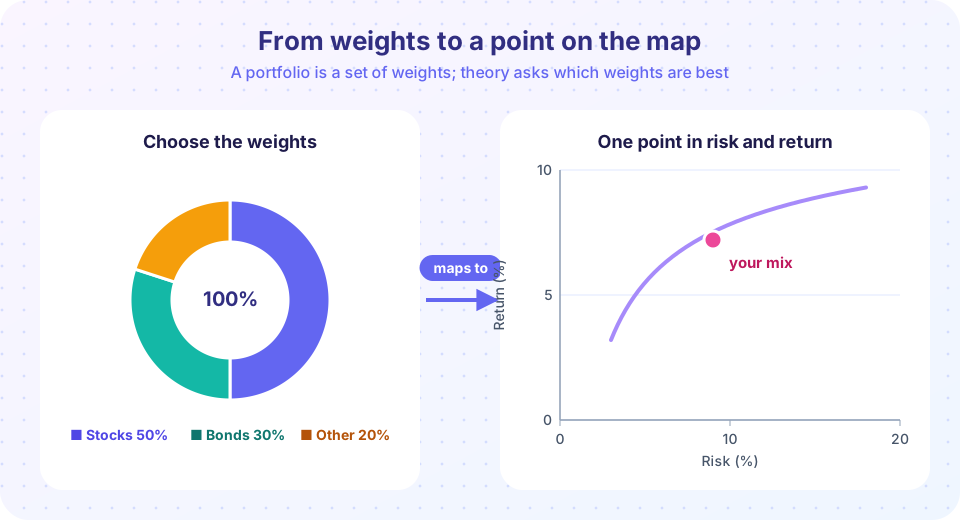
Start with the donut in the picture. A portfolio of 50% stocks, 30% bonds and 20% other holdings is fully described by those three numbers and by what the three assets do. Its expected return is the weighted average of the assets' expected returns, with no surprises. Its volatility is more subtle, because it depends on how the assets move together, as Chapter 3 showed. The formula for any number of assets uses a table of variances and covariances, but the idea is unchanged: lower correlation, lower portfolio risk.
Every possible choice of weights is a point on the risk-return map on the right of the picture. As you shift money from bonds into stocks the point moves up and to the right. As you add a third asset, the points fill an area. The interesting part is the upper-left edge of that area: the portfolios that offer the most return for a given risk (or the least risk for a given return). That edge is the efficient frontier.
The question and the answer
Markowitz asked: given estimates of each asset's expected return, volatility and correlations, which weights should a rational investor choose? His answer has three parts.
- Judge assets by their contribution to the portfolio, not on their own. A risky asset with low correlation to your other holdings can reduce overall risk.
- Some portfolios are strictly worse than others. If a portfolio has a higher-return, same-risk alternative, it is "inefficient" and no investor who cares only about return and risk should hold it.
- Among efficient portfolios, the best one depends on your risk preference. A cautious investor picks a point low on the frontier, an aggressive investor higher up.
William Sharpe extended the idea in the 1960s. If you can also lend and borrow at a risk-free rate, there is one best mix of risky assets for everyone, the one with the highest Sharpe ratio, and you adjust your risk by blending it with cash or borrowing. If every investor reasons this way, the market as a whole becomes that best mix, and the expected return of any asset is pinned down by its beta, its sensitivity to the market. That is the capital asset pricing model, CAPM.
What the theory gives you and what it does not
MPT gives you a clear way to think. It explains why diversification works, why you need not hold only the highest-return assets, why your asset mix matters more than which individual stocks you pick, and why the market portfolio is a sensible default. It also underlies index funds, target-date funds and robo-advisors.
It also has real limits, which later lessons cover in detail:
- Inputs are estimates. Expected returns are notoriously hard to forecast, and small changes in them can swing the "optimal" weights wildly.
- Volatility is not all of risk. Fat tails, drawdowns and liquidity matter.
- Correlations change. They rise in crises, as Chapter 3 noted.
- Investors are not machines. Taxes, costs, goals and emotions play a role.
Treat the theory as a map: it shows the shape of the terrain and helps you avoid obvious mistakes, but it does not tell you where tomorrow's weather will strike.
How the chapter fits together
- Two-asset portfolios: the mathematics in the simplest case, and how correlation bends the curve.
- The efficient frontier and the Sharpe ratio: finding the best mix.
- CAPM and beta: what a fair return is for a given risk.
- Asset allocation and rebalancing: turning theory into practical target mixes.
- Chapter 4 review: a recap and a quiz.
From assets to a portfolio
The best mixes
Pricing risk
Common misconceptions
"Modern portfolio theory says to maximize return." It says to choose the best return for the risk you accept; return alone is never the target.
"The theory is proven right." It is a model: elegant, influential and a useful guide, but built on simplifying assumptions that do not always hold.
"The optimal portfolio is a precise recipe." Because the inputs are estimates, a reasonable mix near the frontier is as good as the exact point.
Try it
The first block generates thousands of random portfolios from three invented assets and plots them, so you can see the area and its upper-left edge. All inputs are examples, not forecasts.
Press Run (or Ctrl + Enter) to see the result here.
Program input · what you'd type while the program runs
Type the answers before you press Run, one per line. Each time the program reads a line (with input()), it gets the next line from this box.
The second block computes the return and volatility of any three weights you type in.
Press Run (or Ctrl + Enter) to see the result here.
Program input · what you'd type while the program runs
Type the answers before you press Run, one per line. Each time the program reads a line (with input()), it gets the next line from this box.
Check your understanding
Quick check · 4 questions
of 4 answered You scored / 4 · perfect!
-
1. What fully describes a portfolio in portfolio theory?
Expected return comes from the weights and returns; volatility also needs correlations. -
2. What is the efficient frontier?
It is the upper-left edge of the achievable risk-return area. -
3. Which is a limit of modern portfolio theory?
The 'optimal' weights are sensitive to estimated inputs. -
4. What is the Sharpe ratio, in one line?
It measures reward per unit of risk.
Summary
- A portfolio is a set of weights; expected return is the weighted average, risk depends on correlations.
- The efficient frontier holds the best risk-return trade-offs; your risk preference picks the point.
- With a risk-free asset there is one best risky mix (highest Sharpe ratio), which leads to CAPM and beta.
- The theory is a map built on estimates, not a forecast.
Next: Two-asset portfolios
Track your progress
Create a free account to tick off lessons and pick up where you left off on any device.
of Investing and Markets lessons completed