


















Lesson 10 of 46 · Financial Markets and Instruments
Chapter 2 review: markets and instruments
Review Chapter 2 of the investing course: issuers, primary and secondary markets, stocks, bonds, funds, ETFs and order types, then test yourself with ten questions.
You now know the cast and the stage: who issues securities, who buys them, where they trade, what the main instruments are and how an order becomes a trade. This review ties it together in a single poster, a table you can use as a cheat sheet and a quiz that mixes all four lessons.
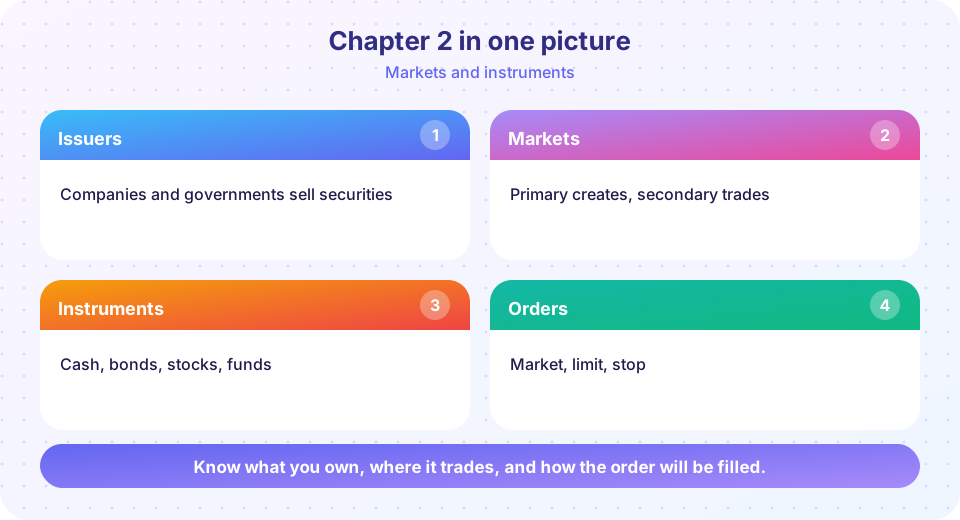
The chapter in one table
| Topic | What to remember | Lesson |
|---|---|---|
| Primary and secondary markets | Primary: issuer gets the cash. Secondary: investors trade, giving liquidity | Overview |
| Index | Market-cap-weighted indexes give big companies big weights | Overview |
| Share | Residual ownership, votes, limited liability | Stocks and exchanges |
| Total return | (end price + dividends - start price) / start price | Stocks and exchanges |
| Market cap | Price × shares outstanding | Stocks and exchanges |
| Order book | Bids below, asks above; spread = best ask - best bid | Stocks and exchanges |
| Bond | Face value, coupon, maturity; price falls when yields rise | Bonds, funds and ETFs |
| Credit risk | Corporate bonds pay a spread for default risk | Bonds, funds and ETFs |
| Funds and ETFs | Pooled baskets; ETFs trade all day; low fees matter | Bonds, funds and ETFs |
| Order types | Market, limit, stop, stop-limit; time in force | Orders and trading |
| Trade life | Match, clearing, settlement (often T+1 or T+2) | Orders and trading |
What to remember
If you only keep three lessons: (1) secondary-market trading makes primary funding possible because it gives investors an exit; (2) bonds and stocks differ in what they promise, with bonds paying a known schedule and shares sharing in whatever is left; (3) your trading costs are the spread, slippage, taxes and fund fees, so prefer low-cost diversified funds and think before using stops, margin or shorting.
Common slips. Calling a low share price "cheap" without looking at market cap or earnings. Expecting a market order to fill at the last quote. Assuming a bond fund cannot lose money when rates rise. Forgetting that a fund's fee is charged every year, not once.
A worked mini-case
You want to buy 1,000 shares of a stock whose order book shows the best ask at $50.04 for 700 shares and $50.05 for the next 400. A market order fills at an average of $50.043, so you pay about $0.003 a share more than the best ask, and you could sell immediately only at the best bid, $50.02: the round-trip spread costs $20 on 1,000 shares. A buy limit at $50.03 would not fill until the ask falls, which is fine if you are patient. Now think about the vehicle: holding the stock through a fund that charges 0.1% a year instead of 1% leaves about $55,800 instead of $43,200 after 30 years on $10,000 at 6%. The cheapest, simplest choices usually do the most for you.
Try it
A small quiz engine for flash-card practice. Add your own terms.
Press Run (or Ctrl + Enter) to see the console output here.
No output.
A second block pulls the chapter's numbers together: it prices a bond, computes a market cap and measures a spread, so you can see all three calculations side by side.
Press Run (or Ctrl + Enter) to see the result here.
Program input · what you'd type while the program runs
Type the answers before you press Run, one per line. Each time the program reads a line (with input()), it gets the next line from this box.
Check your understanding
Quick check · 10 questions
of 10 answered You scored / 10 · perfect!
-
1. Where does the money go when you buy shares in a company's IPO?
An IPO is a primary-market sale, so the issuing company receives the proceeds. -
2. A company has 80 million shares priced at 15. What is its market capitalization?
15 × 80 million = 1,200 million = 1.2 billion. -
3. What does a lower-priced share tell you about the company's size?
Price depends on how many shares exist. Size is market cap, not price. -
4. Bond yields in the market rise from 4% to 5%. Your existing 4% coupon bond:
Newer bonds pay more, so buyers pay less for your older 4% bond. -
5. An ETF differs from a traditional mutual fund mainly because:
ETFs are bought and sold like shares at a market price, while mutual funds price once a day. -
6. You want to buy only if the price is 20.00 or lower. Which order fits?
A limit order refuses any price worse than your limit. -
7. Why does a corporate bond usually yield more than a government bond of the same term?
Investors need extra yield for the chance that a company cannot pay. -
8. The best bid is 31.40 and the best ask is 31.46. What does a quick round trip (buy at the ask, sell at the bid) cost per share, ignoring fees?
You pay 31.46 and receive 31.40, so you lose the 0.06 spread. -
9. Which is true of stop-loss orders?
A stop sets a trigger, not a guaranteed price. -
10. A fund charges 1% a year and a similar index ETF charges 0.1%. Over decades, which statement is most accurate?
Fees are charged every year and compound against you.
Summary
- Primary markets raise money; secondary markets provide liquidity and prices.
- Shares are residual ownership; bonds are tradable loans whose prices fall when yields rise.
- Funds and ETFs pool assets; fees compound, so low cost matters.
- Choose order types to control price (limit) or speed (market), and expect settlement a day or two later.
Track your progress
Create a free account to tick off lessons and pick up where you left off on any device.
of Investing and Markets lessons completed