


















Lesson 44 of 46 · Projects and Practice
Glossary of Investing and Markets Terms
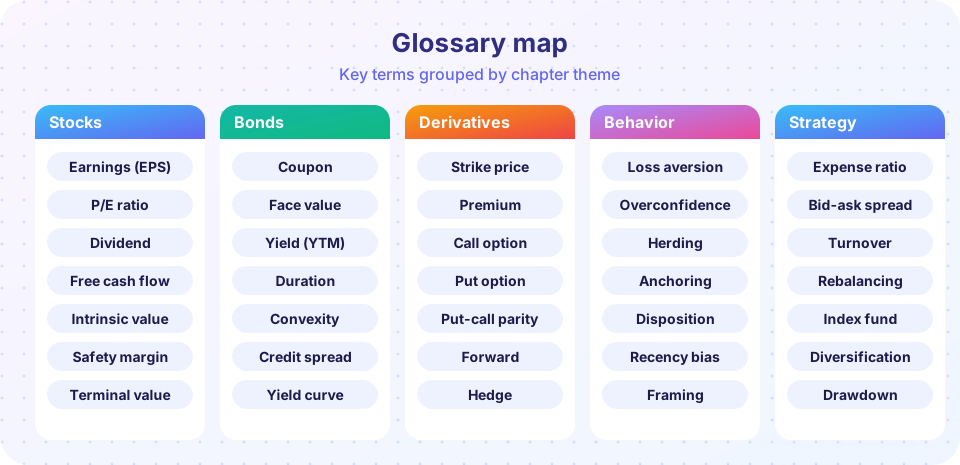
A glossary of key investing terms from valuation, bonds, derivatives, behavior and costs, with one-line definitions and flashcards to test yourself.
Finance has its own vocabulary, and much of the difficulty of the subject is simply knowing what a word means. This glossary collects the key terms of the second half of the course in alphabetical order. Each definition is one or two sentences, with a pointer to the lesson that explains the idea in depth. After the list, a flashcard widget lets you test yourself.
What you will learn
- The meaning of the main terms from chapters 5 to 8.
- Which lesson to revisit for each family of terms.
- How to use flashcards to check recall.
How to use this page
Read the definitions once, then use the flashcards. Recall (producing the answer from memory) works far better for learning than rereading. Terms are tagged by chapter: [S] stocks and valuation, [B] bonds, [D] derivatives, [H] behavior, costs and strategy.
Glossary
Anchoring [H]: letting an irrelevant number, such as your purchase price, influence later judgments.
Asset allocation [H]: the division of a portfolio among asset classes such as stocks, bonds and cash.
Basis [D]: the spot price minus the futures price. See futures and hedging.
Basis point [B]: one hundredth of a percentage point; 0.01 percent.
Bid-ask spread [H]: the gap between the best price to sell and the best price to buy; a trading cost.
Binomial model [D]: an option pricing method that moves the price up or down in each step and works backward from the payoffs.
Black-Scholes [D]: a formula for European option prices that depends on stock price, strike, time, rate and volatility.
Book value [S]: assets minus liabilities as recorded on the balance sheet; accounting equity.
Call option [D]: the right to buy an asset at the strike price on or before expiration.
CAGR [H]: compound annual growth rate, the constant yearly rate that produces the same overall growth.
Convexity [B]: the curvature of the price-yield relationship; it improves the duration estimate.
Cost of carry [D]: the net cost of holding an asset until a future date: interest and storage minus income.
Coupon [B]: the fixed periodic interest payment of a bond.
Credit spread [B]: the yield of a risky bond minus the yield of a government bond of similar maturity.
Current yield [B]: annual coupon divided by the bond's price.
Derivative [D]: a contract whose value depends on an underlying asset, index or rate.
Discount rate [S]: the required yearly return used to convert future cash into present value.
Dividend yield [S]: dividends per share divided by the share price.
Dollar-cost averaging [H]: investing equal sums at regular intervals.
Drawdown [H]: the percentage fall from a previous peak; the maximum drawdown is the largest in a period.
Duration [B]: a measure of a bond's price sensitivity to yield changes; the weighted average time to receive cash flows.
Earnings per share (EPS) [S]: net income divided by shares outstanding.
Enterprise value (EV) [S]: market capitalization plus debt minus cash.
Expense ratio [H]: the yearly fee of a fund, as a percentage of assets.
Face value (par) [B]: the amount a bond repays at maturity.
Forward contract [D]: a private agreement to buy or sell at a fixed price on a future date.
Free cash flow [S]: operating cash flow minus capital spending.
Futures contract [D]: a standardized, exchange-traded forward settled daily through margin.
Gordon growth model [S]: the value of a share as next year's dividend divided by the required return minus growth.
Hedge ratio [D]: the size of a futures position relative to the exposure; the minimum-variance ratio is correlation times the ratio of volatilities.
Hedging [D]: using a derivative to reduce an existing risk.
Implied volatility [D]: the volatility that makes an option model price equal the market price.
Index fund [H]: a fund that holds the securities of a market index at low cost.
Intrinsic value [S]: an estimate of what an asset is worth, based on its cash flows. For an option, the payoff if exercised now.
Investment grade [B]: credit ratings of BBB- (S&P/Fitch) or Baa3 (Moody's) and above.
Leverage [D]: controlling a large exposure with a small amount of money.
Loss aversion [H]: the tendency for losses to weigh more than equal gains.
Margin [D]: the deposit that secures a futures position and is adjusted daily.
Margin of safety [S]: a gap between estimated value and the price paid, as protection against error.
Market capitalization [S]: share price times shares outstanding.
Maturity [B]: the date when a bond's face value is repaid.
Net debt [S]: debt minus cash.
Overconfidence [H]: believing your knowledge or skill is better than it is.
P/E ratio [S]: price per share divided by earnings per share.
Peer group [S]: similar companies used for relative valuation.
Present value [S]: the value today of a future payment, found by discounting.
Premium [D]: the price paid for an option.
Put option [D]: the right to sell an asset at the strike price on or before expiration.
Put-call parity [D]: the relationship C - P = S - K / (1 + r)^T for European options.
Real return [H]: the return after adjusting for inflation.
Rebalancing [H]: trading to restore a portfolio's target weights.
Risk-neutral probability [D]: the probability that makes discounted expected payoffs equal prices in a binomial model.
Spot rate [B]: the yield on a zero-coupon bond for a given maturity.
Strike price [D]: the fixed price in an option contract.
Swap [D]: an agreement to exchange streams of cash flows.
Terminal value [S]: the value at the end of the forecast of all later cash flows.
Turnover [H]: the share of a portfolio traded in a year.
Volatility [D]: the annualized standard deviation of returns.
WACC [S]: the weighted average cost of capital, the discount rate for a firm's overall cash flows.
Yield curve [B]: a plot of yields against maturity.
Yield to maturity [B]: the discount rate that equates a bond's price with the present value of its payments.
Zero-coupon bond [B]: a bond that pays no coupons and is sold at a discount.
Try it
First, flashcards. Press "Show definition" to reveal the answer, then mark whether you knew it. The widget keeps a score and reshuffles the cards you missed.
Second, a small lookup you can extend. Add your own terms and definitions in the dictionary and call define().
Press Run (or Ctrl + Enter) to see the result here.
Program input · what you'd type while the program runs
Type the answers before you press Run, one per line. Each time the program reads a line (with input()), it gets the next line from this box.
Check your understanding
Quick check · 5 questions
of 5 answered You scored / 5 · perfect!
-
1. Enterprise value equals
EV prices the whole operating business: owners' value plus lenders' claims, less cash. -
2. Which pair of terms goes with bonds?
Coupons are bond interest payments and duration measures bond price sensitivity. -
3. The right to sell an asset at a fixed price is a
A put gives the right to sell at the strike price. -
4. Which term describes trading back to target weights?
Rebalancing restores the weights you chose after prices have moved them. -
5. The yield of a risky bond minus the yield of a government bond of similar maturity is the
The credit spread is the extra yield for credit and related risks.
Summary
- The glossary covers valuation, bond, derivative, behavior and strategy terms, tagged by chapter.
- Use flashcards to practice recall rather than rereading definitions.
- When a term is unclear, return to the lesson that introduces it.
Next: Cheat sheet
Track your progress
Create a free account to tick off lessons and pick up where you left off on any device.
of Investing and Markets lessons completed