


















Lesson 41 of 46 · Behavior, Costs and Strategy
Chapter 8 Review: Behavior, Costs and Strategy
Review behavioral biases, fee and tax drag, passive investing, dollar-cost averaging and rebalancing with a summary picture, recap table and a ten-question quiz.
This chapter was about the parts of investing that you control. You cannot choose what markets will return, but you can choose how much to save, how widely to diversify, what to pay, how often to trade, and whether to stick with a plan when it is hardest. The biggest threats are quiet ones: a bias that sells at the bottom, a fee that compounds for decades, a tax bill that could have been deferred. This review ties the lessons together and tests them.
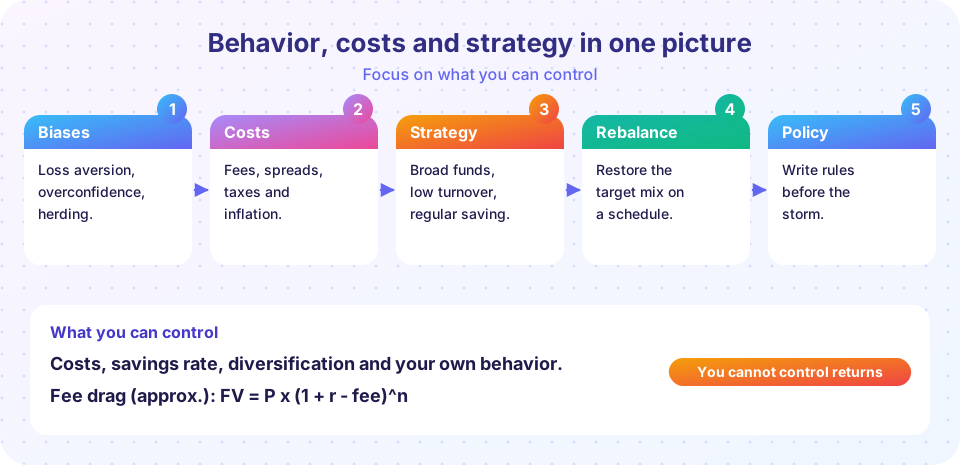
What you will learn
- How biases, costs and strategy connect into one plan.
- The key numbers and formulas to remember.
- Which defenses work best against behavioral mistakes.
- How well you can apply the chapter to mixed questions.
Recap table
| Topic | Key idea | Number or formula |
|---|---|---|
| Loss aversion | Losses weigh more than equal gains | Coefficient about 2.25 in the 1992 estimate |
| Overconfidence | Overtrading reduces net returns | Each trade has a cost |
| Disposition effect | Sell winners early, hold losers | Ask "would I buy it today?" |
| Fee drag | Fees compound against you | FV ≈ P x (1 + r - fee)^n |
| Tax timing | Deferral lets gains compound | Compare taxed yearly with taxed at the end |
| Real return | Adjust for inflation | (1 + nominal) / (1 + inflation) - 1 |
| Passive vs active | Active must beat costs | Average active earns less after costs |
| DCA vs lump sum | Lump sum tends to win, DCA reduces regret | About two-thirds in historical studies |
| Rebalancing | Controls risk, not a return booster | Calendar or 5-point bands |
The plan in six lines
- Decide the purpose and horizon of the money.
- Choose a mix of stocks and bonds you can live with in a crash.
- Use low-cost diversified funds and keep trading to a minimum.
- Save automatically on a schedule.
- Rebalance by a rule, ideally using new contributions first.
- Write it down, and review your goals once a year rather than your portfolio every day.
A worked example: the same investor in two worlds
Imagine an investor with 10,000 who saves 500 a month into a diversified 60/40 portfolio. In one world, the investor automates the contribution, keeps costs near 0.1 percent a year, rebalances annually and ignores the news. In the other world, the same investor checks prices daily, switches funds after a bad year, trades in and out, and pays 1 percent in fees on a managed product. Both experience the same markets.
Three differences accumulate. First, costs: an extra 0.9 percentage points a year are taken from the second portfolio, and, as the fee-drag lesson showed, the effect compounds, so the final difference over 30 years is far larger than 0.9 times 30. Second, timing: after a market fall the second investor sells and sits out the recovery, and in a rally buys more at higher prices. Even without any change in the fund's own return, the investor's actual return is lower than the fund's, and studies of investor behavior suggest this gap is common. Third, tax: frequent selling creates tax events that the first investor avoids.
Nothing in this story requires the first investor to be smarter. They are following a simple, written, automated plan; the second investor is making a new decision every time something frightening or exciting happens. The practical lesson is to design your investing so that the default action is the right one: automatic saving, low-cost diversified funds, a rebalancing rule, and a rule to wait before reacting. When your plan has already decided what to do in a crash, the crash is much less likely to decide for you.
The same pattern holds at every scale. Whenever you find yourself about to make a large change to a portfolio, ask whether a rule you wrote earlier already covers the situation. If it does, follow it. If it does not, add a rule for next time instead of improvising now.
Try it
This tool compares two investors with the same gross returns: one pays a 1 percent fee and trades often, the other pays 0.1 percent and rarely trades. It shows final values and the real value after inflation.
Press Run (or Ctrl + Enter) to see the result here.
Program input · what you'd type while the program runs
Type the answers before you press Run, one per line. Each time the program reads a line (with input()), it gets the next line from this box.
Check your understanding
Quick check · 10 questions
of 10 answered You scored / 10 · perfect!
-
1. Which is the best description of loss aversion?
In prospect theory the value function is steeper for losses than for gains. -
2. A portfolio of 10,000 earns 5% a year before fees. A 1% fee is charged annually. After 20 years it is worth about
The net return is 4%, and 10,000 x 1.04^20 is about 21,911. -
3. An investor says 'I'll sell as soon as I get back to what I paid.' Which bias is at work?
The purchase price is irrelevant to the future return; it acts as an anchor. -
4. Nominal return is 8% and inflation is 3%. The real return is closest to
(1.08 / 1.03) - 1 = 4.85%. -
5. According to Sharpe's arithmetic, why must the average active investor do worse than the average passive investor after costs?
Active and passive investors together hold the market, so active pays more for the same total return. -
6. A 12-month DCA plan and a lump sum are compared. When markets trend up, DCA usually
Cash waiting to be invested misses the growth that the lump sum captures. -
7. A 60/40 portfolio drifts to 70/30. What does a calendar rebalancing rule do?
Calendar rebalancing checks at fixed times and restores the target then. -
8. Which of these is a reason deferring tax helps final wealth?
Untaxed growth is reinvested and earns further returns until the tax is finally paid. -
9. Which is the most reliable defense against panic selling?
Rules made in calm times take the decision away from emotion. -
10. Why can a cautious allocation be wise even when a riskier one has a higher expected return?
An allocation you can keep through losses beats one you abandon at the bottom.
Summary
- Behavior, costs and strategy are the levers an investor controls.
- Biases such as loss aversion, overconfidence and anchoring cause predictable errors; written rules and automation help most.
- Fees, taxes and inflation compound; measure results after all three.
- Passive, low-cost diversified investing, regular saving and rule-based rebalancing form a sound default.
Track your progress
Create a free account to tick off lessons and pick up where you left off on any device.
of Investing and Markets lessons completed