


















Lesson 11 of 46 · Risk, Return and Diversification
Chapter 3 overview: risk, return and diversification
A map of investment risk and return: why higher expected return comes with uncertainty, what volatility measures, and how diversification reduces risk without cutting return.
Every investor is quietly answering one question: how much uncertainty am I willing to accept in return for a better expected outcome? The answer shapes every choice from your bank balance to your retirement fund. In this chapter we turn that vague feeling into numbers. We define return precisely, measure risk with volatility, name the different kinds of risk and then show the one nearly free lunch in finance: diversification.
What you will learn
- The risk and return trade-off, and why it exists.
- What this chapter measures: return, volatility, types of risk and correlation.
- How the lessons fit together.
- Why "risk" in finance means uncertainty in both directions.
Key terms
Expected return: the average outcome you anticipate, weighted by how likely each outcome is.
Volatility: how widely returns spread around their average; usually the standard deviation of returns.
Drawdown: the fall from a peak to a later low.
Diversification: spreading money across assets that do not move in lockstep.
Correlation: a number from -1 to +1 describing how two returns move together.
The central trade-off
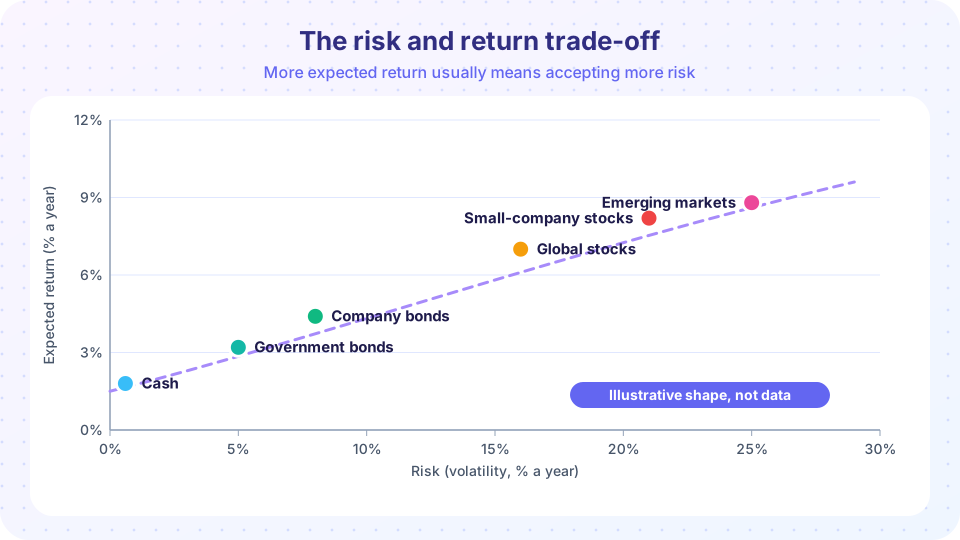
Look at the picture. Cash sits at the bottom left: its value barely moves and its return is small. Moving up and right, each asset class offers a higher expected return and a wider range of outcomes. The dashed line is an idea, not a law: it says that, on average and over long stretches, the market pays more for accepting more risk. If an asset promised a high return with no risk, everyone would buy it and the price would rise until the return fell. This is the logic of competitive markets.
Notice also what the picture hides. Individual assets can sit far from the line. A single company's stock may have far more risk than a diversified stock fund, but not more expected return, because the market does not reward risk you could have avoided. That point comes in the diversification lesson, and it is one of the few places in finance where a rule of thumb is also a mathematical result.
What "risk" means to a finance professional
In everyday speech, risk means the chance of something bad. In finance it means uncertainty about the outcome, in both directions. An asset that might earn +30% or -20% is riskier than one that surely earns +4%, even though the first might look better on average. This definition may feel odd, but it is practical: uncertainty is what you can measure and what forces you to plan for bad years.
The most common numerical measure is volatility, the standard deviation of returns. If a stock fund's yearly returns have averaged 8% with a standard deviation of 16%, then roughly two years in three land between -8% and +24%. We will build and test that statement in Lesson 2.
Volatility is not the only way to think about risk. Investors also care about drawdown (how deep the falls go and how long recovery takes), permanent loss (a company that goes bankrupt never comes back) and shortfall risk (the chance of missing a goal). Each deserves attention; volatility is simply the easiest to calculate and the best-studied.
How the chapter fits together
The four content lessons are a ladder.
- Returns and volatility: how to calculate returns, average them correctly, measure spread and read a bell curve.
- Types of risk and your tolerance: market, inflation, interest-rate, credit, currency and concentration risk, plus how to match risk to you.
- Diversification and correlation: why combining assets reduces risk, and the number that tells you by how much.
- Chapter 3 review: a recap and a ten-question quiz.
Risk is uncertainty
Not all risk is paid
The free lunch
Common misconceptions
"Risk is the same as losing money." Losses are one form of risk. The uncertainty also includes surprises on the upside, and some risks, like inflation, do not show up as falling prices at all.
"A risky asset will always beat a safe one over the long run." On average it should, but there is no guarantee. Risk means it might not.
"Safe assets have no risk." Government bonds fall when rates rise, and cash loses buying power to inflation.
Try it
The first block simulates 30 years of invented yearly returns for three asset types and shows how the spread of outcomes widens with risk. The numbers are made up for demonstration: they are not forecasts.
Press Run (or Ctrl + Enter) to see the result here.
Program input · what you'd type while the program runs
Type the answers before you press Run, one per line. Each time the program reads a line (with input()), it gets the next line from this box.
The second block is a risk-return table calculator for your own example assets.
Press Run (or Ctrl + Enter) to see the console output here.
No output.
Check your understanding
Quick check · 4 questions
of 4 answered You scored / 4 · perfect!
-
1. In finance, risk usually means:
Risk is the spread of possible outcomes, including pleasant surprises. -
2. Why would an asset offering high return and no risk not last in a competitive market?
Buyers would flood in and bid the price up, lowering the future return. -
3. Which is the most common numerical measure of risk in this course?
Volatility is the standard deviation of returns. -
4. Which risk is rewarded, on average, with a higher expected return?
Markets pay for risk you cannot avoid, not for risk you could have diversified.
Summary
- Higher expected return usually goes with higher uncertainty; that is the risk-return trade-off.
- Risk in finance is uncertainty in both directions; volatility measures it, and drawdown measures depth of falls.
- Only the part of risk that cannot be diversified is rewarded.
- This chapter builds the tools: returns and volatility, risk types, diversification and correlation.
Next: Returns and volatility
Track your progress
Create a free account to tick off lessons and pick up where you left off on any device.
of Investing and Markets lessons completed