


















Lesson 46 of 46 · Projects and Practice
Further Study: Where to Go After Investing and Markets
Plan your next steps after the investing course: related tracks on this site, topics worth deeper study, primary sources to read, and a personal study plan tool.
You now have a working vocabulary and a toolkit for investing: how companies are valued, how bonds and derivatives are priced, how behavior and costs shape results, and how to test an idea in code. That is a foundation, not the end. This final lesson shows what the course left out, which other tracks on this site build on it, and how to keep learning in a way that helps rather than tempts you into overtrading.
Educational content only. Nothing in this course is personal financial, tax or legal advice. For decisions about your own money, consider a qualified, licensed professional who can look at your whole situation.
What you will learn
- What this course did not cover and why it matters.
- Which related tracks on this site extend each part of the course.
- How to keep learning from primary sources and your own experiments.
- How to plan your next steps with a simple self-assessment.
What the course did not cover
An introduction has to choose. These topics deserve their own study.
- Real assets and alternatives. Property, commodities, private equity and venture funds behave differently from listed stocks and bonds, with different costs, liquidity and valuation problems.
- Taxes and account rules. They differ by country and change over time. A local, current source matters more here than any general text.
- Retirement and income planning. Drawing down money safely raises its own questions about sequence of returns, longevity and inflation.
- Quantitative portfolio construction. Beyond the introduction in this course: factor models, risk budgeting, optimization with constraints and the estimation errors that make optimizers fragile.
- Advanced derivatives and fixed income. Exotic options, stochastic volatility, mortgage-backed securities and credit derivatives.
- Market structure and regulation. How exchanges, brokers, clearing houses and regulators work and why rules change after crises.
- New asset types. Digital assets and other recent products have short histories and fast-changing rules; apply the same questions you learned: what produces cash flows, what are the costs and risks, and who is the counterparty?
Tracks on this site that build on it
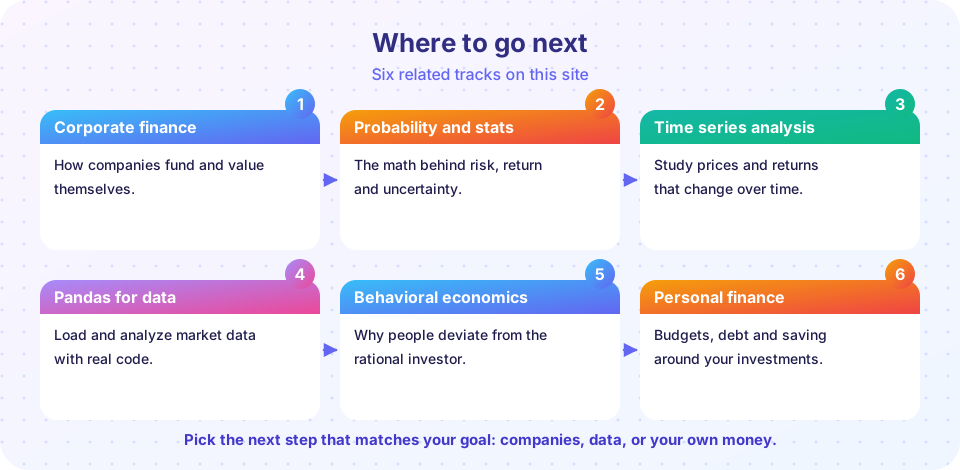
- Corporate finance: the company side of valuation, including capital budgeting, capital structure and the cost of capital that appeared in the DCF lesson.
- Probability and statistics: the mathematics behind risk, return and uncertainty, from distributions to hypothesis testing.
- Time series analysis: methods for data ordered in time, which is the nature of prices, rates and returns.
- Pandas: load, clean and analyze real market data with code, the natural next step after the backtester project.
- Behavioral economics: the full research story behind the biases of chapter 8.
- Personal finance: budgeting, debt, insurance and saving, the base that investing sits on.
Further options include Financial accounting for reading statements in more depth, Monte Carlo simulation for simulating portfolios and option payoffs, and Macroeconomics for the forces that move interest rates and growth.
How to keep learning
Read primary sources. Company annual reports and filings tell you what a business says about itself; the notes to the accounts are often more revealing than the headline numbers. Central bank publications explain how interest rates are set. Fund documents state fees and holdings plainly.
Read the classics, with a critical eye. Benjamin Graham's The Intelligent Investor (value and margin of safety), Burton Malkiel's A Random Walk Down Wall Street (market efficiency and index investing), John Bogle's writings on low-cost funds, Daniel Kahneman's Thinking, Fast and Slow (judgment and bias) and John Hull's Options, Futures, and Other Derivatives (the standard derivatives text) are widely used starting points. Each reflects its author's view; read opposing views too.
Keep a decision journal. Record why you made each investing choice, what you expected, and what would change your mind. Review it every few months. It is the cheapest form of feedback available.
Practice with simulations before real money. The tools in this course let you test ideas in code. A paper portfolio can teach you how you respond to losses without costing anything, though it cannot fully reproduce the feeling of real losses.
Be careful with sources. Finance is full of confident forecasts and products designed to sell. Ask who benefits, what the track record is after costs, and whether claims can be checked. Be especially wary of promised high returns with low risk: that combination is almost always a sign of a mistake or a scam.
Habits that separate learners from gamblers
Two people can read the same books and end up in very different places, and the difference is usually habit. Learners write down a hypothesis before acting, check results against the hypothesis, and accept that being wrong is information. They keep position sizes small enough that any single mistake is survivable, and they measure performance against a sensible benchmark and after costs, not against their memory of their best trades. They also separate learning money from the money their future depends on.
Gamblers, by contrast, remember wins and forget losses, increase their bets after a loss to get even, and treat the market as a place to prove themselves. The course has given you the vocabulary to recognize these habits: loss aversion, the disposition effect, overconfidence and anchoring. The aim of further study is not to find a secret edge but to build a process that keeps working when you are tired, frightened or excited.
Common misconceptions
"After a course I know enough to beat the market." The course teaches how to think and what to avoid; consistent outperformance is hard even for professionals.
"The more I follow the news, the better my results." Frequent attention tends to increase trading and emotional decisions, which are costly.
"One book or one expert has the answer." Sensible people disagree about many questions in finance; understand the arguments rather than choosing a guru.
Try it
First, a self-assessment. Rate your confidence for each chapter and the tool suggests where to review first and which lessons to revisit. It is only a study aid.
Second, a savings goal calculator: how much to save each month to reach a target, for different assumed returns. The returns are assumptions for illustration, not predictions.
Press Run (or Ctrl + Enter) to see the result here.
Program input · what you'd type while the program runs
Type the answers before you press Run, one per line. Each time the program reads a line (with input()), it gets the next line from this box.
Check your understanding
Quick check · 4 questions
of 4 answered You scored / 4 · perfect!
-
1. Which topic was named as outside the scope of this course?
Taxes and retirement drawdown depend on local rules and personal circumstances and need their own study. -
2. Which track is the natural next step for analyzing real market data in code?
Pandas gives you the data-handling tools to extend the backtester project with real series. -
3. What is a good attitude toward investing classics and experts?
Finance has genuine disagreements, so compare arguments and evidence. -
4. Why is a decision journal useful?
Recording your reasons and expectations lets you learn from the outcomes.
Summary
- The course gave you a foundation; real assets, tax and retirement planning, advanced quantitative methods and new asset types need further study.
- Related tracks here extend each direction: corporate finance, statistics, time series, pandas, behavioral economics and personal finance.
- Keep learning from primary sources, critical reading, a decision journal and simulations.
- Be skeptical of promised high returns with low risk, and seek qualified advice for personal decisions.
Next: Back to the course page
Track your progress
Create a free account to tick off lessons and pick up where you left off on any device.
of Investing and Markets lessons completed