


















Lesson 5 of 46 · Getting Started
Chapter 1 review: getting started
Review Chapter 1 of the investing course: inflation and real returns, compound growth, the rule of 72, goals, time horizons and an emergency fund, then test yourself.
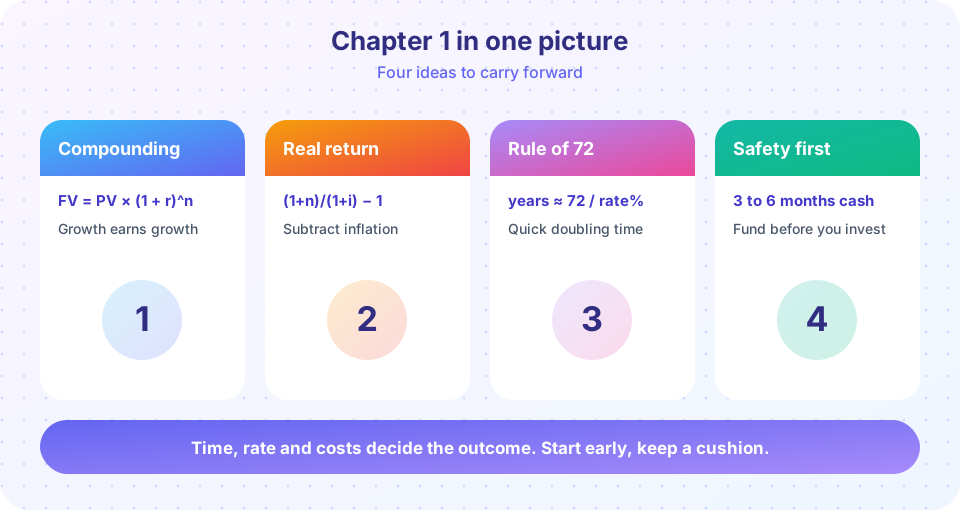
You have finished the foundations. Before moving on to markets and instruments, this review pulls the chapter into one picture, a recap table and a ten-question quiz. Use it to find gaps: if a question surprises you, go back to the lesson named in the table and run its code again.
The chapter in one table
| Idea | Key formula or rule | Lesson |
|---|---|---|
| Inflation erodes buying power | value after n years = amount / (1 + inflation)^n | Why invest at all? |
| Real return | (1 + nominal) / (1 + inflation) - 1 | Why invest at all? |
| Risk premium | Expected extra return for accepting uncertainty; never guaranteed | Why invest at all? |
| Compound growth | FV = PV × (1 + r)^n | Compound growth |
| Rule of 72 | years to double ≈ 72 / rate in percent | Compound growth |
| Early start | The first contributions compound the longest | Compound growth |
| Goal payment | payment = FV × r / ((1 + r)^n - 1) | Goals and accounts |
| Order of priorities | Emergency fund, expensive debt, match, tax-advantaged, taxable | Goals and accounts |
| Time horizon | Shorter horizon means less price risk should be taken | Goals and accounts |
What to remember
Three sentences hold the whole chapter. Idle money loses purchasing power, so the right measure of success is real return, not the number on a statement. Growth compounds, so time and an early start are worth more than clever timing. Every goal has an amount and a date, and its date decides how much risk the money can carry.
Watch for these traps. Comparing nominal returns with zero instead of inflation. Treating a steady 7% as a forecast rather than an illustration. Investing money you will need within two years. Skipping an emergency fund because investing feels more productive.
A worked mini-case
Maya wants $30,000 for a house deposit in six years, and she assumes her savings earn 4% a year. The payment formula gives about $369 a month. But her target is in today's money, and prices will rise. With 3% inflation, the same buying power costs 30,000 × 1.03^6, about $35,822 in six years, which needs about $441 a month. Notice what happened: the inflation lesson changed the target, the compounding lesson gave the formula, and the goals lesson told her that a six-year horizon calls for a cautious mix rather than all stocks. Real planning always uses all three ideas together.
Try it
A mixed practice calculator. Change the inputs and check each result against the formulas in the table.
Press Run (or Ctrl + Enter) to see the result here.
Program input · what you'd type while the program runs
Type the answers before you press Run, one per line. Each time the program reads a line (with input()), it gets the next line from this box.
The second block is a sort of self-test: before you run it, guess which of the three plans ends with the most real buying power.
Press Run (or Ctrl + Enter) to see the result here.
Program input · what you'd type while the program runs
Type the answers before you press Run, one per line. Each time the program reads a line (with input()), it gets the next line from this box.
Check your understanding
Quick check · 10 questions
of 10 answered You scored / 10 · perfect!
-
1. Inflation is 4% and your account pays 4%. What is your real return?
(1.04 / 1.04) - 1 = 0. Your balance grows but your buying power stays flat. -
2. Using the rule of 72, how long does money take to double at 6%?
72 / 6 = 12 years. -
3. 10,000 grows at 5% a year for 10 years. Which expression gives the final value?
Compound growth multiplies by 1.05 each year, ten times. -
4. Why does an early start beat a later start with larger total contributions?
The rate is the same, but each early payment grows for many more years. -
5. What best describes a risk premium?
It is an expected average, not a promise. -
6. A 20% credit card debt is outstanding. Which statement is generally right?
Each dollar repaid stops 20% interest, which is a nearly certain benefit. -
7. Which money is the best fit for a cash account?
Short horizons leave no time to recover from a price fall. -
8. You gain 50% one year and lose 50% the next. Compared with your start, you are:
100 becomes 150, then 75. -
9. How large is a typical emergency fund target in this course?
That range covers common surprises such as a temporary loss of income. -
10. Which is correct about risk tolerance and risk capacity?
A plan you cannot stomach or cannot afford will probably fail.
Summary
- Judge returns after inflation; the exact formula divides growth factors.
- Compounding rewards time: FV = PV × (1 + r)^n and the rule of 72.
- Goals need amounts and dates; horizon sets the risk that fits.
- Build an emergency fund and clear expensive debt before taking market risk.
Track your progress
Create a free account to tick off lessons and pick up where you left off on any device.
of Investing and Markets lessons completed