


















Lesson 31 of 46 · Bonds and Fixed Income
Chapter 6 Review: Bonds and Fixed Income
Review bond pricing, yield to maturity, duration, convexity, the yield curve and credit risk with a one-picture summary, formula table and ten-question quiz.
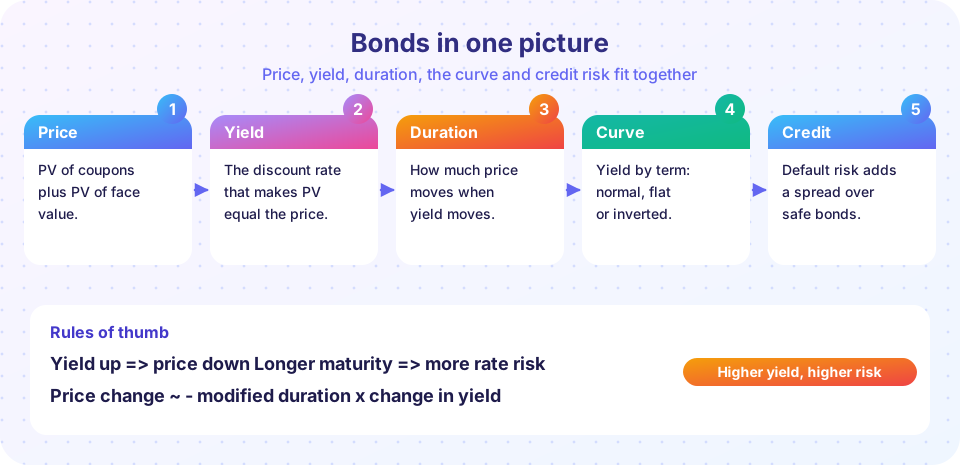
A bond is a schedule of promised payments, and everything in this chapter follows from that fact. Price is the present value of the schedule. Yield is the discount rate that matches a price. Duration measures how far the price moves when the yield moves. The yield curve and credit spreads explain why yields differ across maturities and borrowers. This review collects the ideas, lets you check your arithmetic, and tests the chapter with ten mixed questions.
What you will learn
- How the chapter's five ideas connect.
- Which formulas to remember and when each applies.
- Common mistakes in bond arithmetic and how to avoid them.
- How well you can apply the chapter to mixed problems.
Recap table
| Idea | Formula or rule | Typical mistake |
|---|---|---|
| Bond price | sum of C/(1+y)^t plus F/(1+y)^n |
Forgetting the face value in the last period |
| Zero-coupon price | F / (1+y)^n |
Using coupon logic for a bond with no coupons |
| Premium, par, discount | coupon above, equal to, below yield | Reversing the direction |
| Yield to maturity | solve price equation for y |
Confusing it with current yield |
| Current yield | annual coupon / price | Using it as total return |
| Modified duration | Macaulay / (1+y) |
Treating it as years to maturity |
| Price change | - D_mod x dy (+ convexity term) |
Using it for large moves without convexity |
| Forward rate | (1+s_n)^n / (1+s_(n-1))^(n-1) - 1 |
Reading it as a forecast |
| Expected credit loss | probability of default x (1 - recovery) | Treating the whole spread as loss compensation |
Rules of thumb that hold up
- If yields go up, prices go down, and longer maturities fall further.
- A bond with yield equal to coupon sells at par; above coupon means a discount.
- Duration is shorter than maturity for coupon bonds and equal to maturity for zero-coupon bonds.
- Duration is a straight-line guide; convexity corrects it for larger moves and is good for the holder.
- Extra yield almost always means extra risk of some kind: longer maturity, weaker credit, less liquidity or an embedded option.
A worked example from end to end
Consider a 5-year bond with face value 1,000 and a 3 percent annual coupon, selling for 920. Start with the plain facts. The coupon is 30 a year, so the current yield is 30 / 920, or 3.26 percent. The bond sells at a discount, so you know that its yield to maturity must exceed the coupon rate, and that the price will rise towards 1,000 as time passes if market yields do not change. Solving the price equation gives a yield to maturity of about 4.84 percent: the 80 gain at maturity is spread over five years and added to the coupons.
Next, ask about risk. The modified duration is about 4.5, so a rise in yields of one percentage point would lower the price by roughly 4.5 percent, about 41 per bond; convexity would soften that slightly. If the issuer is a company rather than a government, the yield includes a credit spread, and you can compare it with the expected loss: with a 1 percent annual default probability and 40 percent recovery, expected loss is 0.6 percent a year, so much of the spread is compensation for risk and illiquidity rather than for losses you expect.
Finally, place the bond on the yield curve. If five-year government bonds yield 3.5 percent, the credit spread is about 1.3 percentage points. A steeper curve or wider spreads would lower the price; a flatter curve or narrower spreads would raise it. In a few lines you have used price, yield, duration, the curve and credit risk, which is the whole chapter. The skill to practice is moving between these views quickly and checking that they tell a consistent story.
Try it
The function below prices a bond, reports its duration and convexity, and estimates the effect of a yield jump, in one go. Try a zero-coupon bond by setting the coupon rate to 0.
Press Run (or Ctrl + Enter) to see the result here.
Program input · what you'd type while the program runs
Type the answers before you press Run, one per line. Each time the program reads a line (with input()), it gets the next line from this box.
Check your understanding
Quick check · 10 questions
of 10 answered You scored / 10 · perfect!
-
1. A 2-year bond with face value 1,000 and a 10% annual coupon is priced with a yield of 10%. Its price is
When the yield equals the coupon rate, the price equals face value. -
2. A zero-coupon bond with face value 1,000 matures in 3 years. At a yield of 6% its price is closest to
1,000 / 1.06^3 = 1,000 / 1.191 = 839.6, so about 840. -
3. A bond with a 3% coupon sells at 920 and matures in 5 years. Its current yield is about
Annual coupon 30 divided by price 920 is 3.26%, about 3.3%. -
4. A bond has modified duration 5 and yields rise by 1 percentage point. The estimated price change is
Change = -5 x 0.01 = -5%. -
5. Which bond has the largest interest-rate risk?
Long maturity and a low coupon both increase duration, so the 30-year 2% bond is most sensitive. -
6. What does convexity do to the duration estimate?
The curve lies above the tangent line, so the convexity term adds a positive amount whichever direction yields move. -
7. The 1-year spot rate is 2% and the 2-year spot rate is 3%. The implied forward rate for year 2 is closest to
1.03^2 / 1.02 - 1 = 1.0609 / 1.02 - 1 = 4.01%. -
8. A bond has a 4% annual default probability and a 25% recovery rate. Its expected annual loss is
LGD = 75%, and 0.04 x 0.75 = 3%. -
9. Which description of BBB- is correct on the S&P scale?
BBB- is the lowest rating still classed as investment grade. -
10. A bond bought at a discount, with constant market yields, will
Pull to par: the price moves to face value on the maturity date.
Summary
- Bond price is the present value of promised cash flows at the market yield; YTM is the yield that matches the price.
- Duration and convexity quantify interest-rate risk; longer maturity and lower coupons raise duration.
- The yield curve shows yield by maturity; forward rates are implied by spot rates.
- Credit spreads reward expected default losses plus other risks.
Track your progress
Create a free account to tick off lessons and pick up where you left off on any device.
of Investing and Markets lessons completed