


















Lesson 28 of 46 · Bonds and Fixed Income
Bond Pricing and Yield to Maturity
Price a bond as the present value of its coupons and face value, solve for yield to maturity, and see why prices and yields move in opposite directions.
If you know a bond's promised payments, pricing it is a calculation, not a guess. The price is the present value of every coupon and of the face value, discounted at the yield the market currently demands. Turn the problem around and you can start from a price and ask what yield it implies. Those two directions, price from yield and yield from price, are the heart of bond arithmetic.
This lesson works through both, explains why the relationship is inverse, and shows what happens to a bond's price as time passes.
What you will learn
- How to compute a bond's price from its coupon, face value, maturity and yield.
- How to find yield to maturity and why it needs trial and error.
- Why a bond sells at a premium, at par or at a discount.
- How prices drift toward par as maturity approaches.
Key terms
Price: the present value of the bond's remaining cash flows at the market yield.
Yield to maturity (YTM): the discount rate that makes the present value of all cash flows equal the price.
Current yield: annual coupon divided by price.
Premium / discount: a price above or below face value.
Pull to par: the tendency of a bond's price to move toward face value as maturity nears.
Price from yield
Let C be the coupon paid each period, F the face value, y the yield per period and n the number of periods. The price is
P = C/(1+y) + C/(1+y)^2 + ... + C/(1+y)^n + F/(1+y)^n
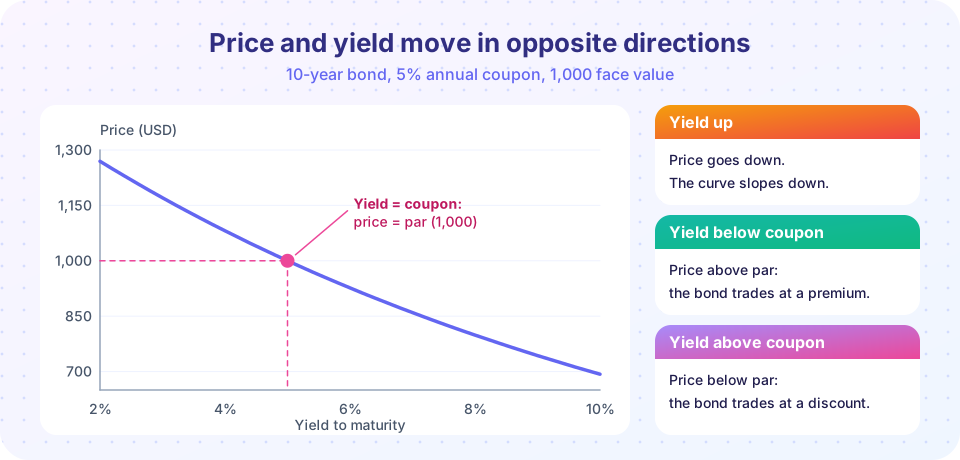
Take a 10-year bond with face value 1,000 and a 5 percent annual coupon (so C = 50). At a market yield of 6 percent, each coupon is divided by 1.06, 1.06 squared, and so on, and the 1,000 is divided by 1.06 to the tenth. The sum is 926.40. At 4 percent it is 1,081.11, and at 8 percent it is 798.70. At exactly 5 percent it is 1,000.00, the par price.
Real bonds usually pay coupons twice a year. To handle that, halve the coupon and the annual yield and double the number of periods: a 5-year bond with a 5 percent coupon and a 6 percent yield becomes 10 periods of 25 each, discounted at 3 percent per period. Quoted yields in the US corporate and Treasury markets follow this convention.
A zero-coupon bond is the simplest case: P = F / (1+y)^n. A 5-year zero at a 4 percent yield costs 1,000 / 1.04^5 = 821.93.
Yield from price
Often you observe the price and need the yield. Suppose the 5-year, 5 percent bond trades at 950. What yield does that imply? There is no algebraic solution for y once n is more than a few periods, because y appears in a polynomial of high degree. So you search: try a yield, compute the price, and adjust. Because price falls steadily as yield rises, this search is easy. If your trial yield gives too high a price, raise it; if too low a price, lower it. The code in the first example does this by bisection, halving the search range each step. The answer is a yield to maturity of about 6.19 percent.
Compare that with the current yield, which is just the annual coupon over the price: 50 / 950 = 5.26 percent. Current yield ignores the fact that you will also gain 50 when the bond is repaid at 1,000, so it understates the return on a discount bond. YTM includes both the coupons and the gain (or loss) at maturity.
YTM carries two assumptions worth remembering. It assumes you hold to maturity, and it assumes every coupon can be reinvested at the same yield. If rates change, your actual return will differ. This is why yield to maturity is a promise-based measure, not a forecast.
Premium, par and discount
Compare the coupon with the market yield.
- Yield equals coupon: the bond sells at par (1,000).
- Yield below coupon: the bond pays more than the market requires, so investors bid up the price: it sells at a premium.
- Yield above coupon: the bond pays less than the market requires, so the price falls: it sells at a discount.
This is the logic behind the opposite movement of price and yield. The bond's cash flows are fixed; only the rate used to discount them changes. A higher rate shrinks every present value.
The shape of the curve
Look at the price-yield curve in the picture. It slopes down, but it is not a straight line: it is steeper at low yields and flatter at high ones. A fall of one percentage point raises the price by more than a rise of one point lowers it. This bend is called convexity, and it works in the bondholder's favor. The next lesson measures it.
Pull to par
On the day a bond matures, its price is exactly the face value, because only the repayment is left. A bond bought at a discount must therefore rise toward 1,000 over time, and one bought at a premium must fall. If yields stay constant, the price follows a smooth path to par. This is not a free lunch: the premium bond's higher coupons compensate you for the price you lose along the way, and the discount bond's lower coupons are made up by the price gain.
Clean price and accrued interest
Between coupon dates a bond accrues interest that the seller has earned but not yet been paid. By market convention, quoted prices are clean prices that exclude accrued interest, and the buyer pays the dirty price: clean price plus accrued interest. Our examples assume you buy right after a coupon payment, so the two are the same.
Common misconceptions
"A high coupon means a high return." A bond with a high coupon often costs more than par; your return depends on coupon and price together.
"YTM is what I will earn for sure." It holds only if you hold to maturity, the issuer pays, and you reinvest coupons at the same rate.
"Prices fall in a straight line when yields rise." The relationship is curved, so the same change in yield moves the price by different amounts at different yield levels.
Try it
First, a pricing function and a bisection solver for yield to maturity. It also compares annual and semiannual coupons.
Press Run (or Ctrl + Enter) to see the result here.
Program input · what you'd type while the program runs
Type the answers before you press Run, one per line. Each time the program reads a line (with input()), it gets the next line from this box.
Second, the price-yield curve itself, with the premium and discount regions shaded.
Press Run (or Ctrl + Enter) to see the result here.
Program input · what you'd type while the program runs
Type the answers before you press Run, one per line. Each time the program reads a line (with input()), it gets the next line from this box.
Third, pull to par: the price of a premium bond and a discount bond over time, with the yield held constant.
Press Run (or Ctrl + Enter) to see the result here.
Program input · what you'd type while the program runs
Type the answers before you press Run, one per line. Each time the program reads a line (with input()), it gets the next line from this box.
Check your understanding
Quick check · 5 questions
of 5 answered You scored / 5 · perfect!
-
1. A 3-year bond has face value 1,000 and a 6% annual coupon, and the market yield is 6%. What is its price?
When the yield equals the coupon rate, the bond sells at par. -
2. A bond with a 4% coupon trades when new comparable bonds yield 5%. It will sell at
Its coupon is below the market yield, so investors pay less than face value. -
3. A zero-coupon bond has face value 1,000, matures in 4 years and has a 5% yield. Which price is closest?
1,000 / 1.05^4 = 1,000 / 1.2155 = 822.7. -
4. Why is current yield an incomplete measure for a discount bond?
Current yield is coupon divided by price; it leaves out the capital gain as the bond is repaid at par. -
5. If market yields stay constant, what happens to the price of a bond trading at a premium as it approaches maturity?
At maturity only the face value is paid, so a premium must decline to par.
Summary
- Bond price = present value of coupons plus face value, discounted at the market yield.
- YTM is the discount rate that equates that present value to the price; it is found by search.
- Yield above coupon means a discount, yield below coupon means a premium, and equal means par.
- The price-yield curve slopes down and bends (convexity); prices pull to par over time.
Next: Duration and convexity
Track your progress
Create a free account to tick off lessons and pick up where you left off on any device.
of Investing and Markets lessons completed