


















Lesson 34 of 46 · Derivatives Basics
Option Pricing: Parity, Binomial Trees and Black-Scholes
Price options by no-arbitrage reasoning: put-call parity, the binomial tree, the Black-Scholes formula and the Greeks, with runnable Python examples.
How much should an option cost? You might guess that the answer needs a forecast of the stock's direction. Remarkably, it does not. The central insight of option pricing, developed by Fischer Black, Myron Scholes and Robert Merton in the early 1970s and building on earlier work, is that an option can be replicated by trading the stock and borrowing, so its price must equal the cost of that replicating strategy. If it did not, a trader could earn a risk-free profit, which would push the price back. Direction matters less than volatility: how much the stock tends to move.
This lesson derives the idea in the simplest setting, a tree with two possible moves, and then shows the famous formula that emerges when time is cut into very small steps.
What you will learn
- What put-call parity says and why it must hold.
- How to price an option with a one-step and a multi-step binomial tree.
- What the Black-Scholes formula needs and what its inputs mean.
- What the Greeks measure and how implied volatility is used.
Key terms
No-arbitrage: the principle that two things with identical payoffs must have the same price.
Replicating portfolio: a combination of the stock and borrowing that copies an option's payoff.
Risk-neutral probability: the artificial probability that makes the discounted expected payoff equal the price.
Volatility (sigma): the annualized standard deviation of the stock's returns.
Greeks: sensitivities of an option's price to its inputs: delta, gamma, vega, theta, rho.
Put-call parity
Take a European call and a European put on the same stock with the same strike K and expiration T, and suppose the stock pays no dividends. Compare two portfolios: (A) one call plus an amount of cash equal to the present value of K, and (B) one put plus one share. At expiration, if the stock S_T ends above K, A is worth S_T - K + K = S_T and B is worth 0 + S_T. If it ends below K, A is worth 0 + K = K and B is worth K - S_T + S_T = K. The two portfolios always have the same payoff, so they must cost the same today:
C + K / (1 + r)^T = P + S, or equivalently C - P = S - K / (1 + r)^T
(with continuous compounding, replace the discount factor by e^(-rT)). This is put-call parity. If you know the price of a call, you can find the put. If the relationship were violated, you could buy the cheap side, sell the expensive side and lock in a profit with no risk, which is why it holds so well in practice.
The binomial model
Imagine a stock at 100 that, after one period, will be either 120 (up) or 80 (down). The interest rate for the period is 5 percent. What is a call with strike 100 worth?
At the end, the call pays 20 if the stock is up and 0 if down. Now build a portfolio of Δ shares and a loan that copies this. To match 20 and 0 with Δ shares: 120 Δ - L(1.05) = 20 and 80 Δ - L(1.05) = 0. Subtracting gives 40 Δ = 20, so Δ = 0.5, and the loan repayment is 40, meaning you borrow 40 / 1.05 = 38.10 today. The portfolio costs 0.5 x 100 - 38.10 = 11.90. That must be the call's price.
Notice what we did not need: the probability that the stock goes up. The same answer comes from a shortcut. Define the risk-neutral probability p = ((1 + r) - d) / (u - d), where u = 1.2 and d = 0.8 are the up and down factors. Here p = (1.05 - 0.8) / 0.4 = 0.625. The option value is the discounted expected payoff using p: (0.625 x 20 + 0.375 x 0) / 1.05 = 11.90. The name is slightly misleading: p is not a forecast. It is a device that makes the replication arithmetic easy, and it is the same whatever any investor's risk attitude.
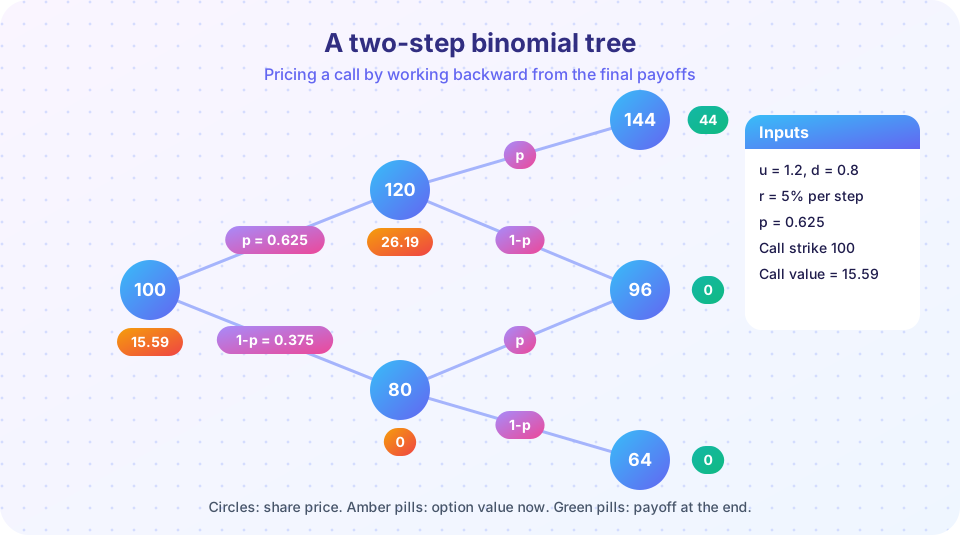
For more periods, repeat backward. In the picture's two-step tree, the stock can reach 144, 96 or 64, and the call pays 44, 0 and 0. At the up node (stock 120), the call is worth 0.625 x 44 / 1.05 = 26.19. At the down node it is worth 0. At the start it is 0.625 x 26.19 / 1.05 = 15.59. Using many small steps, with u = e^(sigma sqrt(dt)) and d = 1/u, the tree approximates a stock that moves continuously, and its option values converge to the Black-Scholes price. The first example below does exactly this.
The Black-Scholes formula
Under the model's assumptions (a stock following a geometric Brownian motion with constant volatility, constant interest rate, no dividends, continuous trading with no costs), a European call is worth
C = S N(d1) - K e^(-rT) N(d2)
with
d1 = [ln(S / K) + (r + sigma^2 / 2) T] / (sigma sqrt(T)) and d2 = d1 - sigma sqrt(T)
where N is the standard normal cumulative distribution function. The put follows from parity: P = K e^(-rT) N(-d2) - S N(-d1).
Take S = 100, K = 100, r = 5%, sigma = 20% and T = 1 year. Then d1 = 0.35, d2 = 0.15, and the call is worth about 10.45 and the put about 5.57. Check parity: 10.45 - 5.57 = 4.88 = 100 - 100 e^(-0.05).
The five inputs and their effect on a call:
- Higher stock price raises the call's value.
- Higher strike lowers it.
- More time to expiry raises it (more chance to move).
- Higher volatility raises it, for calls and puts alike, because the holder keeps upside while the downside is capped at the premium.
- Higher interest rates raise a call's value slightly, since paying the strike later is worth more.
Volatility is the one input you cannot observe. You can estimate it from past returns (historical volatility) or turn the model around: given a market price for the option, solve for the volatility that produces it. That is the implied volatility, and traders quote option prices in those terms. Implied volatilities for options on the same stock vary by strike and expiry, which shows that the constant-volatility assumption is only an approximation.
The Greeks
Because the formula is smooth, you can ask how the price changes when one input moves.
- Delta: change in option price per 1 change in the stock price. For a call it lies between 0 and 1; in our example it is
N(d1), about 0.64. Delta is also the hedge ratio: the number of shares that offsets one option. - Gamma: how fast delta changes as the stock moves. It is highest for at-the-money options near expiry.
- Vega: change in price per 1 point of volatility. Long options have positive vega.
- Theta: change in price as time passes. Long options lose value daily, all else equal.
- Rho: change in price per change in the interest rate.
Market makers use the Greeks to manage books of options, adjusting their stock holdings to stay close to delta-neutral.
Limits of the model
Real markets have jumps, changing volatility, dividends and trading costs. Black-Scholes is still the common language, though: traders use it to translate between prices and implied volatility, and richer models are usually judged by how they differ from it. American options, which can be exercised early, are often priced with binomial trees, because the tree can test early exercise at every node.
Common misconceptions
"An option's price depends on where I think the stock is going." The no-arbitrage price depends on volatility, time and rates, not on a view of direction.
"Risk-neutral probabilities are the real probabilities." They are a pricing tool; the true probability of the stock rising is different and is not needed.
"Higher volatility is bad for option buyers." The reverse: more volatility raises the value of both calls and puts.
Try it
First, a binomial pricer with any number of steps, compared with the Black-Scholes price. Increase steps and watch the difference shrink.
Press Run (or Ctrl + Enter) to see the result here.
Program input · what you'd type while the program runs
Type the answers before you press Run, one per line. Each time the program reads a line (with input()), it gets the next line from this box.
Second, a Black-Scholes calculator that also prints parity and the main Greeks. Change sigma and see which numbers respond.
Press Run (or Ctrl + Enter) to see the result here.
Program input · what you'd type while the program runs
Type the answers before you press Run, one per line. Each time the program reads a line (with input()), it gets the next line from this box.
Third, the value of a call as the stock price changes, for different times to expiry, against its intrinsic value.
Press Run (or Ctrl + Enter) to see the result here.
Program input · what you'd type while the program runs
Type the answers before you press Run, one per line. Each time the program reads a line (with input()), it gets the next line from this box.
Check your understanding
Quick check · 5 questions
of 5 answered You scored / 5 · perfect!
-
1. A stock pays no dividends. Which relation is put-call parity (discrete compounding)?
A call plus cash equal to the present value of K has the same payoff as a put plus one share. -
2. In a one-step binomial model, the stock is 50 and goes to 60 or 40, r = 0 and K = 50. What is the risk-neutral probability of an up move and the call value?
p = (1 - 0.8) / (1.2 - 0.8) = 0.5; the call pays 10 or 0, so its value is 0.5 x 10 = 5. -
3. What happens to the Black-Scholes value of a call and of a put when volatility rises?
More volatility raises the chance of a large favorable move while the loss is limited to the premium, for calls and puts alike. -
4. A call has a delta of 0.6. If the stock rises by 1, the call price rises by about
Delta is the change in option price per 1 change in the stock price. -
5. What is implied volatility?
It is found by inverting the pricing formula given an observed option price.
Summary
- Options are priced by replication: a portfolio of the stock and borrowing copies the payoff, so the option costs the same.
- Put-call parity ties calls and puts together:
C - P = S - K / (1 + r)^T. - The binomial tree values options backward using the risk-neutral probability; with many steps it converges to the Black-Scholes formula.
- Volatility is the key input; delta, gamma, vega, theta and rho describe sensitivities.
Track your progress
Create a free account to tick off lessons and pick up where you left off on any device.
of Investing and Markets lessons completed