


















Lesson 4 of 46 · Getting Started
Goals, time horizons and your first accounts
Learn to turn vague wishes into goals with numbers, match money to time horizons, build an emergency fund first, and understand the main types of investment accounts.
Most beginners ask "what should I buy?" The better first question is "what is this money for, and when do I need it?" A house deposit in three years, a child's education in fifteen and retirement in forty are three different jobs, and they call for three different tools. This lesson shows how to define a goal, how to match it to a time horizon, in what order experts usually suggest tackling money tasks, and what kinds of accounts exist. It is general education, not advice for your situation.
What you will learn
- How to turn a wish into a goal with an amount and a date.
- How to calculate the monthly saving a goal needs.
- Why an emergency fund and paying expensive debt usually come first.
- What the main account types do, and what to check in your own country.
Key terms
Time horizon: how long until you need the money.
Emergency fund: cash set aside for surprises such as job loss or repairs.
Risk tolerance: how much ups and downs you can accept emotionally.
Risk capacity: how much loss your finances can absorb without breaking your plans.
Tax-advantaged account: an account with special tax treatment, created by your government to encourage saving.
From wish to goal
"I want to be comfortable" is a wish. "I want $20,000 for a house deposit in five years" is a goal. A good goal has four parts: a purpose, an amount, a deadline and a priority (must-have or nice-to-have). With those four things you can calculate what to do. Without them, you can only hope.
Here is the calculation. Suppose you need $20,000 in five years and you expect your savings to earn 4% a year. How much must you save each month? Rearranging the future value formula for regular payments gives:
payment = FV × r / ((1 + r)^n - 1)
where r is the monthly rate (0.04 / 12) and n is the number of months (60). Plugging in, the payment is about $302 a month. Without any growth you would need 20,000 / 60 = $333. So growth saves you about $31 a month. For a short goal like this, the growth is helpful but small: the big lever is simply saving regularly. For a 30-year goal the roles reverse, and growth does most of the work.
Time horizon decides the tool
The central rule is that money needed soon should not be exposed to big price swings. A share fund can fall 30% in a bad year, and recovery can take several years. If your deposit is due in 12 months, you cannot wait.
| Horizon | Typical role | Reason |
|---|---|---|
| Under 2 years | Cash, short-term deposits, very safe short-term bonds | Protect against any fall |
| 2 to 7 years | A cautious mix, leaning on safer assets | Some growth, limited damage |
| Over 7 years | Growth-oriented assets such as stock funds can fit | Time to ride out downturns |
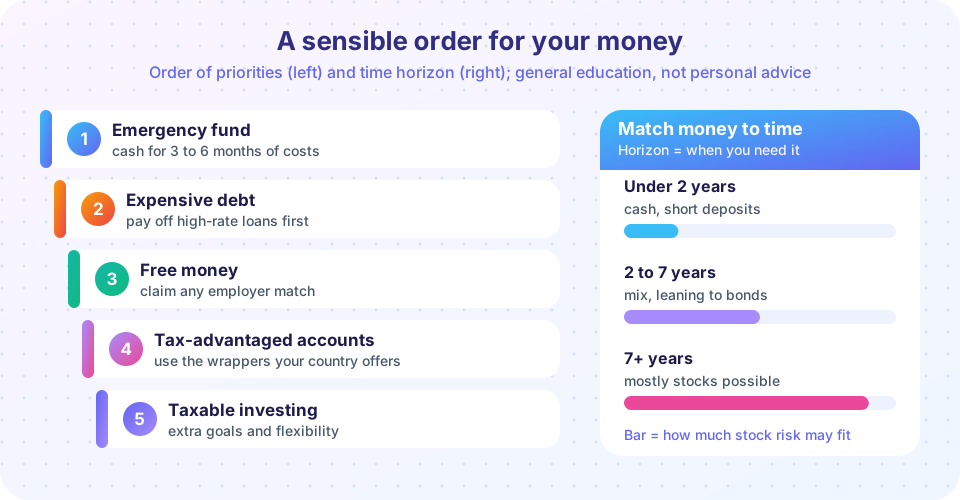
These ranges are rules of thumb, not laws. Nothing says stocks are safe after seven years; it is only that the chance of a loss over long holding periods has historically been lower than over short ones, and that you have time to adapt. As the picture suggests, the bar of "how much stock risk may fit" rises with your horizon.
Many people have several goals at once and keep them in separate "buckets": a cash bucket for the next two years of spending and emergencies, a middle bucket for medium goals, and a growth bucket for the long term. Keeping them separate prevents a stock market fall from forcing you to sell growth assets to pay a bill.
The usual order of priorities
Planners often suggest this sequence. Individual cases differ, so treat it as a checklist to think about, not an order to follow blindly.
- Emergency fund. Keep enough in an easily available cash account to cover about three to six months of essential costs. Closer to six if your income is irregular or you support others. Without it, one surprise forces you to sell investments at a bad time or borrow at a high rate.
- Expensive debt. Paying off a debt that charges 20% is a guaranteed 20% return, better than almost any investment. Credit-card and payday debt usually belong here. A low-rate loan, such as a cheap mortgage, is a different decision.
- Free money. If your employer matches pension or retirement contributions, the match is an instant return on your payment. Missing it is like refusing part of your pay.
- Tax-advantaged accounts. Use the accounts your country provides for retirement and long-term saving.
- Taxable investing. Extra money for other goals goes into an ordinary brokerage account.
The reason for this order is the difference between a certain benefit and an uncertain one. Paying off a 20% loan or claiming a match is nearly certain. Investing in stocks is uncertain. Locking in the sure things first is rational, even though it feels less exciting.
Account types, in general terms
Names and rules vary a great deal by country, so check your own authority's guidance. The categories, however, are widespread.
- Bank savings and deposit accounts. Safe, simple and often insured up to a limit. Interest rates change over time.
- Brokerage accounts. Let you buy stocks, bonds and funds. Profits are usually taxed according to local rules.
- Retirement accounts. Many countries have accounts that give tax benefits in exchange for restrictions on withdrawals. The United States has 401(k) and IRA accounts, the United Kingdom has pensions and ISAs, Canada has RRSPs and TFSAs, Australia has superannuation, and many other countries have equivalents. These names are examples; the details change, so read your government's official guidance.
- Education and child accounts. Special savings plans for school and university exist in several countries.
- Robo-advisors and managed portfolios. Services that automatically hold a diversified mix of funds for a fee. We look at costs in Chapter 8.
When comparing providers, check four things: the fees, whether your money is protected if the firm fails (many countries have an investor-protection scheme), how easy it is to withdraw, and which investments the account allows. Be careful with anyone promising high guaranteed returns; that combination does not exist in honest markets.
Risk tolerance and risk capacity
Two ideas are often confused. Risk tolerance is psychological: how you feel when your portfolio falls 25%. Risk capacity is financial: whether you could afford that fall. A young person with a steady job and a 40-year horizon has high capacity, but may have low tolerance if sleepless nights make them sell at the bottom. A wealthy retiree might have high tolerance but low capacity if the portfolio must fund living costs.
A good plan respects the lower of the two. Chapter 8 discusses how behavior, not mathematics, is often the biggest cause of poor results, and how to design a plan you can stick with.
Common misconceptions
"I should invest first and build savings later." Without an emergency fund, a normal surprise can force you to sell investments at a loss.
"All debt is bad." High-interest debt is almost always worth clearing early; some low-rate debt may reasonably coexist with investing. The comparison is the interest you pay against the return you can reasonably expect, with risk.
"A tax-advantaged account is an investment." It is a wrapper. What you hold inside, such as cash, bonds or a stock fund, is the investment.
Try it
First, a goal calculator. It finds the monthly saving required for a goal and shows the effect of different assumed growth rates.
Press Run (or Ctrl + Enter) to see the result here.
Program input · what you'd type while the program runs
Type the answers before you press Run, one per line. Each time the program reads a line (with input()), it gets the next line from this box.
Second, an emergency-fund planner and bucket sorter. The figures are invented examples; change them to match your own situation.
Press Run (or Ctrl + Enter) to see the result here.
Program input · what you'd type while the program runs
Type the answers before you press Run, one per line. Each time the program reads a line (with input()), it gets the next line from this box.
Check your understanding
Quick check · 4 questions
of 4 answered You scored / 4 · perfect!
-
1. Which is the best example of a goal?
A goal has an amount and a deadline. Those two numbers let you calculate the saving required and choose a suitable tool. -
2. Why is money needed in 12 months usually kept in cash rather than stocks?
Stocks can rise or fall sharply over short periods. A short horizon leaves no time to wait for a recovery. -
3. Paying off a 20% credit card balance is roughly equivalent to what?
Every dollar of debt repaid stops 20% interest, which is a certain return unlike the uncertain return of a market investment. -
4. What is the difference between risk tolerance and risk capacity?
You should respect the lower of the two: a plan you cannot afford or cannot stomach will probably fail.
Summary
- A goal needs a purpose, an amount, a deadline and a priority; then you can calculate the monthly saving.
- The shorter the horizon, the less price risk the money should carry.
- A common order is emergency fund, expensive debt, employer match, tax-advantaged accounts, then taxable investing.
- Account names vary by country; check fees, protection, access and tax rules.
- Risk tolerance (feelings) and risk capacity (finances) both matter; follow the lower one.
Next: Chapter 1 review
Track your progress
Create a free account to tick off lessons and pick up where you left off on any device.
of Investing and Markets lessons completed