


















Lesson 13 of 46 · Risk, Return and Diversification
Types of risk and your tolerance
Learn the main investment risks (market, inflation, interest-rate, credit, currency, liquidity, concentration, sequence), systematic versus diversifiable risk, and risk tolerance.
"Risk" is a single word with many faces. A bond investor worries about rising interest rates, a company owner about one customer leaving, a retiree about a market fall in the first year of withdrawals. Calling all of them "volatility" would hide what can be done about each. This lesson names the main risks, sorts them into the ones you can reduce and the ones you cannot, and ends with how to think about your own tolerance, so that you pick a mix you can live with.
What you will learn
- The main kinds of investment risk and what causes each.
- The difference between systematic and diversifiable risk.
- What sequence-of-returns risk is and why it matters to retirees.
- How to think about risk tolerance without taking a diagnosis from a quiz.
Key terms
Systematic risk (market risk): risk that affects the whole market or economy and cannot be diversified away.
Idiosyncratic risk: risk specific to one company, sector or asset; it can be diversified away.
Credit risk: the chance a borrower fails to pay interest or principal.
Liquidity risk: the chance that you cannot sell quickly without accepting a bad price.
Sequence risk: the danger that bad returns arrive early, when withdrawals have begun.
Risks you cannot diversify away
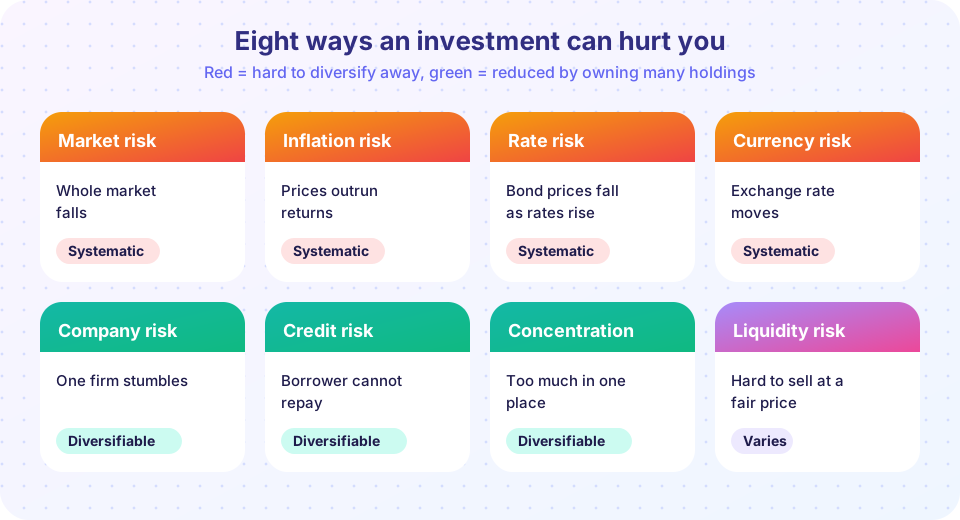
Market risk is the possibility that the whole market falls. Recessions, wars, financial crises and shifts in sentiment push prices down together. Owning 500 stocks does not protect you, because all 500 drop in a crash. Market risk is the price of admission for stock returns, and the premium discussed in Lesson 1 exists because of it.
Inflation risk is the chance that your returns do not keep up with prices. It hits cash and long fixed-rate bonds hardest because their payments are fixed in money terms. Stocks and some real assets have historically had better, though uneven, inflation protection. Some governments issue inflation-linked bonds whose payments rise with a price index.
Interest-rate risk is the effect of rate changes on prices. For bonds it is direct: as Lesson 3 showed, higher yields mean lower prices, and longer bonds fall further. Stocks feel it too, because higher rates raise the return required of every investment and make future profits worth less today.
Currency risk appears when you hold assets in another currency. A foreign share that rises 10% in its local currency may be worth less to you if that currency weakens against yours by 12%. It can be hedged at a cost, or accepted as part of global diversification.
Risks you can reduce
Company risk (also called idiosyncratic or specific risk) is what happens to one business: a failed product, an accounting scandal, a lawsuit, a CEO's departure. It is real and sometimes brutal for a single holder, but a portfolio of many companies largely absorbs it, because bad news at one is offset by good news at another.
Credit risk is the chance that a bond issuer defaults. Corporate and emerging-market bonds carry it, and their extra yield is partly compensation. Spreading across many issuers reduces the damage of any single default.
Concentration risk means having too much in one stock, sector, country, or even one employer. Employees who hold large stakes in their own company face the double danger of losing their job and their savings at the same time.
Liquidity risk is the difficulty of selling. A house, a private business or a thinly traded small-company stock can take time to sell, or only at a big discount. In a panic, even assets that are normally liquid can become hard to sell at a fair price. Liquidity risk varies by asset and by moment, which is why the card says "varies".
Risks that come from the plan
Sequence-of-returns risk concerns people who take money out of their portfolio. Two investors may earn identical average returns, but the one whose bad years come first is hurt much more, because early withdrawals shrink the base that must recover. You can see it in the Python exercise below. It is the main reason retirees often hold a cash buffer for the next few years of spending.
Longevity risk is outliving your money. Behavioral risk is selling in a panic or chasing a hot fund. We treat it fully in Chapter 8, but note it here: the investor's own behavior often does more damage than any market event.
Systematic and idiosyncratic: why the split matters
Split any asset's risk in two. The systematic part moves with the market and cannot be eliminated. The idiosyncratic part is unique to the asset and can be diversified away by holding many assets. The next lesson shows that the idiosyncratic part shrinks quickly as you add holdings while the systematic part remains. Since the market is competitive and offers a way to remove idiosyncratic risk at nearly no cost, it does not pay you for bearing it. Hence the rule that anchors portfolio theory: you are rewarded only for systematic risk. Concentrated bets can pay off, but on average their extra risk is unrewarded.
Risk tolerance and how to think about it
Risk tolerance is how much volatility you can accept without abandoning your plan. Questionnaires used by advisors ask how you would react to a 20% fall, how long you can wait, and how much of your savings you could afford to lose. They give a rough guide, but they are imperfect: people answer calmly in good times and behave differently in a crash. A better approach has four parts.
- Know your capacity. What fall in value could your finances absorb without changing your life? Your income stability, savings buffer and time horizon decide this.
- Imagine the fall concretely. On a $50,000 portfolio, a 30% fall is $15,000. Picture it. Would you stay invested?
- Check your past behavior. What did you do in earlier downturns, even small ones?
- Choose the mix that you could hold through the worst you can imagine. A plan you follow beats a theoretically better plan you abandon.
Nothing here is a diagnosis or a recommendation for you personally; it is a framework for thinking. A licensed adviser can look at your whole situation.
Common misconceptions
"If I diversify, I have no risk." Diversification removes idiosyncratic risk only; market, inflation and rate risks remain.
"Risk tolerance is a personality trait that never changes." It depends on circumstances, wealth, age and recent experience, and tends to be overestimated after long bull markets.
"My employer's stock is safe because I know the company." It concentrates job and savings risks in one place.
Try it
The first block is a simple demonstration of sequence risk. The same ten annual returns are applied in two orders to a retiree who withdraws a fixed amount each year. The returns are invented.
Press Run (or Ctrl + Enter) to see the result here.
Program input · what you'd type while the program runs
Type the answers before you press Run, one per line. Each time the program reads a line (with input()), it gets the next line from this box.
The second block is a demonstration of a tolerance questionnaire. It is a teaching toy, not a test: real profiling tools involve a professional's judgement.
Check your understanding
Quick check · 5 questions
of 5 answered You scored / 5 · perfect!
-
1. Which risk can NOT be removed by owning a large number of different stocks?
Market risk affects all stocks at once, so diversification across stocks does not remove it. -
2. Why does an unrewarded risk exist, in the language of this lesson?
Because anyone can diversify it away cheaply, there is no extra expected return for bearing it. -
3. A retiree withdrawing money suffers a big market fall in the first two years. Which risk is this?
Early falls combined with withdrawals shrink the base that must recover. -
4. Bond prices fall when interest rates rise. This is an example of:
Rate changes move bond prices, especially for long bonds. -
5. Which approach to risk tolerance does the lesson favor?
A plan you stick with beats a better one you abandon in a panic.
Summary
- Systematic risks (market, inflation, interest-rate, currency) cannot be diversified away; idiosyncratic ones (company, credit, concentration) can.
- Liquidity risk varies with the asset and the moment.
- Sequence risk matters when you withdraw; keep a buffer and think in terms of order, not just averages.
- Choose a risk level you could hold through a fall, respecting both tolerance and capacity.
Track your progress
Create a free account to tick off lessons and pick up where you left off on any device.
of Investing and Markets lessons completed