


















Lesson 32 of 46 · Derivatives Basics
Chapter 7 Overview: Derivatives Basics
An overview of derivatives: what they are, why people use them to hedge or speculate, the main types, and how leverage and counterparty risk change the picture.
A derivative is a contract whose value depends on something else, called the underlying: a share, a bond, a stock index, a commodity such as oil, an exchange rate or an interest rate. You do not own the underlying when you hold a derivative. You own a set of rights or obligations that move in step with it. That sounds abstract, but the idea is old: farmers have agreed prices for next season's wheat for centuries, and modern exchanges simply standardized the practice.
Educational information only. Derivatives can magnify losses as well as gains, and some can lose more than you invest. Nothing here is advice to trade them, and all prices and companies in this course are invented examples.
What you will learn
- What a derivative is and what an underlying is.
- Why people use derivatives: hedging, speculation and arbitrage.
- The four main families and how they differ.
- Why leverage and counterparty risk need special care.
Key terms
Underlying: the asset, index or rate from which a derivative takes its value.
Hedging: using a derivative to reduce an existing risk.
Speculation: using a derivative to take a risk in the hope of profit.
Leverage: controlling a large exposure with a small amount of money.
Counterparty risk: the chance that the other party to a contract fails to pay.
Why derivatives exist
Three motives explain most use.
Hedging. A company or investor already has a risk and wants to cut it. A bakery that must buy wheat in six months can lock in the price today. An airline can fix the cost of fuel. A pension fund holding a lot of shares can protect against a market fall. The hedger gives up some potential upside to remove uncertainty.
Speculation. Someone with a view on prices can express it cheaply. A derivative can give exposure to a large amount of the underlying for a small outlay, which is both its appeal and its danger.
Arbitrage and price discovery. Because a derivative must stay linked to its underlying, traders who see a gap between the two can profit by trading both, which pushes prices back into line. Prices in derivative markets also reveal what participants expect about the future.
The four families
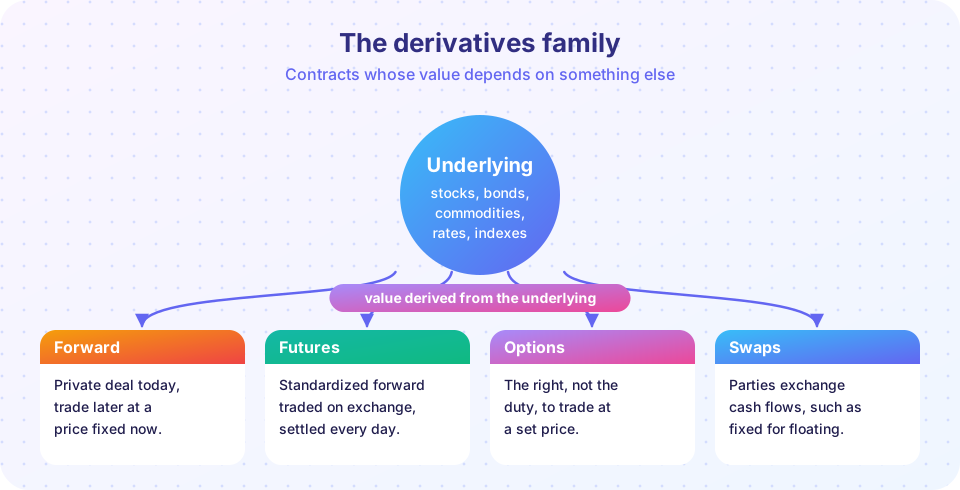
Forwards. A forward is a private agreement to buy or sell an asset at a fixed price on a future date. It is tailored to the parties and traded over the counter, so each side carries the risk that the other will not perform.
Futures. A future is a standardized forward traded on an exchange. A clearing house stands between buyer and seller, and gains and losses are settled in cash every day through margin accounts. The standardization makes futures easy to trade, and daily settlement keeps counterparty risk small.
Options. An option gives its buyer the right but not the obligation to buy (a call) or sell (a put) at a set price. The buyer pays a premium up front, and the maximum loss is that premium. The seller, who takes the obligation, receives the premium and may face large losses.
Swaps. A swap is an agreement to exchange streams of cash flows. The most common is an interest rate swap, in which one party pays a fixed rate and receives a floating rate on an agreed amount, often to convert a variable-rate loan into a fixed one.
Two risks to respect
Leverage. Suppose you control 100 shares priced at 50 each, a 5,000 exposure, through a futures position that requires a 500 deposit. A 10 percent rise in the price earns 500 on a 500 deposit, a 100 percent return. A 10 percent fall loses the entire deposit, and a bigger fall can lose more than you put in. Leverage multiplies both sides.
Counterparty and complexity risk. Over-the-counter contracts depend on the other side paying. Complex structures can hide risk from the people who hold them. Episodes such as the 1995 collapse of Barings Bank, caused by large undisclosed futures and options positions, and the problems with credit default swaps in 2008 are reminders that derivatives need controls.
The path through the chapter
Contracts you will meet
Why use them
Leverage works in both directions.
- Option payoffs and strategies: calls, puts, payoff and profit diagrams, protective puts, covered calls, straddles and spreads, with an interactive payoff explorer.
- Option pricing: put-call parity, the binomial model, the Black-Scholes formula and the Greeks.
- Futures, forwards and hedging: cost of carry, margin, hedge ratios and a hedging simulation.
- Chapter review: a summary picture and a ten-question quiz.
A first experiment
A forward contract has a very simple profit pattern: the buyer gains one-for-one with any rise above the agreed price, and the seller gains one-for-one with any fall. The code below tabulates both sides and shows that one side's gain is the other side's loss.
Press Run (or Ctrl + Enter) to see the result here.
Program input · what you'd type while the program runs
Type the answers before you press Run, one per line. Each time the program reads a line (with input()), it gets the next line from this box.
The second example makes the leverage point concrete with percentages.
Press Run (or Ctrl + Enter) to see the result here.
Program input · what you'd type while the program runs
Type the answers before you press Run, one per line. Each time the program reads a line (with input()), it gets the next line from this box.
Common misconceptions
"Derivatives are just gambling." They are also the main tool companies use to manage risk; whether a position hedges or speculates depends on what the holder already owns.
"Buying an option and selling an option are mirror images in risk." The buyer's loss is capped at the premium; a seller of uncovered options can face very large losses.
"Derivatives create money." Every gain on one side is a loss on the other; in total they transfer risk, not wealth.
Check your understanding
Quick check · 4 questions
of 4 answered You scored / 4 · perfect!
-
1. What is the underlying of a derivative?
A derivative takes its value from an underlying such as a share, commodity or interest rate. -
2. Which contract is standardized, exchange-traded and settled daily?
Futures are standardized and settled each day through margin accounts via a clearing house. -
3. What is the maximum loss of someone who buys an option?
The buyer has a right, not an obligation, so the worst case is losing the premium. -
4. An investor controls a 20,000 exposure with a 2,000 margin deposit. The underlying falls 5%. What is the loss as a percent of the margin?
A 5% fall on 20,000 is 1,000, which is 50% of the 2,000 deposit.
Summary
- A derivative's value comes from an underlying asset, index or rate.
- People use derivatives to hedge, to speculate and to keep prices aligned.
- Forwards, futures, options and swaps are the four main families.
- Leverage multiplies gains and losses; counterparty risk matters for contracts traded over the counter.
Track your progress
Create a free account to tick off lessons and pick up where you left off on any device.
of Investing and Markets lessons completed