


















Lesson 45 of 46 · Projects and Practice
Cheat Sheet: Investing and Markets on One Page
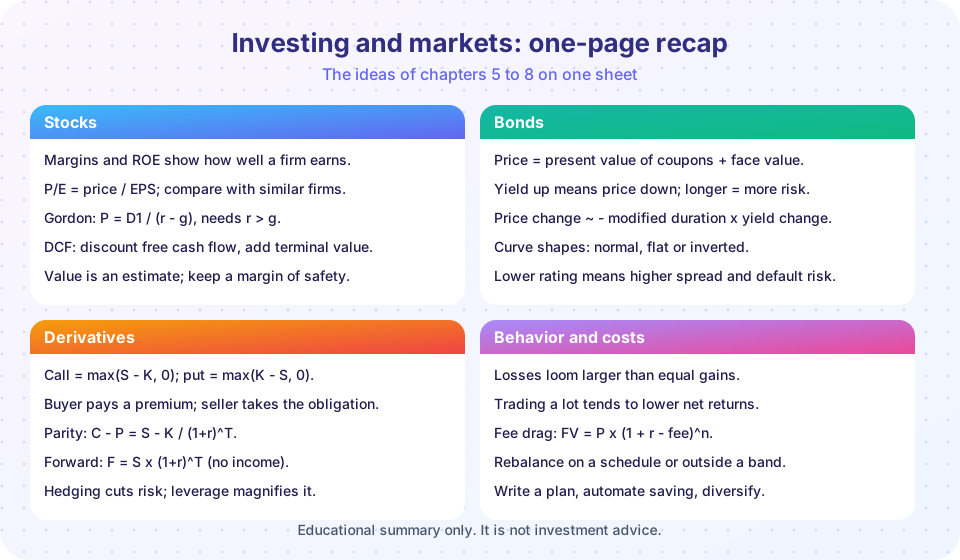
A one-page recap of valuation, bonds, derivatives, behavior and costs, with the key formulas, rules of thumb, a pre-investment checklist and mini calculators.
This page is the course on a single sheet. Keep it next to you when you work through problems or read about an investment. Every line points back to a lesson where the idea is explained in full, so use it as a prompt to remember, not as a replacement for understanding.
Educational summary only. It describes concepts and formulas, not what you should buy or sell.
What you will learn
- The key formulas and rules of the second half of the course in one place.
- A short checklist to run through before any investment decision.
- How to check common calculations quickly with mini calculators.
Key formulas at a glance
| Area | Formula | Lesson |
|---|---|---|
| Margins, ROE | net income / revenue; net income / equity | Statements |
| P/E, earnings yield | price / EPS; EPS / price | Multiples |
| Enterprise value | market cap + debt - cash | Multiples |
| Gordon growth | P = D1 / (r - g) |
DCF |
| DCF | sum of FCF_t / (1+r)^t + discounted terminal value |
DCF |
| Bond price | sum of C/(1+y)^t + F/(1+y)^n |
Bond pricing |
| Price change | - D_mod x dy + 0.5 x C x dy^2 |
Duration |
| Forward rate | (1+s_n)^n / (1+s_(n-1))^(n-1) - 1 |
Yield curve |
| Expected credit loss | probability of default x loss given default | Yield curve |
| Option payoffs | max(S-K, 0); max(K-S, 0) |
Option payoffs |
| Put-call parity | C - P = S - K/(1+r)^T |
Option pricing |
| Forward price | F = S x (1+r)^T or S e^(rT) |
Futures |
| Hedge ratio | rho x sigma_S / sigma_F |
Futures |
| Fee drag | FV = P x (1 + r - fee)^n |
Costs |
| Real return | (1 + nominal)/(1 + inflation) - 1 |
Costs |
| CAGR | (end/start)^(1/years) - 1 |
Backtester |
How to use this sheet
Use the sheet in three ways. When you meet a new investment, scan the checklist at the end and note which questions you cannot answer; those gaps are where the risk hides. When you work a calculation, find the formula in the table and check that you are using the right inputs: next year's dividend rather than this year's, a per-period yield for a semiannual bond, a decimal rather than a percent. And when you read a claim in the news or from a seller, look for the rule of thumb that tests it: does a promised return fit the risk, what are the costs, and what would have to be true for the price to be fair?
The sheet is deliberately short. Each line is a pointer to a lesson in which the reasoning, the assumptions and the exceptions are explained. A formula without its assumptions is dangerous: Gordon growth needs a required return above growth, put-call parity assumes European options without dividends, duration assumes small parallel yield changes, and every backtest assumes the past resembles the future. When in doubt, reread the lesson.
Rules of thumb
- Rule of 72. At a return of
rpercent, money roughly doubles in72 / ryears: 6 percent doubles in about 12 years. - Price and yield move opposite ways; longer maturity and lower coupon mean larger price moves.
- A bond at par has yield equal to coupon; premium means yield below coupon.
- Terminal value dominates a DCF, so stress the discount rate and long-run growth first.
- Before costs, the average active investor earns the market return, and after costs, less.
- Rebalancing manages risk, not returns; choose a simple rule and apply it consistently.
- Losses feel about twice as big as gains, so decide your response to a fall before it happens.
Before-you-invest checklist
- Purpose and horizon. What is the money for and when is it needed?
- Understanding. Can you explain in two sentences how it makes money and how it can lose?
- Cost. What are the total ongoing fees, trading costs and likely taxes?
- Risk. What is the worst fall you could plausibly see, and could you hold through it?
- Diversification. Does it add to or concentrate your existing risks?
- Value or price. If it is a share or bond, what must be true for today's price to be fair?
- Counterparty. If a derivative or a loan is involved, who must pay you and can they?
- Exit. How could you sell, and at what cost?
Try it
First, mini calculators for the four most common quick checks. Everything runs in the page.
Second, the rule of 72 compared with the exact doubling time.
Press Run (or Ctrl + Enter) to see the result here.
Program input · what you'd type while the program runs
Type the answers before you press Run, one per line. Each time the program reads a line (with input()), it gets the next line from this box.
Check your understanding
Quick check · 4 questions
of 4 answered You scored / 4 · perfect!
-
1. Using the rule of 72, about how long does money take to double at 8% a year?
72 / 8 = 9 years. -
2. A bond's yield is below its coupon. It trades at
The coupon is more generous than the market requires, so the price exceeds face value. -
3. Which formula gives the value of a share with next year's dividend D1, required return r and growth g?
The Gordon growth model divides next year's dividend by r minus g. -
4. Which checklist item asks about total ongoing fees and taxes?
Costs and taxes are in item 3 of the checklist.
Summary
- The cheat sheet collects the formulas of valuation, bonds, derivatives and costs, with the lessons that explain them.
- Rules of thumb (rule of 72, price-yield opposition, active-versus-passive arithmetic) are quick checks, not substitutes for analysis.
- A short checklist before any investment covers purpose, understanding, cost, risk, diversification, value, counterparty and exit.
Next: Further study
Track your progress
Create a free account to tick off lessons and pick up where you left off on any device.
of Investing and Markets lessons completed