


















Lesson 26 of 46 · Stocks and Valuation
Chapter 5 Review: Stocks and Valuation
Review the stock valuation chapter with a one-picture summary, a recap table of formulas and a ten-question quiz covering statements, multiples and DCF.
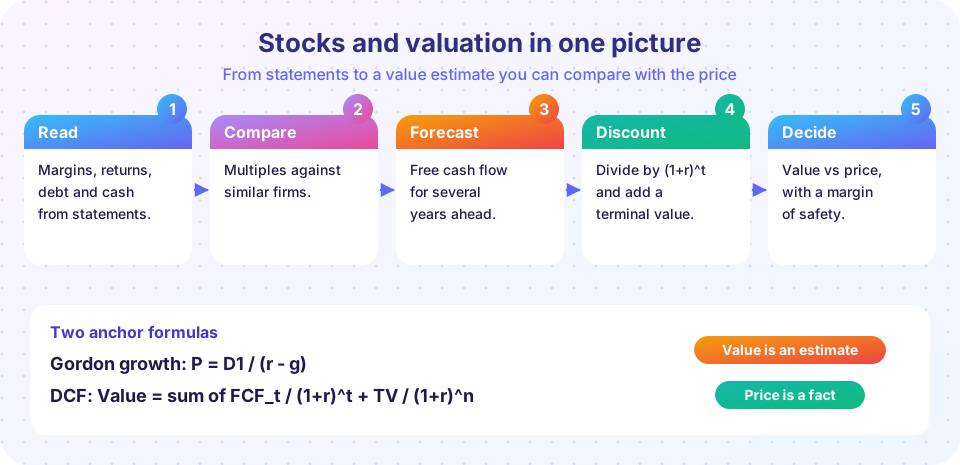
This chapter built a way of thinking about what a share is worth. You started from the statements that describe a business, moved to quick comparisons with peers, and ended with a model that turns future cash flow into a value today. This review pulls the pieces into one picture, lists the formulas you should be able to use from memory, and tests the whole chapter with a longer quiz.
What you will learn
- How the chapter's five steps connect into one workflow.
- Which formulas to remember and what each assumes.
- Where each method is strong and where it breaks.
- How to check your own understanding with mixed questions.
Recap table
| Idea | Formula or rule | Watch out for |
|---|---|---|
| Net margin | net income / revenue | One-off items inflate or deflate it |
| Return on equity | net income / equity | High debt can inflate it |
| Free cash flow | operating cash flow - capex | Can be lumpy from year to year |
| P/E | price / earnings per share | Cycles, negative earnings, growth differences |
| Enterprise value | market cap + debt - cash | Use with EBITDA, not net income |
| Relative value | peer median multiple x company metric | Peers must be truly similar |
| Gordon growth | P = D1 / (r - g) |
Requires r > g; very sensitive when they are close |
| DCF | sum of FCF_t / (1 + r)^t + discounted terminal value |
Terminal value often dominates |
| Equity value | enterprise value - net debt | Remember to divide by shares |
How the methods fit
Think of the methods as a team. Statements tell you what the business has actually done. Multiples tell you how the market treats similar businesses today, which keeps you honest about prevailing prices. DCF tells you what your own expectations about the future imply. When the three agree, your confidence should rise. When they disagree, find the reason: the market may expect faster growth than you do, the peers may not be truly comparable, or your forecast may be too cautious.
Whatever the result, the finish line is the same. You compare an estimate of value with a price, and you act only when the gap is wide enough to survive errors in your assumptions. That gap is the margin of safety. It is the practical answer to the chapter's central fact: price is observed, value is estimated.
Putting the three views together
Return to Brightwater Coffee Roasters. Its statements show a business with a 15 percent operating margin, a 22.8 percent return on equity, comfortable interest coverage and positive free cash flow of 64. Its price-to-earnings ratio of 15.8 sits below the peer median of 18.5, and applying the median to its earnings suggests a price near 21. Yet the base-case DCF, with 8 percent growth for five years, a 10 percent discount rate and 3 percent terminal growth, gives only about 9.22 per share, and a reverse DCF says the market price of 18.00 requires growth of roughly 22 percent a year for five years.
What should an analyst conclude? Not that one method is right. The multiples view says the stock is cheap compared with similar companies, which may only mean that its peers are expensive. The DCF says the market is paying for more growth than the base case allows. A careful analyst asks which of these assumptions is weakest. Is 8 percent growth too cautious for a brand that has grown revenue by 10 percent a year? Is a 10 percent discount rate too high for a stable consumer business? Is the peer group right? Changing the discount rate to 8 percent and terminal growth to 3 percent, for example, raises the value per share to about 14 (the heat map in the DCF lesson shows the whole grid), while the multiples comparison is only as good as the choice of peers.
This kind of reasoning is the real output of valuation: a short list of the assumptions that matter most, and a view about which are reasonable. The number at the end is useful mainly because it forces you to say these things out loud. If you wrote down that you would buy only with a 30 percent margin of safety against your own base case, you have a rule that protects you from your own enthusiasm as well as from the market's.
Try it
This small dashboard collects the chapter's calculations in one function. Feed it numbers for an invented company and read the output as a checklist rather than a verdict.
Press Run (or Ctrl + Enter) to see the result here.
Program input · what you'd type while the program runs
Type the answers before you press Run, one per line. Each time the program reads a line (with input()), it gets the next line from this box.
Try changing g to 0.09 and watch the Gordon value explode, then to 0.10 and watch the model refuse to run. The lesson: when r - g shrinks towards zero, tiny changes in inputs create huge swings in value.
Check your understanding
Quick check · 10 questions
of 10 answered You scored / 10 · perfect!
-
1. A company reports revenue 500, cost of goods sold 300 and operating costs 120. What is the operating margin?
Operating income = 500 - 300 - 120 = 80, and 80 / 500 = 16%. -
2. Which statement shows where a company's cash came from and went?
The cash flow statement reconciles profit to actual cash movements in operating, investing and financing activities. -
3. A stock trades at 60 with earnings per share of 4. What is the earnings yield?
Earnings yield = EPS / price = 4 / 60 = 6.7%, the inverse of the P/E of 15. -
4. Which multiple is the least affected by how a company is financed?
Enterprise value includes debt and subtracts cash, and EBITDA is measured before interest. -
5. Peers trade at a median P/E of 20. A company with EPS of 2.50 trades at 40. What does relative valuation suggest, and what is the right next step?
20 x 2.50 = 50, but a discount may reflect slower growth or higher risk, so check before concluding anything. -
6. Using the Gordon model, a stock's next dividend is 3.00, r = 10% and g = 4%. What is its value?
3.00 / (0.10 - 0.04) = 50.00. -
7. In a DCF, what is usually true of the terminal value?
One number for all later years usually dominates, so long-run growth and the discount rate need the most scrutiny. -
8. A DCF gives an enterprise value of 800. Debt is 300 and cash is 100. There are 50 shares. What is the value per share?
Net debt = 300 - 100 = 200, equity value = 800 - 200 = 600, and 600 / 50 = 12. -
9. What does a margin of safety do?
Buying below your estimate protects you from forecasts that are too optimistic, though it cannot guarantee a profit. -
10. A company reports rising profits for four years while operating cash flow is flat. What does that pattern most justify?
A widening gap between profit and cash is a classic warning sign that deserves investigation.
Summary
- Valuation compares an estimate of value with the market price.
- Statements supply the facts, multiples supply market context, and DCF supplies the logic of future cash.
- EV minus net debt gives equity value; divide by shares for value per share.
- Test assumptions with sensitivity tables and reverse DCF, and keep a margin of safety.
Track your progress
Create a free account to tick off lessons and pick up where you left off on any device.
of Investing and Markets lessons completed