


















Lesson 36 of 46 · Derivatives Basics
Chapter 7 Review: Derivatives Basics
Review forwards, futures, options, swaps, put-call parity, binomial pricing and hedging with a summary picture, formula table and a ten-question quiz.
Derivatives look intimidating, but the ideas in this chapter fit on one page. Forwards, futures and swaps are obligations whose terms are fixed by no-arbitrage reasoning. Options are rights whose payoffs have a hockey-stick shape and whose prices come from replication. Hedging uses them to remove a risk you already have; speculation uses them to take a new one, usually with leverage. This review collects the formulas and tests the whole chapter.
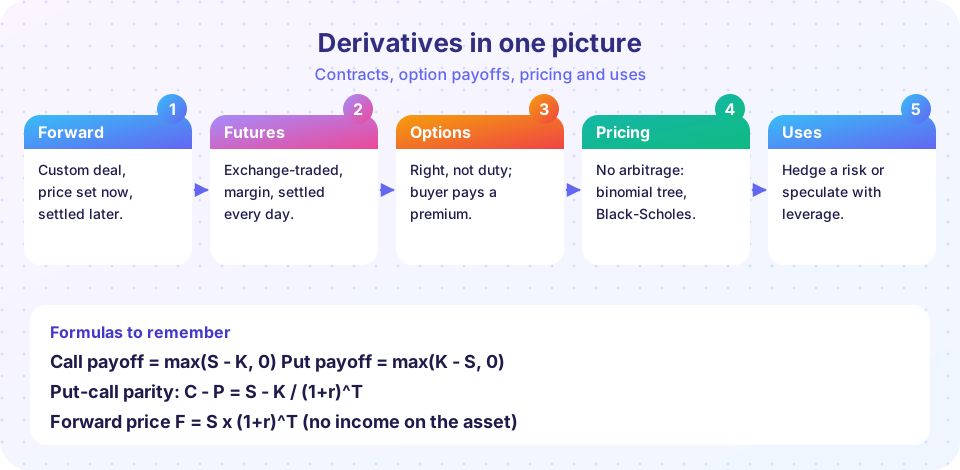
What you will learn
- How the four contract families differ and when each is used.
- The payoff formulas and the pricing relationships to remember.
- How hedging differs from speculation in risk and purpose.
- How well you can apply the chapter to mixed problems.
Recap table
| Idea | Formula or rule | Remember |
|---|---|---|
| Forward price | F = S x (1+r)^T (no income) |
Not a forecast; fixed by arbitrage |
| With dividend yield | F = S e^((r-q)T) |
Income lowers the forward price |
| Long forward profit | S_T - F |
Short side is the mirror image |
| Call payoff | max(S - K, 0) |
Profit = payoff - premium |
| Put payoff | max(K - S, 0) |
Break-even = K - premium |
| Put-call parity | C - P = S - K/(1+r)^T |
Holds for European options, no dividends |
Binomial p |
((1+r) - d) / (u - d) |
Risk-neutral, not a forecast |
| Black-Scholes call | S N(d1) - K e^(-rT) N(d2) |
Volatility is the key input |
| Hedge ratio | rho x sigma_S / sigma_F |
Basis risk always remains |
| Swap net payment | (floating - fixed) x notional |
Only the difference changes hands |
Choosing the tool
Ask three questions. First, do you need certainty or protection? A forward or future fixes a price and removes both gain and loss; an option removes the loss but costs a premium. Second, how long and how standardized? An exchange-traded future is liquid and has little counterparty risk; a custom forward or swap fits exactly but depends on the counterparty. Third, how much risk can you bear? Leverage turns small price moves into large changes in your account, and options sellers can lose far more than they receive.
A worked example from end to end
A small manufacturer expects to buy 10,000 units of a metal in three months. The spot price is 50 and the three-month futures price is 51. The firm is worried that prices will rise, so it considers three choices.
Do nothing. If the price rises to 60 it pays 600,000 instead of 500,000; if it falls to 45 it pays 450,000. The cost is uncertain across a range of 150,000.
Hedge with futures. It buys 10,000 units' worth of futures at 51. If the spot price rises to 60, the futures also rise to about 60, giving a gain of about 9 per unit, so the net price is near 51. If the spot price falls to 45, the futures loss of about 6 per unit raises the net price back to about 51. The firm has fixed its cost near 510,000 and accepts that it will not benefit from a fall. The leftover uncertainty is basis risk.
Buy call options. A call with a strike of 52 costs, say, 2 per unit. If the price rises to 60 the firm exercises the call and buys at 52, so with the premium its cost is 54 per unit. If the price falls to 45 the call expires worthless and the firm pays 45 plus the 2 premium, 47. The options cap the cost near 54 and keep most of the benefit of a fall, but the premium is paid in any case.
Which is best depends on what the firm fears. If it must protect a margin, the futures fix the cost. If it wants protection but also wants to benefit from lower prices, the options cost more up front but keep the upside. Notice that nothing here required a forecast of where the price would go. The decision was about the shape of the risk the firm wanted to keep, which is how practitioners use derivatives.
Try it
This toolkit prices a forward, prices a European option by Black-Scholes, checks parity, and prints strategy profit for a range of prices. Change one input at a time and predict the direction of the result before running.
Press Run (or Ctrl + Enter) to see the result here.
Program input · what you'd type while the program runs
Type the answers before you press Run, one per line. Each time the program reads a line (with input()), it gets the next line from this box.
Check your understanding
Quick check · 10 questions
of 10 answered You scored / 10 · perfect!
-
1. A stock costs 50 and pays no dividends. With a 6% annual rate, the fair one-year forward price is
50 x 1.06 = 53.00. -
2. Who has the larger potential loss?
An uncovered call writer's loss grows without limit as the stock rises. -
3. A put with strike 60 costs 4. What is the profit at expiration if the stock ends at 48?
Payoff = 60 - 48 = 12, profit = 12 - 4 = 8. -
4. Put-call parity connects
A call plus cash has the same payoff as a put plus the stock, so their prices are linked. -
5. In a binomial model with u = 1.1, d = 0.9 and a per-period rate of 2%, what is the risk-neutral probability of an up move?
p = (1.02 - 0.9) / (1.1 - 0.9) = 0.12 / 0.20 = 0.60. -
6. What is the effect of an increase in volatility on a call's value, all else equal?
The holder gains from large favorable moves and loses at most the premium. -
7. A futures position loses 1,500 in a day. The account falls below maintenance margin. What happens?
Daily settlement requires the holder to top the account back up or lose the position. -
8. A company that will buy copper in three months wants to protect against a price rise. It should
A long hedge gains when prices rise, offsetting the higher purchase cost. -
9. Basis risk arises because
Differences in asset, timing or location leave some residual risk in a hedge. -
10. A swap pays 3% fixed and receives floating on 20 million notional. Floating is 2% for the year. What is the net payment?
Net = (2% - 3%) x 20 million = -200,000, so the company pays.
Summary
- Forwards and futures fix a price by cost of carry; futures are settled daily through margin.
- Options pay
max(S - K, 0)ormax(K - S, 0); the buyer's loss is capped at the premium, the writer's is not. - Replication gives put-call parity, the binomial tree and Black-Scholes; volatility is the key input.
- Hedging offsets an existing exposure; leverage and counterparty risk need controls.
Track your progress
Create a free account to tick off lessons and pick up where you left off on any device.
of Investing and Markets lessons completed