


















Lesson 22 of 46 · Stocks and Valuation
Chapter 5 Overview: What Is a Stock Worth?
A map of the stock valuation chapter: financial statements, valuation multiples, dividend and discounted cash flow models, and why price and value differ.
A share of stock has a price you can look up in a second. Whether that price is a bargain, fair or too high is a different question, and it is the question this chapter is about. Valuation is the craft of turning facts about a business into an estimate of what its shares are worth, so that you can compare that estimate with the market's price.
This course is educational. It explains how analysts think and what the numbers mean. It does not tell you what to buy or sell, and every company in it is invented. Real investing involves risk, including the loss of money.
What you will learn
- Why the market price of a share and its estimated value are different ideas.
- How the four lessons of this chapter fit together into one valuation workflow.
- Why every valuation depends on assumptions that you can write down and test.
- What the rest of the chapter will ask you to compute and read.
Key terms
Market price: the price at which a share last traded; it is set by buyers and sellers.
Intrinsic value: your estimate of what a share is worth based on the business's future cash flows.
Fundamental analysis: valuing a company from its financial statements, growth and risk.
Discount rate: the yearly return you demand for waiting and for taking risk; future cash is divided by it.
Margin of safety: a deliberate gap between your value estimate and the price you are willing to pay.
Price versus value
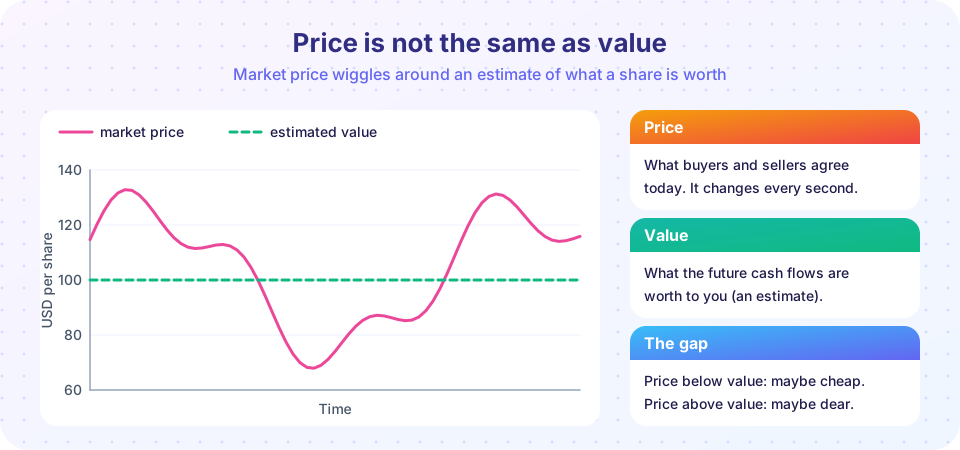
When you buy a share you own a small slice of a business. That slice has a claim on the company's future profits, paid to you either as dividends or as growth in the value of the business. So the sensible answer to "what is a share worth?" is "the value today of all the cash it will ever pay you." That is the central idea of valuation, and it is called intrinsic value.
The market price is something else. It is where the last buyer and seller met. Prices move on news, mood, interest rates and the flow of money in and out of funds. The investor and teacher Benjamin Graham described the market as a business partner called Mr. Market, who turns up every day offering to buy your share or sell you his, at prices that swing with his mood. You are free to ignore him on days when his price looks silly. Valuation is how you decide whether a price is silly.
Two facts keep this from being easy. First, intrinsic value is not observable. Two careful analysts looking at the same company will produce two different numbers, because they will forecast growth and choose a discount rate differently. Second, the market is made of many such analysts, so when prices look wrong it is often because you have missed something rather than because everybody else has. Healthy humility, then: a valuation gives you a reasoned range, not a verdict.
The workflow of the chapter
The chapter follows the order in which a practitioner would work.
The valuation workflow
Why more than one method?
Disagreement is information, not failure.
The end goal
What each lesson covers
- Reading financial statements: the income statement, balance sheet and cash flow statement of an invented coffee roaster, and the ratios that summarize them (margins, return on equity, debt and coverage).
- Valuation multiples: price-to-earnings, price-to-book, price-to-sales and enterprise value ratios; how to compare a company with its peers and why cheap-looking numbers can mislead.
- Dividend discount and DCF valuation: the Gordon growth formula, free cash flow forecasts, terminal value, and sensitivity tables that show how much an answer depends on its assumptions.
- Chapter review: a one-picture summary, a recap table and a ten-question quiz.
Along the way you will use the discount-rate idea from the earlier chapters on risk and return: a risky business deserves a higher discount rate and therefore a lower present value for the same cash flows. If you want to look back at how risk and return are measured, the chapter on risk, return and diversification comes first in the course.
A first experiment
The code below invents a company whose value is 100 per share and lets its price wander around that value with a gentle pull back towards it. It counts the share of days the price sits above value. The point is not realism; it is that a price can sit above or below a fixed value for long stretches, so a gap alone is never an instruction.
Press Run (or Ctrl + Enter) to see the result here.
Program input · what you'd type while the program runs
Type the answers before you press Run, one per line. Each time the program reads a line (with input()), it gets the next line from this box.
Change pull to 0.2 and run it again. A stronger pull keeps the price close to value; a weak pull lets it drift far away for months. Real markets are somewhere in between, which is why patience and a margin of safety both matter.
Common misconceptions
"A low price means a cheap stock." A price of 3 can be expensive and a price of 3,000 cheap; price per share means nothing until you compare it with earnings, cash flow or assets per share.
"A good company is a good investment." A wonderful business bought at too high a price can still be a poor investment; valuation connects the quality of the business to the price you pay.
"If my model gives one number, it is the answer." A model gives one number for one set of assumptions. Change the assumptions and the number moves, sometimes a lot.
Check your understanding
Quick check · 4 questions
of 4 answered You scored / 4 · perfect!
-
1. What is intrinsic value?
Intrinsic value is a reasoned estimate built from future cash flows; the last trade price is the market price. -
2. Why do two careful analysts often reach different valuations of the same company?
Valuation depends on assumptions about the future, and sensible people disagree about those. -
3. In Graham's story, how should an investor treat Mr. Market's daily quotes?
The quotes are offers; the investor decides whether the price is attractive compared with an estimate of value. -
4. What does a margin of safety protect against?
Paying well below your estimate leaves room for forecasts that turn out too optimistic.
Summary
- Market price is observed; intrinsic value is estimated.
- Valuation turns statements, peer comparisons and cash flow forecasts into a reasoned range.
- Every valuation rests on assumptions, so write them down and test them.
- A margin of safety allows for the errors that are certain to exist.
Track your progress
Create a free account to tick off lessons and pick up where you left off on any device.
of Investing and Markets lessons completed