


















Lesson 3 of 46 · Getting Started
Compound growth: how time does the heavy lifting
Understand compound interest, the future value formula, the rule of 72 and why starting early beats saving more later, with worked examples and live charts.
Albert Einstein is often quoted as calling compound interest the eighth wonder of the world, but there is no solid evidence he ever said it. You do not need a famous name to see the point. Compounding means that growth earns growth: the interest you collect this year is added to the pile, and next year the whole bigger pile earns interest. Money grows slowly at first, then faster, and the effect is so strong that when you start matters as much as how much you save.
What you will learn
- How compound growth differs from simple (straight-line) growth.
- How to use the future value formula, and how to rearrange it.
- How to estimate doubling time with the rule of 72.
- Why an early start can beat a bigger but later contribution.
Key terms
Principal: the amount you start with.
Compound interest: interest calculated on the principal and on all earlier interest.
Future value (FV): what a sum will be worth after some time at a given growth rate.
Present value (PV): what a future sum is worth today.
Annualized return: the single yearly rate that would give the same overall growth.
Simple versus compound growth
Suppose you put $10,000 in an account that pays 7% a year. With simple interest you earn 7% of the original $10,000 each year: $700, always. After 10 years you would have $10,000 + 10 × $700 = $17,000.
With compound interest you earn 7% of the current balance. Year 1 gives $700 and a balance of $10,700. Year 2 gives 7% of $10,700 = $749, a balance of $11,449. Each year the interest is a bit larger than the one before. After 10 years the balance is $10,000 × 1.07¹⁰, about $19,672, nearly $2,700 more than the simple version. After 30 years the gap is huge: about $76,123 against $31,000.
The rule behind this is one line:
FV = PV × (1 + r)^n
Here PV is the starting amount, r is the rate per period as a decimal (7% = 0.07), and n is the number of periods. Each period multiplies the balance by the same growth factor, 1 + r. That repeated multiplication is why the curve bends upward: it is an exponential.
You can rearrange the formula to answer other questions. To find the starting amount needed for a goal, divide: PV = FV / (1 + r)^n. This is called discounting. To find the growth rate that took you from one value to another, use r = (FV / PV)^(1/n) - 1. Investors call this the annualized or compound annual growth rate (CAGR). If $10,000 became $19,672 in 10 years, then r = (1.9672)^(0.1) - 1, which is 7%.
Compounding frequency
Interest can be added once a year, monthly, daily, and so on. With a nominal 6% rate, $1,000 compounded yearly becomes $1,060 after a year. Compounded monthly at 0.5% per month, it becomes $1,000 × 1.005¹², about $1,061.68. More frequent compounding helps a little, but the effect is small compared with the effect of the rate and the number of years. Do not be dazzled by frequency; look at the effective annual rate, which is the true yearly growth after compounding. Here it is 6.17%.
The rule of 72
How long until money doubles? Solving (1 + r)^n = 2 exactly needs logarithms: n = ln(2) / ln(1 + r). The rule of 72 is a mental shortcut:
years to double ≈ 72 / rate in percent
At 7% it says about 10.3 years (the exact answer is 10.24). At 10% it says 7.2 years (exact 7.27). At 4% it says 18 years (exact 17.67). The rule works well for rates from about 4% to 15% and gives a feel for the power of small differences. A 2% rate takes about 36 years to double; a 12% rate takes about 6.
The rule also works in reverse for costs and for inflation. Inflation at 3% halves buying power in about 24 years. A fee of 2% a year quietly eats a large fraction of your wealth over decades; we return to this in Chapter 8.
Why starting early wins
Compare two investors who both earn 7% a year, with contributions at the end of each year.
- Ann invests $5,000 a year from age 25 to 34, which is 10 payments, $50,000 in total. Then she stops and never adds more.
- Ben waits. He invests $5,000 a year from age 35 to 64, which is 30 payments, $150,000 in total.
At age 65, Ann has about $525,872 and Ben about $472,304. Ann paid in one third as much and ended with more. Her early money had 30 to 40 years to compound; each of Ben's payments had fewer years. The moral is not "stop after ten years", which would be a poor plan, but that the first years of saving are the most valuable years, because they have the most time to grow.
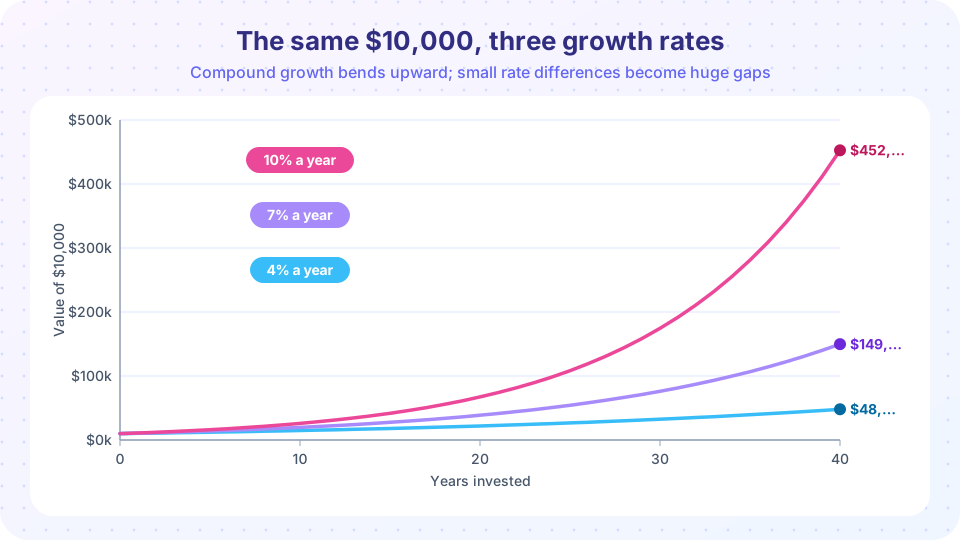
There is a second moral: most of the growth arrives late. In the 10%-a-year line in the picture, more than half of the final value (about 61%) is added in the last ten years. That is why impatience is expensive. Selling in a panic, or pausing contributions for a few years, interrupts the part of the curve that matters most.
Growth rates are not forecasts
Every example here uses a fixed rate for clarity. Real investment returns vary: +20% one year, -15% the next. The average of such returns is not the same as the growth rate you actually get. If an investment gains 50% and then loses 50%, you have not broken even: $100 becomes $150, then $75. The compound annual growth rate is about -13.4% a year, not 0%. This difference between the arithmetic average and the compound (geometric) return is called volatility drag, and Chapter 3 returns to it in detail. For now, remember that the fixed-rate tables describe what would happen if you earned a steady rate, a useful simplification, not a prediction.
Common misconceptions
"A rate that is twice as big gives twice the money." Over long periods it gives far more than double. The 10% line above ends near $452,593, almost ten times the 4% line ($48,010).
"Compound growth means my money rises every year." Compounding is a mathematical rule for a steady rate. Actual markets move up and down, and your balance can fall for years.
"It is too late for me to start." The formula favors early starts, but every extra year still counts. Starting now is always better than starting later.
Try it
First, a table that compares the rule of 72 with the exact doubling time, so you can judge the shortcut for yourself.
Press Run (or Ctrl + Enter) to see the result here.
Program input · what you'd type while the program runs
Type the answers before you press Run, one per line. Each time the program reads a line (with input()), it gets the next line from this box.
Second, the early-versus-late comparison from above as a chart. Change ann_years, ben_start or the rate to test your intuition.
Press Run (or Ctrl + Enter) to see the result here.
Program input · what you'd type while the program runs
Type the answers before you press Run, one per line. Each time the program reads a line (with input()), it gets the next line from this box.
A third quick experiment: write your own doubling-time function and test it.
Press Run (or Ctrl + Enter) to see the console output here.
No output.
Check your understanding
Quick check · 5 questions
of 5 answered You scored / 5 · perfect!
-
1. You invest 1,000 at 5% a year with annual compounding. What is the formula for the value after 8 years?
Compound growth multiplies by 1.05 each year, so after 8 years the balance is 1,000 × 1.05^8, about 1,477. -
2. Using the rule of 72, about how long does money take to double at 9% a year?
72 / 9 = 8 years. The exact answer is about 8.04 years. -
3. Why did Ann end with more than Ben despite paying in less?
Both earned 7%. Ann's earlier money had 30 to 40 years to grow, while Ben's payments had on average fewer years. -
4. An investment rises 50% one year and falls 50% the next. What is the result?
100 becomes 150, then 75. Percentage gains and losses do not cancel because each applies to a different base. -
5. What does the effective annual rate tell you?
A nominal 6% compounded monthly has an effective annual rate of about 6.17%.
Summary
- Compound growth follows FV = PV × (1 + r)^n; growth earns growth, so curves bend upward.
- The rule of 72 estimates doubling time: years ≈ 72 / rate in percent.
- Early contributions are worth the most because they compound longest.
- Fixed rates are a simplification: real returns vary, and a +50% then -50% sequence loses 25%.
Track your progress
Create a free account to tick off lessons and pick up where you left off on any device.
of Investing and Markets lessons completed