


















Lesson 39 of 46 · Behavior, Costs and Strategy
Costs, Fees and Taxes: The Quiet Drag on Returns
See how expense ratios, trading costs, taxes and inflation compound against investors over decades, with calculators for fee drag, tax drag and real returns.
Nobody can promise you a market return, but costs are certain. Every year a fund charges its fee, every trade crosses a spread, and every taxable gain triggers a bill. Each of these looks small in a single year. Over decades they compound, because money paid in fees is money that no longer grows. This lesson classifies the main costs, shows the arithmetic of fee drag, and then covers taxes and inflation, the two other forces that separate what an investment earns from what you keep.
What you will learn
- The main kinds of investing cost: fees, trading costs, taxes and inflation.
- How a small annual fee compounds into a large difference over decades.
- How taxes and the timing of taxes change net returns.
- How to compute real (inflation-adjusted) returns.
Key terms
Expense ratio: the yearly fee of a fund as a percentage of the money invested, taken out of the fund's assets.
Bid-ask spread: the gap between the price at which you can sell and the price at which you can buy.
Turnover: the share of a fund's holdings that is bought and sold in a year.
Real return: the return after adjusting for inflation.
Tax-advantaged account: an account type in which gains or income receive favorable tax treatment; names and rules differ by country.
The cost menu
Fund fees. The expense ratio is charged every year. Broad index funds and ETFs often charge a few hundredths of a percent to a few tenths; actively managed funds commonly charge several tenths to more than 1 percent. Some funds add sales loads, a commission paid when you buy or sell units, and some pay ongoing distribution fees. Always read the fee table in a fund's documents.
Advisory and platform fees. A financial adviser or platform may charge a percentage of the assets managed (often around 1 percent a year in some markets) or a flat fee. Whether the service is worth that depends on what you receive: planning, behavioral coaching, tax work, or only a portfolio you could build yourself.
Trading costs. Commissions at many online brokers are now zero or low for ordinary stock trades in some countries, but costs persist in other forms. The bid-ask spread is a cost every time you trade: buy at the ask, sell at the bid. For large, widely traded shares it is tiny, and for small stocks, some bonds and thinly traded funds it can be sizeable. Large orders may also move the price against you (market impact). Funds incur such costs inside their portfolios, and these do not appear in the expense ratio. Higher turnover generally means higher hidden trading costs.
Taxes. Rules differ widely by country, so treat this as a general picture and check your own rules. Interest and dividends are usually taxed as income, sometimes at special rates. Selling an asset for more than you paid creates a capital gain, which in some countries is taxed at a lower rate if held long enough. Selling at a loss may reduce your tax. Many countries offer accounts that defer or exempt tax on investment returns, within limits.
Inflation. Not a bill but a cost: it reduces what your money can buy. The real return is (1 + nominal) / (1 + inflation) - 1. A 6 percent nominal return with 2.5 percent inflation is a real return of about 3.4 percent.
Fee drag, step by step
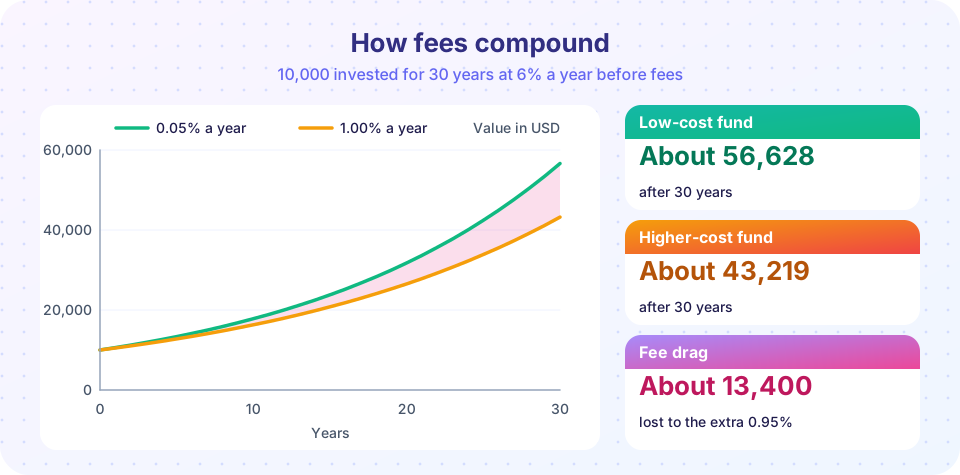
Suppose a portfolio earns 6 percent a year before costs and you invest 10,000 for 30 years. Compare two funds that track the same market: Fund L charges 0.05 percent a year and Fund H charges 1.00 percent.
- Fund L earns about 5.95 percent net, and 10,000 grows to about 56,600.
- Fund H earns about 5.00 percent net, and 10,000 grows to about 43,200.
The difference of roughly 13,400 is the fee drag. The extra fee of 0.95 points per year sounds like less than one percent. But it took almost a quarter of the final wealth, because Fund H gave up a bit more of the growth each year and lost the growth on what it had given up. The longer the horizon, the larger the share. In terms of gains rather than final value, Fund H's investor kept only about 70 percent of the growth that a no-fee fund would have produced, so the manager collected the remaining 30 percent. A manager must beat the market by the amount of the fee, year after year, just for you to break even with the cheaper fund. Studies of active funds, such as the periodic SPIVA reports, have repeatedly found that most actively managed funds in major markets underperform their benchmarks over long periods after fees, although some beat them in some years.
A handy approximation: final value ≈ P x (1 + r - f)^n, where f is the fee. It is exact when the fee is deducted from the return each year, which is how expense ratios work.
Taxes: rate and timing
Two things matter: how much tax and when you pay it.
Imagine an investment returning 7 percent a year over 30 years in a taxable account where gains are taxed at 20 percent. If the investor sells and rebuys every year (turnover of 100 percent), tax is due each year and the net growth rate is about 5.6 percent: 10,000 becomes about 51,000. If the investor holds and sells only at the end, the money compounds at 7 percent until the final sale, when tax of 20 percent applies to the total gain: about 62,900 after tax. Deferral is worth roughly 12,000 here. This is why buy-and-hold is tax-efficient, and why tax-advantaged accounts, which defer or exempt tax altogether, are so valuable. The third example below reproduces these figures.
Avoiding tax must not drive bad investment decisions, though. A sensible order is: pick a strategy suited to your goals and risk, use available tax-advantaged accounts, then keep turnover low and sell losers when it makes sense for your tax position. Tax rules change, so verify the current ones for your country.
Inflation and real returns
Prices of goods rise over time. If your investments earn 3 percent and inflation is 3 percent, your purchasing power has not grown. The last line of any return calculation should therefore be the real return. Over long periods this matters in both directions: cash savings at low interest rates can lose purchasing power, and stocks have historically earned positive real returns over long horizons, although with large swings along the way and no guarantee for the future.
What you can do about costs
- Compare expense ratios of funds that hold similar assets, and prefer the cheaper one unless there is a clear reason not to.
- Keep turnover low and avoid frequent trading.
- Check what any adviser charges and what you get for it.
- Use tax-advantaged accounts where available and appropriate.
- Think in real, after-cost, after-tax terms.
Common misconceptions
"A 1% fee is only 1% of my money." It is 1 percentage point of return every year, which in the example above removed about 30 percent of the growth over 30 years.
"Low-cost funds are lower quality." An index fund holds the same securities as the market it tracks; its lower cost is a result of not paying for stock picking.
"I should never pay tax, so I should never sell." Tax is a cost to weigh against risk, diversification and goals, not the only objective.
Try it
First, a fee-drag calculator. Change the return, the fees and the horizon to see how the gap changes.
Press Run (or Ctrl + Enter) to see the result here.
Program input · what you'd type while the program runs
Type the answers before you press Run, one per line. Each time the program reads a line (with input()), it gets the next line from this box.
Second, the growth curves of the lesson picture, with the gap shaded. Add a third fee and see where it lands.
Press Run (or Ctrl + Enter) to see the result here.
Program input · what you'd type while the program runs
Type the answers before you press Run, one per line. Each time the program reads a line (with input()), it gets the next line from this box.
Third, tax drag and real returns.
Press Run (or Ctrl + Enter) to see the result here.
Program input · what you'd type while the program runs
Type the answers before you press Run, one per line. Each time the program reads a line (with input()), it gets the next line from this box.
Check your understanding
Quick check · 5 questions
of 5 answered You scored / 5 · perfect!
-
1. A fund returns 7% before fees and charges 0.5% a year. Approximately how much does 1,000 grow to in 10 years after fees?
The net return is 6.5%, and 1,000 x 1.065^10 is about 1,877. -
2. Which cost does NOT appear in a fund's expense ratio?
Spreads and impact costs from buying and selling holdings reduce returns but are not part of the expense ratio. -
3. Nominal return 5% and inflation 3%. The real return is closest to
(1.05 / 1.03) - 1 = 1.94%. -
4. Why does deferring tax until the end usually give a larger final value?
Money that would have been paid as tax each year stays invested and earns returns. -
5. A cheaper fund that tracks the same index as a costlier fund will, before any difference in tax, most likely
The same holdings produce the same gross return; the lower fee leaves more of it with the investor.
Summary
- Costs include fund fees, advisory fees, trading costs and spreads, taxes and inflation.
- A small annual fee compounds: at 6 percent gross, 1 percent a year takes roughly 30 percent of 30-year growth compared with a minimal fee.
- Tax timing matters; deferring tax lets gains keep compounding.
- Real return is
(1 + nominal) / (1 + inflation) - 1; judge results after costs, tax and inflation.
Next: Strategy and rebalancing
Track your progress
Create a free account to tick off lessons and pick up where you left off on any device.
of Investing and Markets lessons completed