


















Lesson 6 of 46 · Financial Markets and Instruments
Chapter 2 overview: how financial markets work
A map of financial markets: who raises money, who supplies it, primary and secondary markets, brokers, regulators and indexes, with a preview of the chapter's lessons.
A financial market is simply a place, physical or electronic, where buyers and sellers agree prices for financial assets. The magic is not in the building. It is in the matching: a company that needs money for a factory meets thousands of people with savings, and each side gets something it wants. This overview draws the map of the territory so that the detailed lessons in this chapter have somewhere to sit.
What you will learn
- The three groups in every market: issuers, investors and intermediaries.
- The difference between primary and secondary markets.
- What an exchange, a broker, a market maker and a regulator do.
- How a stock index summarizes a market.
Key terms
Security: a tradable financial asset such as a share or bond.
Issuer: the organization that creates and sells a security.
Exchange: an organized marketplace with rules for trading listed securities.
Broker: a firm that carries out trades on your behalf.
Index: a number that tracks the combined value of a group of securities.
The big picture
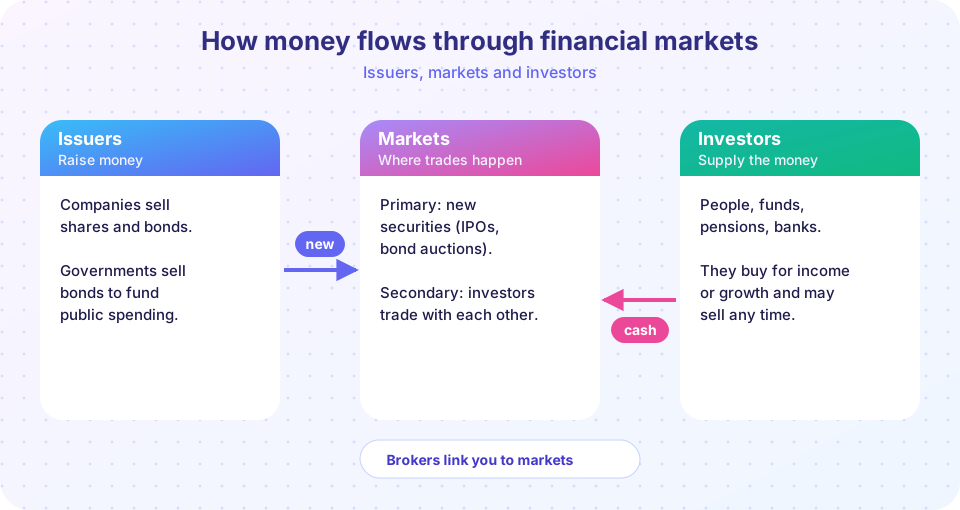
Every market has issuers who need money, investors who have it, and intermediaries who connect them. Companies issue shares, which are small ownership stakes, and bonds, which are loans split into tradable pieces. Governments and local authorities issue bonds. Banks, insurers and funds are both investors and issuers. The reward for issuers is cash today; the reward for investors is a claim on future profits, interest or repayment.
Two layers keep the machine working. In the primary market new securities are sold for the first time. When a company sells shares to the public for the first time, that is an initial public offering (IPO), and the money flows to the company. A government bond auction is another primary sale. In the secondary market investors trade existing securities with each other. When you buy a share on an exchange, the money goes to the previous owner, not to the company. That may sound unimportant, but the secondary market is what makes primary sales possible: people lend or invest more readily when they know they can sell later. This ability to sell quickly at a fair price is called liquidity.
The cast of characters
- Exchanges such as the New York Stock Exchange, Nasdaq, the London Stock Exchange, Deutsche Börse, the Tokyo Stock Exchange, the Bombay and National stock exchanges in India and many others list companies and run orderly trading. Many trade electronically through matching engines rather than a physical floor.
- Brokers give you access. You send an order to your broker, who routes it to a market. Online brokers made investing available to anyone with a phone.
- Market makers quote prices at which they will buy and sell, earning a small gap called the spread. They add liquidity, especially in less popular securities.
- Custodians and clearing houses keep track of who owns what and make sure both sides of each trade deliver. The orders lesson follows a trade through them.
- Regulators such as the SEC in the United States, the FCA in the United Kingdom, ESMA and national authorities in Europe, and many others write the rules on disclosure, fair trading and fraud. Regulation does not protect you from losing money on a bad investment. It aims to protect you from deception and unfair practices.
- Rating agencies and analysts assess credit quality and estimate company values.
Not all trading happens on exchanges. Bonds and many derivatives trade over the counter (OTC): dealers quote prices directly to each other and to clients, often by electronic networks. That is why a bond price can be harder to find than a share price.
Reading a market through an index
Headlines say "the market rose 1%". They usually mean an index, a calculated number summarizing a basket of securities. The S&P 500, the FTSE 100, the DAX, the Nikkei 225 and the MSCI World are examples. Two common designs exist:
- Price-weighted: each stock counts in proportion to its share price (the Dow Jones Industrial Average works this way). A $400 share moves the index more than a $20 share, even if the company is smaller.
- Market-cap-weighted: each stock counts in proportion to its market capitalization, the share price times the number of shares. Larger companies have larger weights (the S&P 500 and the MSCI World work this way). This is the standard design for index funds.
An index is not an investment you can buy directly, but funds built to follow it are. We will meet them in the lesson on bonds, funds and ETFs and return to them in Chapter 8.
Common misconceptions
"When I buy a share, my money goes to the company." Only in a primary sale, such as an IPO. On an exchange you are buying from another investor.
"Regulated means safe." Regulation targets fraud and unfair practice, not market risk. A fully regulated stock can lose half its value.
"The market is a single thing." There are separate markets for shares, bonds, currencies, commodities and derivatives, each with its own rules, participants and risks.
What the chapter covers
- Stocks and exchanges: what a share is, how an exchange works, the order book, the spread and market capitalization.
- Bonds, funds and ETFs: the instrument families, from cash to single stocks, and how funds package them.
- Orders and how trades happen: market, limit and stop orders, and a trade's life from click to settlement.
- Chapter 2 review: a recap and a ten-question quiz.
Who is in the market?
Two layers
Why liquidity matters
Try it
An index calculator, using three invented companies, to see the two designs side by side.
Press Run (or Ctrl + Enter) to see the result here.
Program input · what you'd type while the program runs
Type the answers before you press Run, one per line. Each time the program reads a line (with input()), it gets the next line from this box.
The second block classifies example transactions as primary or secondary, so you can test your understanding of where the money goes.
Press Run (or Ctrl + Enter) to see the console output here.
No output.
Check your understanding
Quick check · 4 questions
of 4 answered You scored / 4 · perfect!
-
1. Who receives the money when you buy a share on an exchange?
This is a secondary-market trade between investors. The issuer only receives money in a primary sale such as an IPO. -
2. What does liquidity mean?
Liquid assets can be sold quickly with little price impact. Thin markets have wide spreads and big price jumps. -
3. In a market-cap-weighted index, which company has the largest influence?
Weights are proportional to price times shares outstanding. -
4. What do regulators mainly try to prevent?
Regulation promotes disclosure and fairness. It does not remove market risk.
Summary
- Markets connect issuers, investors and intermediaries.
- The primary market raises new money; the secondary market provides liquidity for existing securities.
- Exchanges, brokers, market makers, clearing houses and regulators each have a role; bonds often trade over the counter.
- Indexes summarize markets; market-cap weighting is the standard for index funds.
Next: Stocks and exchanges
Track your progress
Create a free account to tick off lessons and pick up where you left off on any device.
of Investing and Markets lessons completed