


















Lesson 8 of 46 · Financial Markets and Instruments
Bonds, funds and ETFs: the main instruments
Meet the main investment instruments: cash, bonds, stocks and funds. Learn coupons, yield, why bond prices fall when rates rise, ETFs versus mutual funds, and fees.
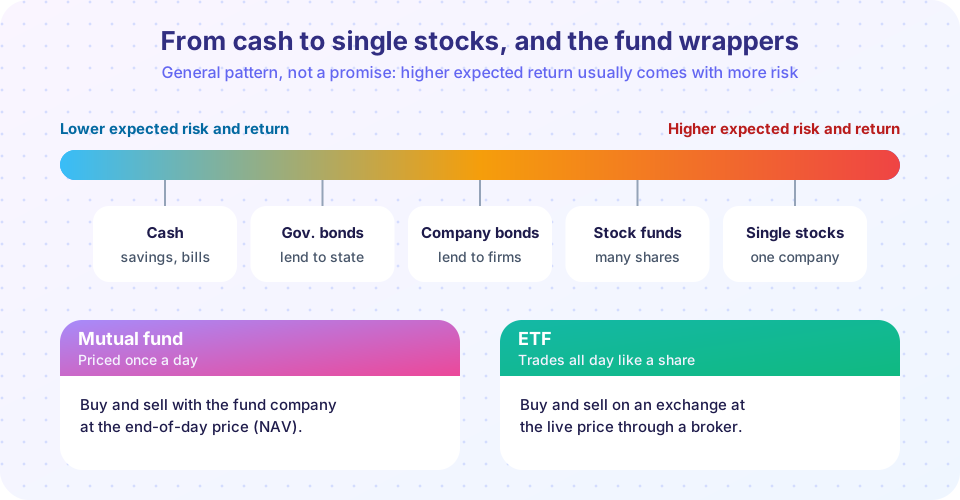
Beyond shares, investors can hold dozens of kinds of assets. Most portfolios, though, are built from just a handful of families: cash, bonds, stocks and packaged funds that hold the rest. Knowing what each is, what it pays and what can go wrong is the most useful vocabulary an investor can have. This lesson walks through the family tree from least to most risky and then shows how funds and ETFs wrap them for ordinary savers.
What you will learn
- How a bond works: face value, coupon, maturity and yield.
- Why bond prices fall when interest rates rise.
- The difference between government and corporate bonds, and what credit risk is.
- How mutual funds and ETFs work and why their fees matter.
Key terms
Bond: a loan that you make to a government or company in return for regular interest and repayment at maturity.
Coupon: the interest a bond pays, stated as a percentage of its face value.
Yield: the return you earn if you buy at today's price and hold to maturity.
Fund: a pooled investment that holds many securities for many investors.
Expense ratio: the yearly fee a fund charges, as a percentage of the money invested.
Cash and money-market instruments
At the safest end are cash in a bank, short-term government bills and money-market funds, which hold very short-dated, high-quality loans. They hold their nominal value and pay a modest interest rate that follows the central bank's rate. The risk is not price movement but inflation: as Lesson 1 showed, the interest may be less than the rise in prices.
Bonds: loans you can trade
When a government or company needs to borrow, it can issue bonds. Each has four key numbers:
- Face value (par): the amount repaid at the end, often 1,000.
- Coupon: the interest rate on the face value. A 5% coupon on a 1,000 bond pays 50 a year, usually split into semi-annual payments.
- Maturity: the date the face value is repaid, from a few months to 30 years or more.
- Issuer: who owes the money.
A 10-year bond with a 5% coupon pays 50 a year for 10 years and then returns 1,000. Held to maturity, an investor knows exactly what they will receive, provided the issuer pays. That known schedule is why bonds are called fixed income.
Why price and yield move in opposite directions
Bonds trade on the secondary market, and their price changes every day. Suppose new bonds start paying 6% while yours pays only 5%. Nobody will pay full price for your 5% bond when 6% is available, so its price falls until its yield matches the market. Conversely, when new bonds pay only 4%, your 5% bond becomes more attractive and its price rises. So when interest rates rise, existing bond prices fall, and when rates fall, prices rise.
The yield to maturity is the discount rate that makes the present value of all remaining payments equal the price. For the 10-year 5% bond:
| Market yield | Price of the 1,000 bond |
|---|---|
| 4% | about 1,081 |
| 5% | 1,000 |
| 6% | about 926 |
The longer the maturity, the larger the price swing for a given change in rates. This sensitivity is called duration, which Chapter 6 explains fully.
Government versus corporate bonds
Bonds from stable governments in their own currency are considered the safest, because the government can tax and, in its own currency, create money. They are not risk-free: their prices move with interest rates and inflation can eat their payments. Corporate bonds pay more because the issuer might fail to pay. This is credit risk, or default risk, and rating agencies grade it on scales from the highest grade down to "junk" (also called high-yield). The extra yield over a government bond is the credit spread, your payment for taking the risk. Bondholders rank above shareholders in a bankruptcy, which is why bonds are less risky than the same company's stock.
Stocks, and what lies beyond
Stocks sit higher on the spectrum. Over long periods they have typically paid more than bonds, but with larger and more frequent price falls. There are further families: real estate (directly, or through listed real estate investment trusts, REITs), commodities such as gold and oil, and alternative assets such as private equity. Each behaves differently and some are hard to trade. A beginner's portfolio usually needs only cash, bonds and stocks, and gets the rest through funds if at all.
Funds: a basket with one price
Buying 500 shares one by one would be expensive and clumsy. A fund pools money from many investors and buys a basket. Each investor owns units whose value reflects the basket. Funds give instant diversification, professional administration and small minimum amounts. Two common wrappers exist:
| Mutual fund | ETF (exchange-traded fund) | |
|---|---|---|
| Price | Set once a day, at the net asset value (NAV) | Changes all day, like a share |
| Bought through | The fund company or a platform | A broker on an exchange |
| Minimum | Sometimes a set amount | One share, or less with fractional shares |
| Typical use | Regular monthly investing | Flexible trading, often lowest cost |
The NAV is the total value of what the fund holds, minus its liabilities, divided by the number of units. An ETF's market price can differ slightly from its NAV; market makers keep the two close by creating and redeeming ETF shares in large blocks.
Index funds and active funds
An index fund (or index ETF) simply copies an index such as the S&P 500 or a world stock index. It buys everything in the index in the same weights, so management is cheap and automatic. An actively managed fund employs people who try to beat the market by picking securities. The research on this is sobering: after fees, most active funds underperform their benchmark over long periods, and the few that outperform are hard to identify in advance. Chapter 8 returns to the evidence.
Fees
Funds charge an expense ratio, deducted from the fund's assets. Index ETFs may charge 0.03% to 0.20% a year, while many active funds charge 0.5% to 1.5% or more. That looks small, but fees compound against you. On $10,000 growing at 6% a year for 30 years, a 0.1% fee leaves about $55,800, while a 1% fee leaves about $43,200. You pay the fee every year regardless of performance, and it is the one thing you can control. Check also for sales charges, trading commissions, platform fees and the bid-ask spread of the ETF.
Common misconceptions
"Bonds are safe." Bonds from stable issuers pay predictably if held to maturity, but their prices fall when rates rise, and corporate bonds can default. Long-maturity bonds can lose a lot of value.
"A fund is diversified, so it cannot lose money." A stock fund holds many stocks, but if the whole market falls, so does the fund. Diversification reduces some risks, not market risk.
"A cheaper fund is a worse fund." For index funds, a lower fee means a higher return for you, because the holdings are the same.
Try it
First, a bond pricing calculator. Try different yields and maturities to see the price rise and fall.
Press Run (or Ctrl + Enter) to see the result here.
Program input · what you'd type while the program runs
Type the answers before you press Run, one per line. Each time the program reads a line (with input()), it gets the next line from this box.
Second, what fees do to a portfolio over time.
Press Run (or Ctrl + Enter) to see the result here.
Program input · what you'd type while the program runs
Type the answers before you press Run, one per line. Each time the program reads a line (with input()), it gets the next line from this box.
Check your understanding
Quick check · 5 questions
of 5 answered You scored / 5 · perfect!
-
1. A bond pays a 4% coupon on a face value of 1,000. How much interest does it pay each year?
4% × 1,000 = 40 a year. -
2. Market interest rates rise sharply. What usually happens to the price of an existing bond with a lower coupon?
New bonds offer better yields, so buyers demand a lower price for the old bond until its yield matches. -
3. Why do corporate bonds usually pay more than government bonds of the same maturity?
The extra yield is the credit spread, a payment for default risk. -
4. Which describes an ETF?
ETFs combine a fund's basket with exchange trading, so price changes during the day. -
5. Over 30 years at 6% gross, a 1% yearly fee leaves the investor with roughly:
10,000 grows to about 57,435 without fees and about 43,219 with a 1% fee, roughly 25% less.
Summary
- Cash holds value but not buying power; bonds pay fixed interest and are priced inversely to market yields.
- Corporate bonds carry credit risk and pay a credit spread; stocks sit higher on the risk spectrum.
- Funds and ETFs pool many assets; index funds copy a benchmark cheaply.
- Fees compound: a 1% fee takes about a quarter of final wealth over 30 years at 6%.
Track your progress
Create a free account to tick off lessons and pick up where you left off on any device.
of Investing and Markets lessons completed