


















Lesson 29 of 46 · Bonds and Fixed Income
Duration and Convexity: Measuring Interest-Rate Risk
Learn Macaulay and modified duration, how to estimate a bond's price change from a yield move, and how convexity improves the estimate.
Everyone knows that bond prices fall when yields rise. A practical investor wants to know by how much. A 2-year bond and a 30-year bond with the same coupon react very differently, and an investor holding a mix needs one number that sums up the sensitivity. That number is duration, and its refinement, convexity, makes the estimate accurate for larger moves.
This lesson builds both from the price formula you already know, using the same 10-year, 5 percent bond.
What you will learn
- What Macaulay duration is and why it is a weighted average time.
- How modified duration estimates the percentage price change for a small yield change.
- Why the estimate is imperfect and how convexity corrects it.
- Which bond features make duration longer or shorter.
Key terms
Macaulay duration: the weighted average time, in years, until a bond's cash flows are received, weighted by present value.
Modified duration: Macaulay duration divided by (1 + y); the approximate percentage price change per one unit change in yield.
Convexity: a measure of how much the price-yield curve bends; it improves duration's estimate.
DV01: the dollar change in price for a one basis point (0.01 percentage point) change in yield.
Basis point: one hundredth of a percentage point.
Duration as a weighted average time
A bond that pays everything at the end, such as a zero-coupon bond, ties up your money for exactly its maturity. A coupon bond returns some of your money earlier, so its effective waiting time is shorter. Macaulay duration captures this by weighting each payment's time by its share of the bond's price:
D = sum over t of [ t x PV(cash flow t) ] / Price
For a zero-coupon bond the formula collapses: all the weight is on the last payment, so duration equals maturity. For our 10-year, 5 percent bond at a 5 percent yield, the calculation gives a Macaulay duration of about 8.11 years: shorter than the maturity of 10 because coupons come back along the way.
From duration to price sensitivity
Dividing by (1 + y) gives the modified duration:
D_mod = D / (1 + y), here 8.11 / 1.05 = 7.72.
Its meaning is the first-order rule that makes duration useful:
percentage price change ≈ - D_mod x change in yield
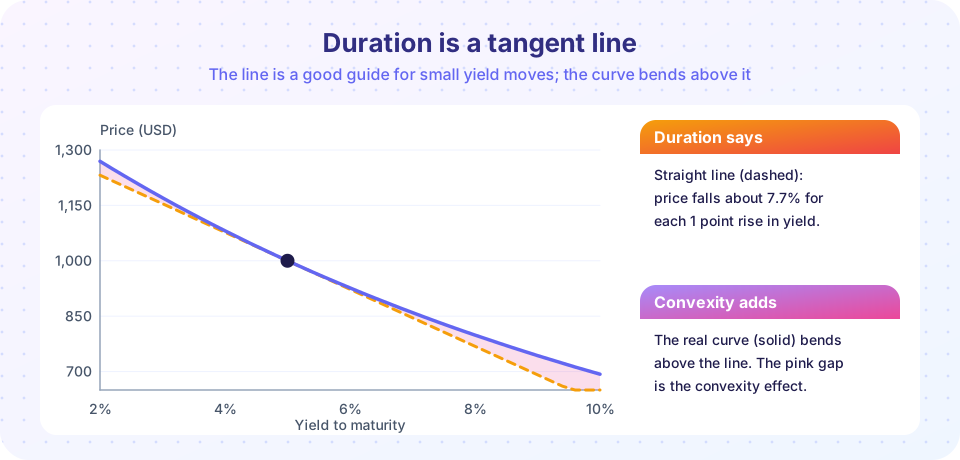
If the yield rises by one percentage point (0.01), the price falls by about 7.72 percent. For a bond priced at 1,000 that is a fall of about 77. The true price at a 6 percent yield is 926.40, a fall of 7.36 percent. At a 4 percent yield the true price is 1,081.11, a rise of 8.11 percent.
Two features of this comparison deserve attention. First, duration's estimate is close for a one-point move. Second, it is the same size either way (plus or minus 7.72 percent), while the real change is smaller for a rise and bigger for a fall. The real curve bends above its tangent line, which is exactly what the picture shows.
A related practical measure is DV01, the price change for one basis point: 1,000 x 7.72 x 0.0001 = 0.77 per bond. Traders who hold millions of dollars of bonds quote their risk this way.
Convexity
Convexity measures the curvature that duration ignores. Using it, the improved estimate is
percentage price change ≈ - D_mod x dy + 0.5 x Convexity x dy^2
The second term is always positive for an ordinary bond, because dy^2 is positive whichever way yields move. It raises the estimate when yields fall (the price rises by more) and softens the loss when yields rise. That is why convexity is valuable to a bondholder: all else equal you prefer more of it. For our bond the convexity is about 75 (in years squared); the code below computes it exactly. With a one-point rise in yield the correction is 0.5 x 75 x 0.0001, about +0.37 percent, which moves the estimate from -7.72 percent to -7.35 percent, very close to the true -7.36 percent.
For small yield changes duration alone is enough. The larger the move, the more you need convexity.
What makes duration longer or shorter
- Maturity. Longer maturity, longer duration. A 30-year bond is far more sensitive than a 2-year bond.
- Coupon. A higher coupon returns cash sooner, lowering duration. A zero-coupon bond has the highest duration for its maturity.
- Yield. At a higher yield, later cash flows are discounted more heavily and carry less weight, so duration is a little lower.
Duration is also additive across a portfolio: the duration of a bond portfolio is the market-value weighted average of its bonds' durations. An investor who needs money in about eight years may choose bonds whose duration is about eight, so that a rise in yields (which lowers prices but raises the return on reinvested coupons) and a fall in yields (the opposite) roughly offset each other at the horizon. This technique is called immunization.
Using duration in practice
Duration turns a vague worry about interest rates into a number you can act on. A fund manager who expects yields to rise can shorten the portfolio's duration by shifting into shorter bonds, so that prices fall less. One who expects yields to fall can lengthen it. An insurer with liabilities due in twelve years can choose assets whose duration is also about twelve, so that a parallel change in yields changes assets and liabilities by similar amounts. Ordinary savers meet the same idea in bond funds: a fund with an average duration of 6 years will lose about 6 percent of its value if yields rise by one point, before counting the interest it earns, which is a useful sanity check before buying one.
Duration also explains something that surprises many first-time bond buyers. In a year when yields rise sharply, a long-term bond fund can show a big loss even though every bond in it is still expected to pay in full. The loss is a mark-to-market change in price, not a default. If you hold an individual bond to maturity, you still receive the promised payments, but the funds you could have earned by waiting for higher yields are an opportunity cost. A fund, which never matures, must manage this continually.
Limits of duration
Duration assumes that all yields across maturities move by the same amount (a parallel shift), which is not how real yield curves behave. It also loses accuracy for large yield changes and for bonds with options, such as callable bonds, whose cash flows change when rates move. For those, practitioners use effective duration, found by actually repricing the bond with the option model at slightly higher and lower yields.
Common misconceptions
"Duration is the same as maturity." Only for zero-coupon bonds. A coupon bond's duration is shorter than its maturity.
"Duration predicts the exact price." It is a linear approximation; large yield changes need the convexity term.
"Long bonds are always riskier." They have more interest-rate risk, but a short-term bond from a weak issuer may have far more credit risk.
Try it
First, compute Macaulay duration, modified duration and convexity, and compare the estimates with the exact price changes.
Press Run (or Ctrl + Enter) to see the result here.
Program input · what you'd type while the program runs
Type the answers before you press Run, one per line. Each time the program reads a line (with input()), it gets the next line from this box.
Second, plot the three estimates for a range of yield changes, so you can see the tangent line separate from the curve.
Press Run (or Ctrl + Enter) to see the result here.
Program input · what you'd type while the program runs
Type the answers before you press Run, one per line. Each time the program reads a line (with input()), it gets the next line from this box.
Third, how maturity and coupon change duration.
Press Run (or Ctrl + Enter) to see the result here.
Program input · what you'd type while the program runs
Type the answers before you press Run, one per line. Each time the program reads a line (with input()), it gets the next line from this box.
Check your understanding
Quick check · 5 questions
of 5 answered You scored / 5 · perfect!
-
1. A bond has a modified duration of 6. If its yield rises by 0.5 percentage points, its price falls by about
Price change = -6 x 0.005 = -3%. -
2. What is the duration of a 7-year zero-coupon bond?
All the cash arrives at maturity, so the weighted average time is the maturity. -
3. Compared with an otherwise identical bond, a bond with a higher coupon has
More cash arrives early, lowering the weighted average time. -
4. Why does adding the convexity term raise the estimate when yields fall?
Because the curve lies above the tangent, the true price is higher than the straight-line estimate for any yield move. -
5. A bond fund holds half its money in a bond with duration 4 and half in one with duration 10. What is the fund's approximate duration?
Portfolio duration is the weighted average: 0.5 x 4 + 0.5 x 10 = 7.
Summary
- Macaulay duration is the present-value-weighted average time to receive cash; modified duration is that divided by
(1 + y). - Percentage price change is about
- D_mod x change in yieldfor small moves. - Convexity measures the bend in the price-yield curve and adds
0.5 x C x dy^2to the estimate. - Longer maturity and lower coupons raise duration; portfolio duration is a weighted average.
Track your progress
Create a free account to tick off lessons and pick up where you left off on any device.
of Investing and Markets lessons completed