


















Lesson 43 of 46 · Projects and Practice
Practice Problems: Stocks, Bonds, Derivatives and Costs
Fourteen practice problems with worked solutions on valuation, bonds, options, hedging, fees and rebalancing, plus a random problem generator in Python.
Reading about formulas is not the same as using them. This lesson gives you fourteen problems that cover the course, from earnings per share to hedge ratios. Try each one on paper first, then compare with the worked solution below. A Python cell computes every answer so you can check your arithmetic. All companies and numbers are invented.
Educational exercises only. The scenarios are made up to practice calculations and are not investment advice.
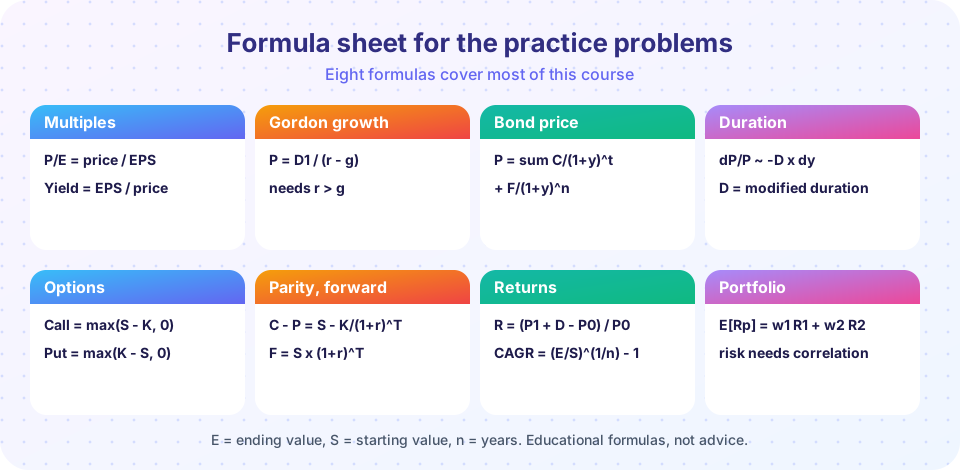
What you will learn
- How to choose the right formula for a problem and set it up.
- How to check answers with a quick calculation or a program.
- Which steps trip people up: units, compounding periods and signs.
- How to turn a story into numbers.
Part A: Stocks and valuation
1. Multiples. A company earned net income of 2,400,000 and has 800,000 shares outstanding. The shares trade at 36. Find EPS, the P/E ratio and the earnings yield.
2. Gordon growth. A company just paid a dividend of 1.20 per share. Dividends are expected to grow 4 percent a year forever and your required return is 9 percent. What is the share worth?
3. Enterprise value. A company has a market capitalization of 900, debt of 250, cash of 100 and EBITDA of 150 (all in millions). Find its enterprise value and EV/EBITDA.
4. Mini DCF. Free cash flow is 100 now and will grow 5 percent a year for three years, then 2 percent forever after that. The discount rate is 8 percent. Find the enterprise value.
Part B: Bonds
5. Bond price. A bond with face value 1,000, a 4 percent annual coupon and three years to maturity is priced at a yield of 5 percent. What is its price?
6. Yield to maturity. A 5-year bond with face value 1,000 and a 3 percent annual coupon sells for 920. Find its current yield and approximate YTM.
7. Duration. A bond has a modified duration of 6.5. The yield rises by 0.4 percentage points. Estimate the percentage price change.
8. Forward rate. The 1-year spot rate is 2.5 percent and the 2-year spot rate is 3.0 percent. Find the implied one-year forward rate starting in one year.
Part C: Derivatives
9. Option profit. You buy a call with strike 45 for a premium of 2.50. At expiration the stock is at 52. Find your profit per share. Separately, a put with strike 60 costs 3: what is its break-even price?
10. Put-call parity. A stock is priced at 100. A European call with strike 100 and one year to expiry costs 9. The annual rate is 5 percent and no dividends are paid. Find the put's price.
11. Hedge. A firm wants to hedge a 5,000,000 exposure with futures contracts worth 100,000 each. The correlation between spot and futures changes is 0.85, the spot volatility is 0.22 and the futures volatility is 0.20. How many contracts?
Part D: Behavior, costs and strategy
12. Fee drag. Invest 20,000 for 25 years at a 7 percent return before fees. Compare a fund charging 0.2 percent with one charging 1.2 percent.
13. Rebalancing. A 50/50 portfolio of 100,000 has stocks rise 20 percent while bonds are unchanged. What are the new weights and how much must be sold to return to 50/50?
14. Real return. The nominal return is 6.5 percent and inflation is 3 percent. Find the real return.
Worked solutions
1. EPS = 2,400,000 / 800,000 = 3.00. P/E = 36 / 3 = 12. Earnings yield = 3 / 36 = 8.33 percent.
2. The next dividend is D1 = 1.20 x 1.04 = 1.248. The value is 1.248 / (0.09 - 0.04) = 24.96. A common slip is using D0 instead of D1 in the numerator.
3. EV = 900 + 250 - 100 = 1,050. EV/EBITDA = 1,050 / 150 = 7.0.
4. The cash flows are 105, 110.25 and 115.76. Discounted at 8 percent, they sum to about 283.6. The terminal value at the end of year 3 is 115.76 x 1.02 / (0.08 - 0.02), about 1,968, which discounts to about 1,562. The enterprise value is about 1,846. Notice how most of it, about 85 percent, comes from the terminal value.
5. P = 40/1.05 + 40/1.05^2 + 1,040/1.05^3, about 972.77. The bond sells at a discount because its coupon (4 percent) is below the yield (5 percent).
6. Current yield = 30 / 920 = 3.26 percent. YTM must be higher, since the bond will also gain 80 as it is repaid at par: solving the price equation gives about 4.84 percent.
7. Price change is about -6.5 x 0.004 = -2.6 percent.
8. f = 1.03^2 / 1.025 - 1 = 3.50 percent.
9. The call payoff is 52 - 45 = 7, so the profit is 7 - 2.50 = 4.50 per share. The put's break-even is the strike minus the premium: 60 - 3 = 57.
10. Parity: C - P = S - K / (1 + r)^T. So P = C - S + K / 1.05 = 9 - 100 + 95.24 = 4.24.
11. h = 0.85 x 0.22 / 0.20 = 0.935. The number of contracts is 0.935 x 5,000,000 / 100,000 = 46.75, so about 47 contracts.
12. At a net 6.8 percent, 20,000 grows to about 103,600. At a net 5.8 percent it grows to about 81,900. The extra fee costs about 21,700, close to a fifth of the low-fee result.
13. Stocks become 60,000 and bonds stay 50,000, for a total of 110,000. The stock weight is 54.5 percent. To return to 50/50, stocks should be 55,000, so sell 5,000 of stocks and buy 5,000 of bonds.
14. 1.065 / 1.03 - 1 = 3.40 percent.
Common slips
Compounding periods. If a bond pays semiannually, halve the coupon and yield and double the number of periods.
Units. Keep percentages as decimals in formulas (0.05, not 5) and say whether a rate is per period or per year.
Which dividend. The Gordon formula needs next year's dividend, D1.
Signs. Option writers' payoffs are the negatives of buyers'; futures hedgers gain on the futures leg when the spot leg loses.
Try it
The first cell reproduces all fourteen answers, so you can check your own working.
Press Run (or Ctrl + Enter) to see the result here.
Program input · what you'd type while the program runs
Type the answers before you press Run, one per line. Each time the program reads a line (with input()), it gets the next line from this box.
The second cell is a generator that makes new bond and Gordon-growth problems from a seed. Change the seed for endless practice and use the printed answer to check yourself.
Press Run (or Ctrl + Enter) to see the result here.
Program input · what you'd type while the program runs
Type the answers before you press Run, one per line. Each time the program reads a line (with input()), it gets the next line from this box.
Check your understanding
Quick check · 6 questions
of 6 answered You scored / 6 · perfect!
-
1. A stock pays 2.00 now. Dividends grow 3% a year and the required return is 8%. Which expression gives the value?
Use next year's dividend over r - g: 2.06 / 0.05 = 41.20. -
2. A bond's yield rises from 4% to 5% and its modified duration is 8. The price falls by about
Percentage change is about -8 x 0.01 = -8%. -
3. A put has strike 50 and premium 2. At expiration the stock is 44. The profit per share is
Payoff = 50 - 44 = 6, and profit = 6 - 2 = 4. -
4. A 60/40 portfolio of 100,000 has stocks gain 10% and bonds gain 0%. Roughly what stock weight results?
Stocks 66,000, bonds 40,000, total 106,000, and 66,000 / 106,000 is 62.3%. -
5. Why does the final value in the fee-drag problem differ by more than the fee difference times the years?
The annual fee lowers the growth rate itself, so the loss compounds. -
6. In the mini DCF (problem 4), why is the terminal value about 85% of the total?
A perpetuity of cash flows beyond the explicit forecast carries most of the value.
Summary
- Match the problem to its formula, then watch units, compounding periods and signs.
- Use next year's dividend in the Gordon model and keep rates as decimals.
- A hedge ratio of
rho x sigma_S / sigma_Ftells you how many contracts to use. - Check by an independent route (a quick estimate or a program) before trusting a number.
Next: Glossary
Track your progress
Create a free account to tick off lessons and pick up where you left off on any device.
of Investing and Markets lessons completed