


















Lesson 33 of 46 · Derivatives Basics
Options: Calls, Puts, Payoffs and Strategies
Learn how calls and puts work, how to read payoff and profit diagrams, and how protective puts, covered calls, straddles and spreads are built.
An option is a contract that gives the buyer a choice. A call option gives the right to buy an asset at a fixed price. A put option gives the right to sell at a fixed price. Because it is a right and not a duty, the buyer will use it only when doing so helps. That asymmetry, which limits the buyer's loss while leaving gains open, is what makes options different from forwards and futures and what makes their payoff pictures look like hockey sticks.
This lesson teaches the vocabulary, the arithmetic of payoff and profit, and four classic strategies built from simple pieces. All prices are invented.
What you will learn
- The terms of an option contract: strike, expiration, premium and style.
- How to compute payoff and profit for buyers and sellers of calls and puts.
- What intrinsic value and time value are.
- How protective puts, covered calls, straddles and spreads are built and what each risks.
Key terms
Strike price (K): the fixed price at which the option holder may buy (call) or sell (put).
Premium: the price paid for the option.
Expiration: the date the option ends.
Intrinsic value: what the option would be worth if exercised now: max(S - K, 0) for a call and max(K - S, 0) for a put.
Writer: the seller of an option, who takes on the obligation.
The contract
Consider a call on a stock with a strike of 100 that expires in three months. Its buyer pays a premium, say 6 per share, to the seller (the writer). On the expiration date, if the stock is above 100, the holder can buy at 100 and keep the difference. If the stock is at or below 100, the right is worthless and the holder walks away, having lost only the premium.
Two styles exist. A European option can be exercised only at expiration; an American option can be exercised any time up to then. Most index options are European; most listed single-stock options in the United States are American. The exercise price and style are in the contract, and standard US listed equity options cover 100 shares, so a premium of 6 per share costs 600 per contract.
An option is in the money if exercising would pay (stock above the strike for a call, below it for a put), at the money if the stock is near the strike, and out of the money otherwise.
Payoff versus profit
The payoff is what the option is worth at expiration, ignoring what you paid. The profit subtracts the premium.
| Position | Payoff at expiration | Profit |
|---|---|---|
| Long call (buyer) | max(S - K, 0) |
payoff - premium |
| Short call (writer) | -max(S - K, 0) |
premium - max(S - K, 0) |
| Long put (buyer) | max(K - S, 0) |
payoff - premium |
| Short put (writer) | -max(K - S, 0) |
premium - max(K - S, 0) |
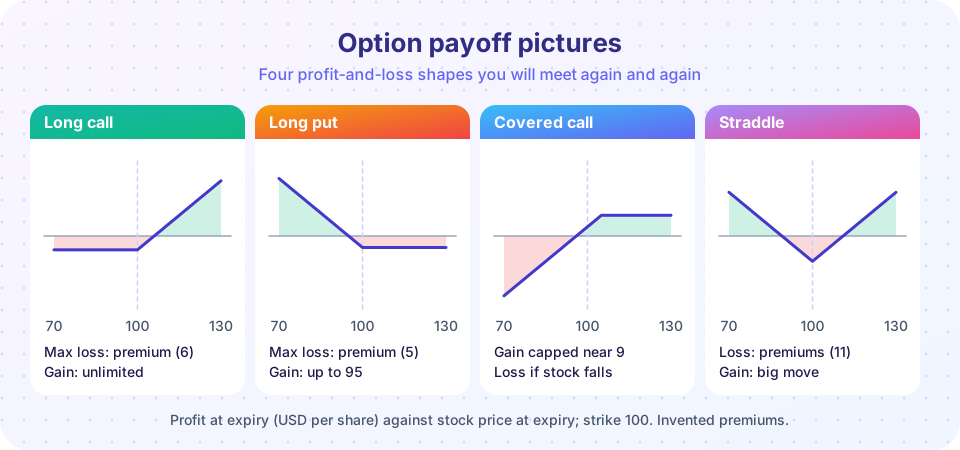
For the long call above, K = 100 and premium = 6. If the stock ends at 90, the profit is -6 (the whole premium). At 106 the profit is zero: that is the break-even price, strike plus premium. At 130 the profit is 24. The gain has no upper limit, while the loss cannot exceed 6.
For a long put with K = 100 and a premium of 5, the profit is largest when the stock collapses: if it falls to 60, the payoff is 40 and the profit 35. The break-even is 95, and the most you can make is 95 per share, because a stock cannot fall below zero.
Writers are on the other side of every trade. A call writer keeps the premium if the stock stays low but loses without limit if it soars, unless the call is covered by owning the stock. A put writer earns the premium if the stock stays high and loses heavily if it crashes. Selling options without any cover is therefore a high-risk activity.
Intrinsic value and time value
Before expiration an option is worth more than its intrinsic value. The extra is its time value: the chance that the stock will still move in the holder's favor before expiry. Time value is largest for at-the-money options with a long time to run and a volatile stock, and shrinks to zero at expiration, which is why an option holder is fighting the clock.
Four classic strategies
Options can be combined with each other and with the stock to reshape risk. Each strategy below uses the diagrams in the picture.
Protective put. You own the stock and buy a put. If the stock collapses, the put pays and limits your loss. It works like insurance, and like insurance it has a cost. Example: buy the stock at 100 and a put with strike 95 for 3. The worst case at expiration is losing the 5 between 100 and 95 plus the 3 premium, so 8 per share, however far the stock falls.
Covered call. You own the stock and sell a call. You collect the premium but give up gains above the strike. Example: buy at 100, sell a 105 call for 4. The most you can make is (105 - 100) + 4 = 9 per share; the break-even drops to 96. If the stock falls a lot, the premium softens the loss only slightly.
Long straddle. You buy a call and a put with the same strike. You profit if the stock moves far in either direction, and lose if it stays put. With K = 100, a call at 6 and a put at 5 cost 11, so you need the stock to end below 89 or above 111 to make money. A straddle is a bet on volatility rather than direction.
Bull call spread. You buy a call at one strike and sell a call at a higher strike. This lowers the cost and caps the gain. Example: buy the 100 call for 6, sell the 110 call for 2. Net cost 4, maximum loss 4, maximum gain 6 (the 10 gap between strikes minus the net cost), and break-even at 104.
Notice a pattern. Every strategy changes the shape of the profit curve; none of them removes risk for free. If a strategy has limited loss, it has paid for it in cost or in capped upside.
Common misconceptions
"Options are just cheap stock." An option can lose all of its value in days, and the stock must move enough to beat the premium; owning the stock has no such expiry date.
"The most I can lose is always the premium." That holds for buyers. Writers, especially of uncovered calls, can lose far more than the premium.
"A strategy with limited risk is safe." Limited loss can still mean a loss on a large share of the money used, and the same position may lose the entire premium repeatedly.
Try it
First, a table of payoff and profit for a call and a put at a range of final prices.
Press Run (or Ctrl + Enter) to see the result here.
Program input · what you'd type while the program runs
Type the answers before you press Run, one per line. Each time the program reads a line (with input()), it gets the next line from this box.
Second, an interactive payoff explorer. Choose a strategy, move the strike and premium, and watch the break-even points and risk change. It is a demonstration of the formulas, not a trading tool.
Third, the four strategies of this lesson side by side, plotted with the profit formulas.
Press Run (or Ctrl + Enter) to see the result here.
Program input · what you'd type while the program runs
Type the answers before you press Run, one per line. Each time the program reads a line (with input()), it gets the next line from this box.
Check your understanding
Quick check · 5 questions
of 5 answered You scored / 5 · perfect!
-
1. You buy a call with strike 50 for a premium of 3. At expiration the stock is at 58. What is your profit per share?
Payoff = 58 - 50 = 8, and profit = 8 - 3 = 5. -
2. What is the break-even stock price at expiration for a long put with strike 80 and premium 4?
A put buyer needs the stock to fall below the strike by at least the premium: 80 - 4 = 76. -
3. Which strategy has the largest possible loss on an uncovered position?
The writer of an uncovered call loses more as the stock rises, with no upper limit. -
4. A covered call involves
You hold the shares, collect the call premium and give up gains above the strike. -
5. A long straddle with total cost 10 and strike 100 makes a profit only if the stock at expiration is
The stock must move more than the 10 paid, in either direction.
Summary
- A call is a right to buy at the strike and a put is a right to sell; the buyer pays a premium and risks only that.
- Payoff ignores the premium, profit subtracts it, and break-even is strike plus premium (call) or strike minus premium (put).
- Option value is intrinsic value plus time value, and time value decays.
- Protective puts, covered calls, straddles and spreads reshape the profit curve; none is free of cost or risk.
Next: Option pricing
Track your progress
Create a free account to tick off lessons and pick up where you left off on any device.
of Investing and Markets lessons completed