


















Lesson 20 of 46 · Portfolio Theory
Asset allocation and rebalancing
Learn how to choose a target mix of stocks, bonds and cash, why allocation drives results, how glide paths work, and how to rebalance by calendar or threshold with worked numbers.
Theory is only useful if it ends in a decision you can carry out. For most investors the decision is asset allocation: how to divide your money among broad categories such as stocks, bonds and cash. Research and experience agree that this one choice does more to shape the risk and return of a diversified portfolio than the selection of individual securities. After you have chosen a mix, markets will push it out of shape, and you will need a rule for pulling it back. That rule is rebalancing.
What you will learn
- What asset allocation is and why it matters more than stock picking.
- How time horizon and risk shape a target mix, and what a glide path is.
- How to rebalance by calendar, by threshold and with new money.
- What rebalancing does and does not do, including its costs.
Key terms
Asset allocation: the split of a portfolio among asset classes.
Strategic allocation: a long-term target mix that you set and keep.
Glide path: a plan that reduces stock exposure gradually as a goal date approaches.
Drift: the movement of actual weights away from targets as prices change.
Rebalancing: trading to bring weights back to targets.
Why allocation matters most
Stocks, bonds and cash behave very differently. A portfolio of 90% stocks will fall much more in a crash than one with 40% stocks, whatever shares you pick. A well-known 1986 study by Brinson, Hood and Beebower, which examined large US pension funds, found that the policy mix explained most of the variation in a fund's returns over time. The study is often over-quoted (it does not say that allocation explains most of the return level, nor that stock selection is worthless), but the central point holds: the mix is the main driver of how bumpy your ride will be. It is also the choice most under your control and with the lowest cost.
Choosing a target
There is no universal right answer, but a sensible process has four steps.
- Set the goal and horizon. A retirement fund for someone 35 years away can accept more swings than a house deposit due in three years.
- Estimate your risk capacity and tolerance (Lesson 3 of Chapter 3). Choose a mix with a plausible worst fall you could live with.
- Pick broad asset classes, typically global stocks, bonds and cash, using low-cost index funds. More categories add complexity; they should earn their place.
- Write it down as percentages, and decide how you will maintain it.
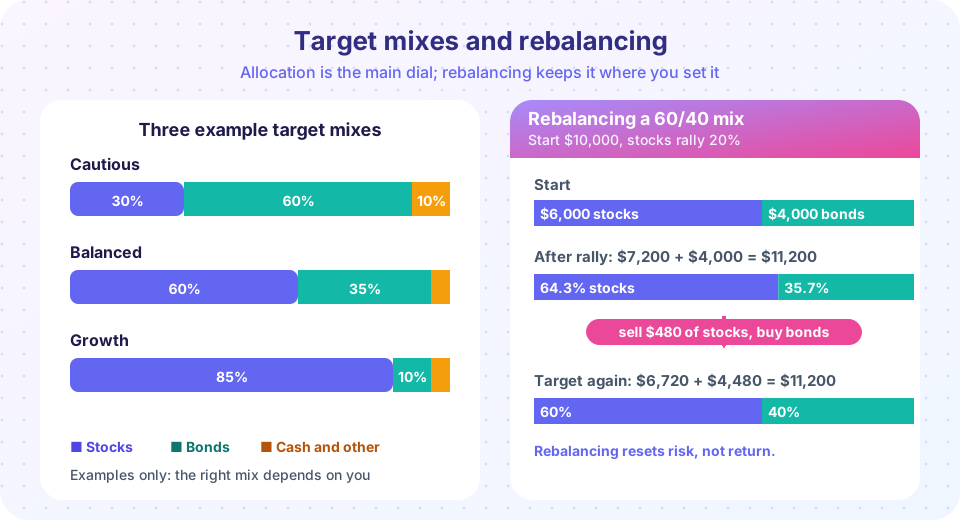
The picture shows three examples:
| Style | Stocks | Bonds | Cash and other | Typical use |
|---|---|---|---|---|
| Cautious | 30% | 60% | 10% | Short horizon or low risk appetite |
| Balanced | 60% | 35% | 5% | Medium horizon |
| Growth | 85% | 10% | 5% | Long horizon, high tolerance |
These are illustrations, not suggestions for you. An old rule of thumb says "hold your age in bonds" or "110 minus your age in stocks". Such rules are crude: they ignore your income, savings and preferences. Treat them as conversation starters.
Glide paths and target-date funds
Time horizon shrinks as the goal nears, so many people reduce stock exposure over time. A glide path specifies the schedule: for instance, 90% stocks at age 25, falling gradually to 50% at 65. A target-date fund does this automatically: you choose the fund named for your retirement year, and it shifts from growth toward safety as the date approaches. These funds are a convenient default; check their fees, and note that different providers' glide paths vary widely.
Why rebalancing is needed
Suppose you start with $10,000 in a 60/40 mix: $6,000 in stocks and $4,000 in bonds. Stocks rally 20% while bonds stay flat. Now the stocks are worth $7,200, the bonds $4,000, and the total is $11,200. The stock weight has drifted to 7,200 / 11,200 = 64.3%. You hold more risk than you chose, and without action the drift will continue in any long bull market.
To rebalance, trade back to 60/40: the target for stocks is 0.60 × 11,200 = $6,720, and for bonds 0.40 × 11,200 = $4,480. So sell $480 of stocks and buy $480 of bonds. After rebalancing, you hold the risk you chose, though not more return: rebalancing controls risk, it does not promise extra profit.
Rebalancing methods
- Calendar: rebalance on a fixed date, such as once a year. Simple and predictable; research suggests annual or semi-annual checks are enough for most people.
- Threshold (bands): rebalance when any asset drifts more than a set amount, such as 5 percentage points (or a relative 20%). More responsive in turbulent markets.
- Cash-flow: direct new contributions to the underweight asset, and take withdrawals from the overweight one. Needs no selling at all and avoids taxes and costs. It works best for savers who are adding money regularly.
- Combination: check on a calendar, but trade only when a threshold is exceeded.
Think of costs. Selling can trigger taxes (depending on your country and account type) and transaction costs. Rebalancing inside a tax-advantaged account usually avoids taxes. Rebalancing too often wastes money, rebalancing too rarely lets risk drift. Most studies find that the details matter little: pick a reasonable rule and stick to it.
Does rebalancing add return?
You may hear of a "rebalancing bonus". When assets with similar long-run returns fluctuate independently, selling the winner and buying the loser captures extra growth over time. The effect is real in theory but small and not guaranteed: in a long, strong trend such as a prolonged bull market, rebalancing out of the winning asset can slightly reduce returns. Its main value is risk control and discipline: it forces you to sell some of what has become expensive and buy some of what has become cheap, without needing to forecast anything.
Practical points
- Include everything. Look at all your accounts together, because your allocation is the sum.
- Use funds that fit. Broad index funds keep the mix clear and the costs low.
- Review life changes. A new job, a child, a house purchase or retirement may justify a new target. Do not change the target because of news headlines.
- Keep a written plan. In a crash it is easier to follow a plan you made calmly in advance than to decide under stress.
Common misconceptions
"Rebalancing is selling winners to make money." It is mainly risk control. Sometimes it helps return and sometimes it does not.
"I should change my allocation when the market looks dangerous." Timing the market is very difficult. Change your allocation when your goals or circumstances change, not when headlines scare you.
"There is a perfect allocation." Many mixes are reasonable. The best is the one you can hold through bad years.
Try it
First, simulate the effect of rebalancing. The returns are drawn randomly from invented distributions, and the same random returns are used for each strategy, so the difference is only the rule. Run it a few times by changing the seed.
Press Run (or Ctrl + Enter) to see the result here.
Program input · what you'd type while the program runs
Type the answers before you press Run, one per line. Each time the program reads a line (with input()), it gets the next line from this box.
In the run with seed 21 the drifting portfolio ended with more money, because stocks happened to do well, but its stock weight climbed to about 92%, far more risk than the 60% you chose. Change the seed and you will see runs where the rebalanced portfolio wins; the point of rebalancing is the steady risk level, not a bigger number.
Second, a trade calculator. Enter holdings and targets, and it tells you what to buy and sell, including a threshold check. With the example numbers the 4.3-point drift is inside a 5-point band, so a threshold rule would wait, although the calculator still prints the trades that would restore the targets exactly.
Press Run (or Ctrl + Enter) to see the result here.
Program input · what you'd type while the program runs
Type the answers before you press Run, one per line. Each time the program reads a line (with input()), it gets the next line from this box.
Check your understanding
Quick check · 5 questions
of 5 answered You scored / 5 · perfect!
-
1. Why is asset allocation considered the most important portfolio decision?
The split between stocks, bonds and cash drives how volatile your portfolio is. -
2. A 70/30 portfolio worth 10,000 drifts so stocks are 8,000 and bonds 3,000 (total 11,000). What should you do to get back to 70/30?
Target stocks = 0.70 × 11,000 = 7,700. Sell 8,000 - 7,700 = 300 and buy 300 of bonds. -
3. Which rebalancing approach needs no selling?
Cash-flow rebalancing uses new money to restore the mix. -
4. What is a glide path?
Target-date funds follow a glide path. -
5. What is the main benefit of rebalancing?
Return effects are small and uncertain; the benefit is risk control.
Summary
- Asset allocation, the split among stocks, bonds and cash, mostly determines how bumpy your ride is.
- Choose a target from your goal, horizon and risk capacity and tolerance; write it down.
- Rebalance by calendar, thresholds or cash flows; costs and taxes argue against doing it too often.
- Rebalancing controls risk and imposes discipline; it does not guarantee extra return.
Next: Chapter 4 review
Track your progress
Create a free account to tick off lessons and pick up where you left off on any device.
of Investing and Markets lessons completed