


















Lesson 27 of 46 · Bonds and Fixed Income
Chapter 6 Overview: Bonds and Fixed Income
A map of the bond chapter: what bonds are, who issues them, how price and yield relate, and how duration, the yield curve and credit risk fit together.
A bond is a loan that you, the investor, make to a government or a company. In return the borrower promises to pay interest on a schedule and to repay the original amount on a fixed date. Because the payments are specified in advance, bonds are called fixed income securities, and their prices behave very differently from stocks: instead of guessing at an unknown stream of profits, you start with a list of promised payments and ask what they are worth.
Educational information only. The bonds, yields and companies in this course are examples, and nothing here is a recommendation to buy or sell any security. Bonds can lose value when interest rates rise or when issuers fail to pay.
What you will learn
- The vocabulary of bonds: face value, coupon, maturity, price and yield.
- Who issues bonds and the main kinds you will meet.
- The four main risks bondholders face.
- How the lessons in this chapter build on each other.
Key terms
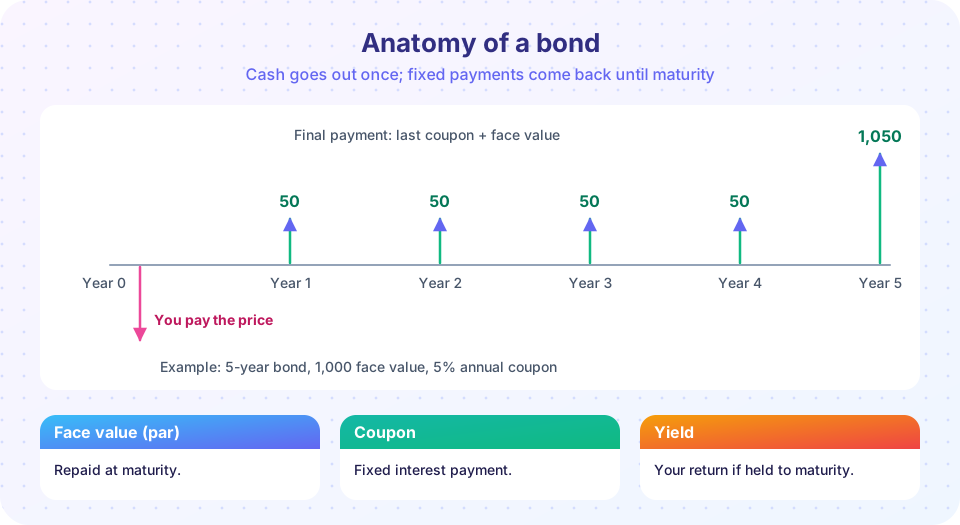
Face value (par): the amount repaid at maturity, typically 1,000 for a single bond.
Coupon: the fixed interest payment, quoted as a percentage of face value per year.
Maturity: the date on which the borrower repays the face value.
Yield to maturity (YTM): the single annual return you earn if you buy at today's price, hold to maturity and receive every payment.
Issuer: the borrower: a government, a company, a city or an agency.
Anatomy of a bond
Take a bond with face value 1,000, a 5 percent coupon and five years to maturity. It pays 50 each year for five years, and in year five it also repays 1,000. That is the whole contract. The only open question is what price to pay today for it.
The answer comes from the same discounting idea you used for stocks. If the market demands a 5 percent return on bonds of this risk, the bond is worth exactly 1,000: each 50 coupon and the final 1,000 are discounted at 5 percent and add up to 1,000. If the market demands 4 percent, the bond is worth 1,044.52, because its 5 percent coupon is now generous. If the market demands 6 percent, it is worth 957.88. The bond's contract never changed, but its price did, and that is the single most important fact about bonds: when market yields rise, prices fall, and when yields fall, prices rise. The next lesson explains why in detail.
Who issues bonds
Governments. National governments borrow by issuing bonds. In the United States, Treasury bills mature within a year, notes in two to ten years and bonds in twenty to thirty years. Many governments issue bonds linked to inflation. Bonds of governments that borrow in their own currency and have strong institutions are usually treated as the safest in that currency, though they still carry interest-rate risk.
Municipalities and agencies. Cities, states and public bodies issue bonds to fund schools, roads and utilities. In some countries interest on these is tax-favored.
Companies. Firms issue corporate bonds to raise money for factories, acquisitions or refinancing. Because companies can fail, they pay more than comparable government bonds; the extra is the credit spread.
Some bonds pay no coupon at all. A zero-coupon bond is sold at a discount and pays only the face value at maturity: a five-year zero priced to yield 4 percent costs about 821.93 per 1,000. Others can be repaid early (callable bonds), convert into shares, or have coupons that float with an interest-rate benchmark.
The risks of bonds
- Interest-rate risk. If market yields rise after you buy, the price of your bond falls. It matters if you must sell before maturity. Longer maturities mean greater sensitivity, measured by duration.
- Credit (default) risk. The issuer might delay or miss payments. Rating agencies grade issuers; lower grades pay higher yields.
- Inflation risk. Fixed payments buy less if prices rise faster than expected.
- Liquidity and call risk. Some bonds are hard to sell quickly at a fair price, and callable bonds may be repaid just when you would prefer to keep the high coupon.
How the chapter fits together
Five ideas in this chapter
Risk and reward
The extra yield is called a credit spread.
- Bond pricing and yield: present value of coupons, yield to maturity, current yield, premium and discount bonds, and the price-yield curve.
- Duration and convexity: how to measure and use interest-rate sensitivity.
- The yield curve and credit risk: spot and forward rates, curve shapes, credit ratings, spreads and expected loss.
- Chapter review: a one-picture summary and a ten-question quiz.
A first experiment
The code lists the cash flows of the five-year bond above and prices it at three market yields. Run it, then change the coupon or the number of years.
Press Run (or Ctrl + Enter) to see the result here.
Program input · what you'd type while the program runs
Type the answers before you press Run, one per line. Each time the program reads a line (with input()), it gets the next line from this box.
The second example compares a bond's price with a zero-coupon bond of the same maturity across many yields, to show that both fall as yields rise but at different speeds.
Press Run (or Ctrl + Enter) to see the result here.
Program input · what you'd type while the program runs
Type the answers before you press Run, one per line. Each time the program reads a line (with input()), it gets the next line from this box.
Common misconceptions
"Bonds are safe, so they cannot lose money." A bond held to maturity returns the promised cash if the issuer pays, but its market price can fall a lot before then, and issuers can default.
"The coupon is the return." The coupon is a payment. The return you earn depends on the price you paid, which is what yield to maturity measures.
"Rising rates are only bad for bonds." Higher rates lower the price of existing bonds, but new money can be invested at the higher yields; the effect on a long-term holder is more mixed than it first appears.
Check your understanding
Quick check · 4 questions
of 4 answered You scored / 4 · perfect!
-
1. A bond with a face value of 1,000 and a 6% coupon pays how much each year?
The coupon is a percentage of face value: 6% of 1,000 is 60. -
2. What happens to the price of an existing bond when market yields rise?
Its fixed payments are now less attractive than new bonds paying higher yields, so buyers pay less. -
3. What is a zero-coupon bond?
It has no coupons; your return is the difference between the discount price and the face value. -
4. Why do corporate bonds usually pay more than government bonds of the same maturity?
The credit spread is the extra yield investors demand for the chance that the company will not pay.
Summary
- A bond is a loan with a fixed schedule of coupons and a repayment of face value at maturity.
- Its price is the present value of those cash flows; yield to maturity is the return implied by the price.
- Prices move opposite to yields, and longer bonds move more.
- The main risks are interest-rate, credit, inflation and liquidity or call risk.
Next: Bond pricing and yield
Track your progress
Create a free account to tick off lessons and pick up where you left off on any device.
of Investing and Markets lessons completed