


















Lesson 35 of 46 · Derivatives Basics
Futures, Forwards, Swaps and Hedging
Learn forward pricing by cost of carry, how futures margin and daily settlement work, how to hedge with the right number of contracts, and how swaps fit.
Options give a right. Forwards and futures give an obligation: both sides must trade at the agreed price. That sounds riskier, and for a speculator it is, but it is exactly what a business wants when it needs certainty. A farmer who sells wheat forward knows the price she will get. A factory that buys metal forward knows what its inputs will cost. This lesson explains how the agreed price is set, how futures contracts are kept honest day to day, how to size a hedge, and where swaps fit.
What you will learn
- How the forward price is fixed by cost of carry and why arbitrage enforces it.
- How futures margin, marking to market and margin calls work.
- How to compute a hedge, including the minimum-variance hedge ratio and basis risk.
- What an interest rate swap is and how its cash flows are found.
Key terms
Cost of carry: the net cost of holding the underlying until delivery: interest paid minus income received, plus storage.
Margin: a deposit that protects the clearing house and the other side against losses.
Marking to market: settling gains and losses in cash every day.
Basis: the spot price minus the futures price.
Hedge ratio: the size of the futures position relative to the exposure being hedged.
Notional: the principal amount on which swap payments are calculated.
The forward price
Suppose a stock trades at 100 today and pays no dividends. You want to agree today on a price to buy it in six months. What price is fair? Think of how the seller could build the position: borrow 100 now at 5 percent a year, buy the stock, and hold it until delivery. The cost at delivery is the loan repaid with interest. The fair forward price is that cost (here with continuous compounding; annual compounding would give 102.47):
F = S x e^(rT) = 100 x e^(0.05 x 0.5) = 102.53
This is the cost of carry model. If the quoted forward were higher, say 105, an arbitrageur would borrow, buy the stock, sell it forward at 105, and collect the difference of 2.47 for sure. If it were lower, the arbitrageur would short the stock, lend the proceeds and buy it forward. These trades push the forward price back to the fair value. Notice again that the forward price is not a forecast of the future stock price; it is fixed by today's price and the interest rate.
Income and storage adjust the formula. If the stock pays a dividend yield q, holding it earns money, so with continuous compounding F = S e^((r - q)T). For a commodity such as oil, storage costs u add: F = S e^((r + u)T), with a possible "convenience yield" subtracted when owning the physical good has its own value. A market in which futures prices are above spot is called contango; one in which they are below is backwardation.
Futures: forwards with daily settlement
A forward settles once, at the end, so the risk of default builds up over time. A futures contract removes that by settling gains and losses every day. The buyer (long) and the seller (short) each deposit an initial margin with a broker, a small fraction of the contract's value. At the end of each day the exchange's clearing house adds or subtracts the day's price change from each account. If an account falls below the maintenance margin, the holder receives a margin call and must top it back up, or the position is closed.
An example with an invented oil contract: one contract covers 1,000 barrels, the price is 80 per barrel, initial margin is 4,000 and maintenance margin is 3,000. You go long. The next day the price falls to 79, and your account loses 1,000 and drops to 3,000, exactly at the maintenance level. A further fall to 77.50 loses another 1,500, taking the account to 1,500, so you receive a margin call to restore it to 4,000. The first example below lets you rerun this.
Margin is what makes futures leveraged: a 5,000 deposit may control a 100,000 position. It also means a large adverse move forces you to find cash fast, even if you believe the price will recover.
As the contract approaches expiry, the futures price converges to the spot price, because at delivery they are the same thing. The gap before that, spot minus futures, is the basis.
Hedging with futures
A short hedge is used by someone who owns the asset or will sell it: sell futures to lock in a price. A long hedge is used by someone who will need to buy: buy futures.
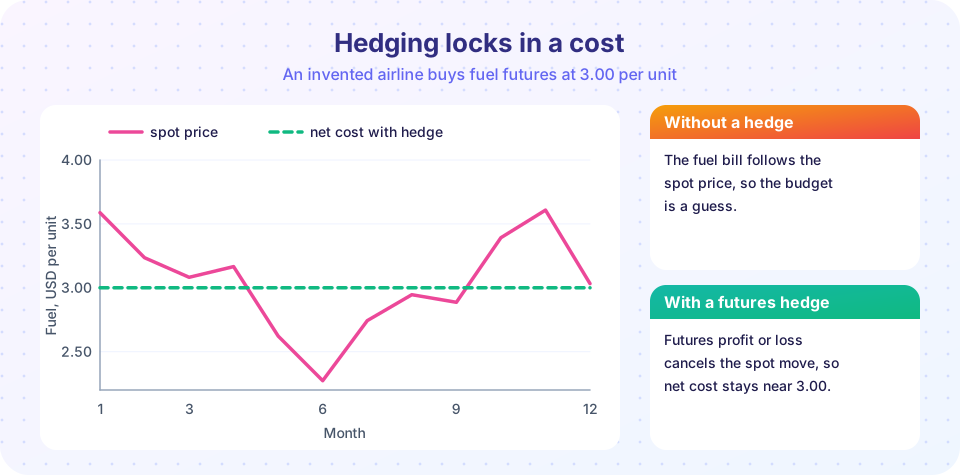
Take the airline of the picture. It needs 1,000,000 units of fuel in a few months and the futures price is 3.00. It buys futures for the full amount. Suppose the spot price at the time of purchase has risen to 3.40. The airline pays 3.40 for the fuel but earns 0.40 per unit on its futures, so its net cost is 3.00. Suppose instead the price falls to 2.60: it pays 2.60, loses 0.40 on futures, and again nets 3.00. The hedge removes the uncertainty, and also the chance of a lucky fall. A competitor that did not hedge will have lower costs if prices drop, and higher if they climb.
Perfect hedges are rare. The asset you want to hedge may not have a futures contract (jet fuel is often hedged with a related product such as heating oil), the contract's expiry may not match your date, and the basis may not be zero when you close the position. The leftover uncertainty is basis risk.
When the hedging instrument is only imperfectly related, choose the minimum-variance hedge ratio:
h* = rho x (sigma_S / sigma_F)
where rho is the correlation between changes in the spot and futures prices and sigma_S, sigma_F are the standard deviations of those changes. If rho = 0.9, sigma_S = 0.30 and sigma_F = 0.25, then h* = 0.9 x 1.2 = 1.08. The number of contracts is h* times the exposure divided by the contract size. A ratio near 1 is a sign of a good hedging instrument; a low correlation means that even the best hedge leaves a lot of risk.
A hedge is judged by risk reduction, not by profit. If the futures position makes money while the physical business loses, that is the hedge doing its job. A company that evaluates the futures leg alone, and calls it a loss, has misunderstood hedging.
Swaps
A swap is a series of forward-like exchanges. In a plain interest rate swap, one party pays a fixed rate and receives a floating rate on a notional amount, usually for several years, exchanging only the net difference. A company with a 10 million floating-rate loan that fears rising rates can enter a swap to pay 4 percent fixed and receive the floating rate. If the floating rate is 5 percent in a year, it receives 1 percent of 10 million, or 100,000, which offsets the higher interest on its loan. If the floating rate is 3 percent, it pays 100,000 to the swap counterparty, which is offset by the cheaper loan. The net cost is fixed at about 4 percent either way, plus the loan's margin. Currency swaps and commodity swaps work on similar principles.
Common misconceptions
"The forward price is the market's forecast." It is determined by today's spot price and the cost of carry, not by what traders expect.
"A hedge that loses money failed." A hedge is meant to offset losses elsewhere; judge it with the exposure, not alone.
"Futures profits are free of risk because they are settled daily." Daily settlement limits default risk, but margin calls can force you to close losing positions at the worst moment.
Try it
First, the forward price with the cost of carry and a check for arbitrage against a quoted price.
Press Run (or Ctrl + Enter) to see the result here.
Program input · what you'd type while the program runs
Type the answers before you press Run, one per line. Each time the program reads a line (with input()), it gets the next line from this box.
Second, a margin account simulation for a long futures position.
Press Run (or Ctrl + Enter) to see the result here.
Program input · what you'd type while the program runs
Type the answers before you press Run, one per line. Each time the program reads a line (with input()), it gets the next line from this box.
Third, a simulation of an airline buying fuel with and without a hedge. The hedge is imperfect: the futures price at the time of purchase differs from spot by random "basis noise".
Press Run (or Ctrl + Enter) to see the result here.
Program input · what you'd type while the program runs
Type the answers before you press Run, one per line. Each time the program reads a line (with input()), it gets the next line from this box.
Check your understanding
Quick check · 5 questions
of 5 answered You scored / 5 · perfect!
-
1. A non-dividend-paying stock costs 80 and the annual interest rate is 5%. What is the fair one-year forward price (annual compounding)?
F = 80 x 1.05 = 84.00. -
2. What does marking to market mean?
Futures accounts are credited or debited with each day's price change. -
3. A farmer expects to sell wheat in three months and fears a price fall. She should
A short hedge gains when prices fall, offsetting the lower selling price. -
4. Correlation 0.8, spot volatility 0.40 and futures volatility 0.32. What is the minimum-variance hedge ratio?
h* = 0.8 x 0.40 / 0.32 = 1.00. -
5. A company pays 4% fixed and receives floating on a 10 million swap. Floating is 6% for the year. What does the company receive net?
Net = (6% - 4%) x 10 million = 200,000.
Summary
- The forward price is spot compounded at the cost of carry, enforced by arbitrage; it is not a forecast.
- Futures are standardized and settled daily through margin accounts; margin calls make leverage risky.
- A hedge reduces uncertainty by offsetting an existing exposure; the minimum-variance ratio is
rho x sigma_S / sigma_F, and basis risk remains. - A swap exchanges cash flows; a fixed-for-floating swap turns floating-rate costs into fixed ones.
Next: Chapter review
Track your progress
Create a free account to tick off lessons and pick up where you left off on any device.
of Investing and Markets lessons completed