


















Lesson 30 of 45 · Transition Metals
Chapter 6 Review: Transition Metals
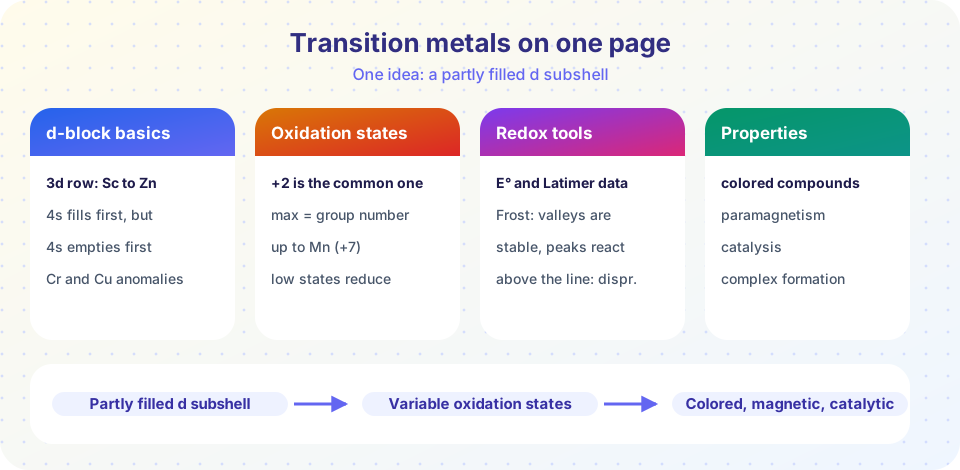
A one-picture summary of d-block chemistry with a recap table, Frost diagrams for iron and copper, and a ten-question mixed quiz.
This chapter had one big idea: a partly filled d subshell. From it we derived variable oxidation states, color, magnetism, catalysis and a thermodynamic toolkit (Latimer and Frost diagrams) for deciding which states survive. This review ties those pieces together and checks that you can apply them.
What you will learn
- Link configuration, oxidation state, color and magnetism in one reasoning chain.
- Apply Latimer and Frost rules to new data.
- Check yourself with ten mixed questions.
Chapter in a table
| Topic | Rule or fact | Example |
|---|---|---|
| Configuration | Atoms fill 4s first; ions lose 4s first; Cr and Cu are exceptions | Fe³⁺ is [Ar] 3d⁵ |
| d count | group number − oxidation state | Mn⁷⁺ is d⁰, Cu²⁺ is d⁹ |
| Trends | IE₁ nearly constant across 3d; mp and density peak mid-row | V, Cr melt highest |
| Oxidation states | Max = group number to Mn; high = oxidizing, low = reducing | MnO₄⁻ oxidizes, Ti³⁺ reduces |
| Color | d⁰ and d¹⁰ lack d–d bands; charge transfer can still color | Zn²⁺ colorless, MnO₄⁻ purple |
| Magnetism | μ = √(n(n+2)) | Mn²⁺ high spin: 5.92 BM |
| Latimer | Non-adjacent E = ΣnE / Σn; right > left means disproportionation | Cu⁺, Mn³⁺ |
| Frost | Low = stable; above the chord = disproportionates | Mn²⁺ valley |
| Nernst | E = E° − (0.0592/n) log Q; H⁺ shifts E | MnO₄⁻ weaker at high pH |
Key terms
d count: number of d electrons in an ion.
Disproportionation: simultaneous oxidation and reduction of one species.
Frost diagram: plot of nE° against oxidation number.
Charge-transfer transition: an electron jump between ligand and metal orbitals, often intense.
Common misconceptions
"Everything stable in acid is stable in base." Frost diagrams change with pH; Mn²⁺ is the sink in acid, MnO₂ in neutral and basic solution.
"A single oxidation state is enough to predict color." You also need the ligands, the geometry and whether charge transfer applies.
Try it
Draw Frost diagrams for iron and copper from the Latimer data. Look for the lowest point and any point above its chord.
Press Run (or Ctrl + Enter) to see the result here.
Program input · what you'd type while the program runs
Type the answers before you press Run, one per line. Each time the program reads a line (with input()), it gets the next line from this box.
Use these flashcards to revise.
Press Run (or Ctrl + Enter) to see the console output here.
No output.
Check your understanding
Quick check · 10 questions
of 10 answered You scored / 10 · perfect!
-
1. Which is the configuration of Cr?
Half-filled d plus a singly occupied 4s is lower in energy. -
2. What is the d count of Cu²⁺?
Group 11 − 2 = 9. -
3. Which ion has the highest spin-only moment (high spin)?
Mn²⁺ is d⁵ with five unpaired electrons: μ ≈ 5.92 BM. -
4. Which is a reducing agent?
Ti³⁺ is a low oxidation state with a readily removed electron. -
5. Latimer: Cu²⁺ —0.153→ Cu⁺ —0.521→ Cu. What is E°(Cu²⁺/Cu)?
(0.153 + 0.521)/2 = 0.337 V. -
6. A Frost diagram point lies above the line joining its neighbors. The species...
It can lower its free energy by splitting into its neighbors. -
7. As pH rises, MnO₄⁻/Mn²⁺ becomes...
The 8 H⁺ in the half-reaction make E fall by 0.0947 V per pH unit. -
8. Which is colorless?
d¹⁰ has no d–d transitions. -
9. Which catalyst is paired with its process correctly?
Iron catalyzes the Haber process; V₂O₅ the contact process; Pt–Rh the Ostwald process. -
10. Fe²⁺ ion vs Fe³⁺ ion: which statement is supported by Fe data (Fe³⁺ 0.771 Fe²⁺ −0.447 Fe)?
The right potential (−0.447) is lower than the left (0.771).
Summary
- A partly filled d subshell produces variable oxidation states, color, magnetism and catalysis.
- Count d electrons (group − oxidation state) and then reason about color and magnetism.
- Latimer and Frost diagrams turn E° data into predictions about stability and disproportionation.
- The Nernst equation links potentials to pH and concentration.
Track your progress
Create a free account to tick off lessons and pick up where you left off on any device.
of Inorganic Chemistry lessons completed