


















Lesson 5 of 45 · Getting Started
Chapter 1 review: getting started
Review the foundations of inorganic chemistry: blocks of the periodic table, naming and formulas, and oxidation states, with a recap table and a ten-question quiz.
You now have the working vocabulary of inorganic chemistry. This review puts the three lessons of the chapter on one page, gives you a way to check formulas by code, and ends with a longer quiz that mixes everything together.
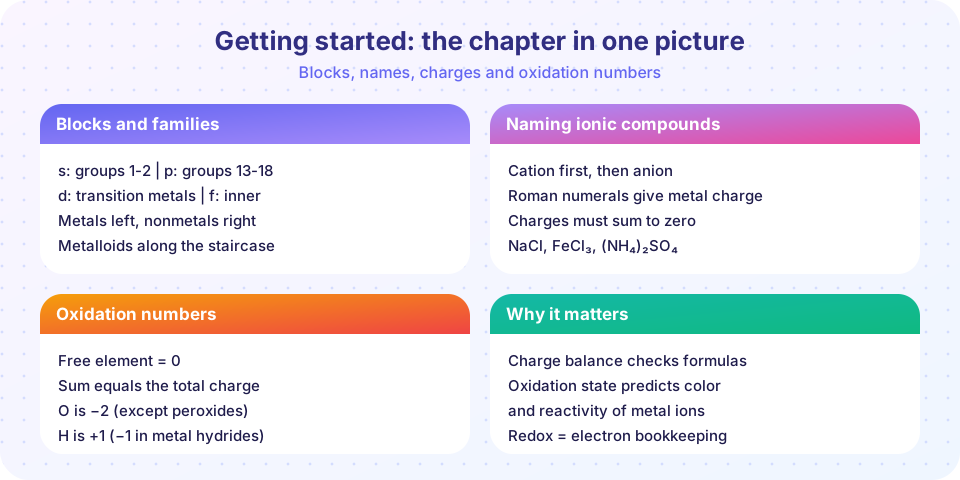
The chapter in a table
| Topic | Key idea | Example |
|---|---|---|
| Periodic table | Groups share valence electrons; blocks follow the subshell being filled | Cl: period 3, group 17, p-block |
| Metals, nonmetals, metalloids | About 80% of elements are metals; metalloids form a staircase | Si is a metalloid |
| Writing formulas | Balance charges with the least common multiple | Al³⁺ + SO₄²⁻ gives Al₂(SO₄)₃ |
| Naming ionic compounds | Cation, then anion; Roman numeral for variable charge | FeCl₃: iron(III) chloride |
| Naming molecular compounds | Greek prefixes | N₂O₄: dinitrogen tetroxide |
| Oxidation numbers | Rules in priority order, sum equals the charge | Mn in KMnO₄ is +7 |
| Redox | Oxidation = increase in oxidation number | Zn is oxidized by Cu²⁺ |
Try it
A final tool: check whether a formula is electrically neutral given a table of ion charges. This is a handy sanity check whenever you write a formula from memory.
Press Run (or Ctrl + Enter) to see the result here.
Program input · what you'd type while the program runs
Type the answers before you press Run, one per line. Each time the program reads a line (with input()), it gets the next line from this box.
Check your understanding
Quick check · 10 questions
of 10 answered You scored / 10 · perfect!
-
1. Which element has the address period 4, group 8, d-block?
Iron is in period 4 and group 8. Ruthenium is in period 5. -
2. Which of these is a halogen?
Halogens are group 17: F, Cl, Br, I. -
3. What is the formula of calcium phosphate?
Three Ca²⁺ give +6 and two PO₄³⁻ give −6. -
4. FeCl₃ is named:
Three Cl⁻ require Fe³⁺, so the Stock numeral is III. -
5. The oxidation state of nitrogen in NO₃⁻ is:
x + 3(−2) = −1 gives x = +5. -
6. In 2Mg + O₂ → 2MgO, what is reduced?
Oxygen goes from 0 to −2, a decrease, so it is reduced. Magnesium goes from 0 to +2 and is oxidized. -
7. Which pair of statements about metalloids is correct?
Metalloids such as Si, Ge and As lie along the staircase and have properties between those of metals and nonmetals. -
8. Which compound name uses Greek prefixes correctly?
Binary compounds of two nonmetals take Greek prefixes. PCl₅ is phosphorus pentachloride. -
9. Why is Fe₃O₄ said to have a fractional average oxidation state of +8/3?
Magnetite contains one Fe²⁺ for every two Fe³⁺, which averages to +8/3. -
10. Which species is most likely an oxidizing agent?
Dichromate contains Cr(VI), a high oxidation state that readily accepts electrons.
Summary
- Blocks and groups organize the elements, and valence electrons explain family behavior.
- Formulas follow from balanced charges; names follow from formulas.
- Oxidation numbers are an electron-bookkeeping tool that predicts redox behavior, color and stability.
Track your progress
Create a free account to tick off lessons and pick up where you left off on any device.
of Inorganic Chemistry lessons completed