


















Lesson 19 of 45 · Acids, Bases and Solvents
Nonaqueous solvents
Learn how solvent polarity, permittivity and self-ionization shape inorganic chemistry, with the solvent-system concept of acids and bases in liquid ammonia, H2SO4 and BrF3.
Most of the chemistry you have met so far happens in water. Water is cheap, safe and astonishingly good at dissolving ions. But it is also reactive: it destroys sodium metal, hydrolyzes many halides, and oxidizes powerful reductants. Chemists therefore reach for other liquids when water gets in the way. Choosing a solvent is choosing a chemical environment, and the solvent can reverse which compound is a strong acid or a good reductant.
What you will learn
- How permittivity and donor ability make a solvent suitable for ions
- What self-ionization is and how it defines acids and bases in any solvent
- Properties of liquid ammonia, sulfuric acid, DMSO and others
- Why some chemistry needs a nonaqueous solvent
Key terms
- Relative permittivity (dielectric constant, εᵣ): how much a solvent reduces the electrostatic force between charges, compared with a vacuum.
- Protic / aprotic: a protic solvent can donate H⁺ (water, NH₃, ethanol); an aprotic solvent cannot (DMSO, acetonitrile, THF).
- Donor number: a measure of how strongly a solvent donates electron pairs to Lewis acids.
- Self-ionization (autoionization): two solvent molecules reacting to give a cation and an anion.
- Solvent system definition: an acid raises the concentration of the solvent's cation; a base raises its anion.
What makes a good solvent for salts?
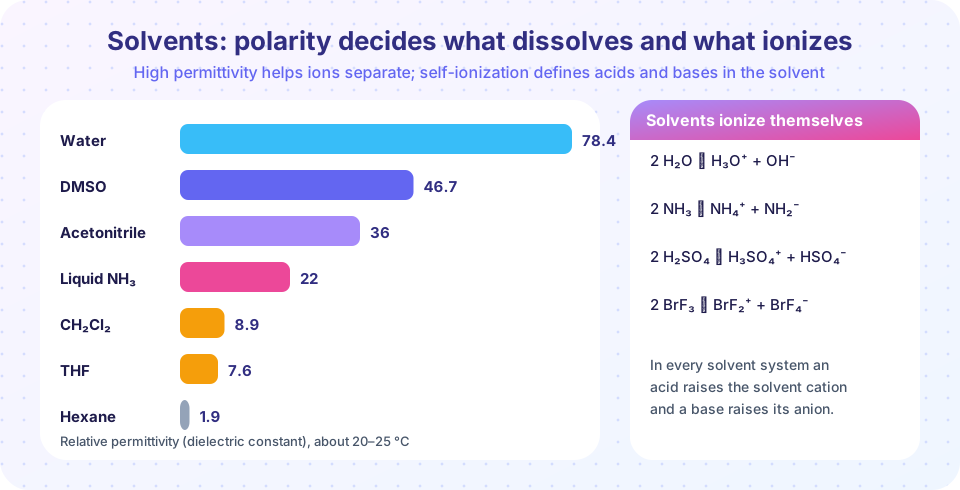
Two things matter. First, a high relative permittivity weakens the attraction between oppositely charged ions. The Coulomb energy between two charges is divided by εᵣ, so in water (εᵣ about 78) the force between ions is only about 1/78 of its vacuum value, while in hexane (about 1.9) it is nearly the full strength. Second, the solvent needs donor or acceptor sites to solvate ions: water's oxygen lone pairs bind cations, and its O–H hydrogens bind anions.
Typical values at about 20 to 25 °C: water 78, DMSO 47, acetonitrile 36, liquid ammonia about 22 (at its boiling point), dichloromethane 9, THF 7.6, hexane 1.9. A salt dissolves best in polar solvents with the right donor ability, and a solvent such as DMSO dissolves many salts well but does not hydrogen-bond to anions, which makes anions in DMSO more reactive than in water.
Self-ionization and the solvent-system definition
Water ionizes slightly: 2 H₂O ⇌ H₃O⁺ + OH⁻, with Kw = 1.0 × 10⁻¹⁴ at 25 °C. Many other solvents do the same:
| Solvent | Self-ionization |
|---|---|
| Water | 2 H₂O ⇌ H₃O⁺ + OH⁻ |
| Liquid ammonia | 2 NH₃ ⇌ NH₄⁺ + NH₂⁻ |
| Sulfuric acid | 2 H₂SO₄ ⇌ H₃SO₄⁺ + HSO₄⁻ |
| Bromine trifluoride | 2 BrF₃ ⇌ BrF₂⁺ + BrF₄⁻ |
The solvent system definition generalizes Arrhenius: an acid increases the concentration of the solvent's cation, and a base increases the concentration of its anion. In liquid ammonia, NH₄Cl is an acid and NaNH₂ is a base. In BrF₃, SbF₅ is an acid (it accepts F⁻ to give SbF₆⁻ and leaves BrF₂⁺) and KF is a base (it supplies F⁻ to give BrF₄⁻).
Liquid ammonia
Ammonia boils at −33 °C, so it is handled at low temperature or under pressure. It dissolves alkali metals to give deep blue solutions containing solvated electrons, Na → Na⁺(am) + e⁻(am). These solutions are powerful reducing agents used in the Birch reduction in organic chemistry, and they conduct electricity well. Strong bases such as the amide ion are stable in ammonia, while they would be destroyed by water. In ammonia, acetic acid behaves as a strong acid because ammonia is a much better proton acceptor than water, a leveling effect in the opposite direction.
Sulfuric acid, HF and other protic solvents
Anhydrous H₂SO₄ has a very high permittivity (about 100) and a high boiling point (it decomposes near 337 °C). It is an excellent acid solvent: bases are things that give HSO₄⁻, and very few substances act as acids in it. Adding the Lewis acid SbF₅ to the related acid HSO₃F gives magic acid, a superacid more acidic than 100 percent sulfuric acid, which can protonate even hydrocarbons.
Anhydrous hydrogen fluoride (bp 19.5 °C) has a similar permittivity to water and dissolves many fluorides, but it is extremely hazardous and etches glass.
Polar aprotic solvents
DMSO, acetonitrile, DMF and sulfolane have high permittivity but no acidic hydrogens. Anions are poorly solvated, so reactive anions (F⁻, CN⁻) become much stronger nucleophiles and bases. Acids are less ionized: the pKa of acetic acid is about 12 in DMSO instead of 4.76 in water, because the anion is not stabilized by hydrogen bonds.
Why use them?
- To use a reagent that water destroys (alkali metals, organolithiums, strong bases such as LDA or NaNH₂).
- To dissolve substances that are insoluble in water.
- To make an anion or cation more reactive by avoiding solvation.
- To measure the strength of very strong acids, which are leveled in water.
- To access electrochemical windows beyond water's roughly 1.2 V stability limit, as in lithium-ion batteries.
Common misconceptions
- "A polar solvent dissolves everything polar." Permittivity is one factor. Ability to solvate the specific ions matters too.
- "Aprotic means unreactive." Aprotic solvents can still be Lewis bases (DMSO) or reactive toward strong reagents (THF with organolithiums at room temperature).
- "pH applies to any solvent." pH and the 0 to 14 range are defined for water; every solvent has its own acidity scale and its own autoionization constant.
Try it
Why does permittivity matter? The Coulomb energy of an Na⁺ and Cl⁻ pair at contact is E = −N_A e² / (4π ε₀ εᵣ r). This program computes it for a pair separated by 282 pm in several solvents and compares it to thermal energy RT.
Press Run (or Ctrl + Enter) to see the result here.
Program input · what you'd type while the program runs
Type the answers before you press Run, one per line. Each time the program reads a line (with input()), it gets the next line from this box.
Water's own self-ionization depends on temperature. The code below tabulates pKw and the pH of neutral water, which is not always 7.
Press Run (or Ctrl + Enter) to see the result here.
Program input · what you'd type while the program runs
Type the answers before you press Run, one per line. Each time the program reads a line (with input()), it gets the next line from this box.
Check your understanding
Quick check · 5 questions
of 5 answered You scored / 5 · perfect!
-
1. In the solvent-system definition, what is an acid in liquid ammonia?
The solvent cation is NH₄⁺. Acids increase it, and bases (such as NaNH₂) increase NH₂⁻. -
2. Why are salts more soluble in water than in hexane?
Water weakens ion-ion attraction (εᵣ about 78) and binds ions through its lone pairs and O-H groups. Hexane does neither. -
3. Which substance dissolves in liquid ammonia to give a deep blue solution?
Alkali metals dissolve to give solvated cations and solvated electrons, which absorb in the red and give the blue color. -
4. Which of these is an aprotic solvent?
DMSO has no O-H or N-H hydrogens to donate. Water, ammonia and ethanol are protic. -
5. At 100 °C the pH of pure water is about 6.1. Is the water acidic?
At higher temperature Kw is larger, so neutral water has a lower pH. Neutrality means [H⁺] = [OH⁻].
Summary
- Solvents differ in permittivity, donor ability and whether they can donate protons.
- Self-ionization defines the solvent's own acid (cation) and base (anion).
- Liquid ammonia, sulfuric acid, BrF₃ and polar aprotic solvents each allow chemistry that water cannot.
- pH and neutrality are defined relative to the solvent and the temperature.
Next: Chapter 4 review
Track your progress
Create a free account to tick off lessons and pick up where you left off on any device.
of Inorganic Chemistry lessons completed