


















Lesson 33 of 45 · Coordination Chemistry
Crystal Field Theory: Splitting the d Orbitals
See why ligands split the d orbitals, compute crystal field stabilization energies, and decide between high-spin and low-spin complexes.
In a free gas-phase ion the five d orbitals have exactly the same energy. Put the ion in a complex and that equality breaks. Crystal field theory (CFT) explains how: treat each ligand as a negative point charge (or the negative end of a dipole) and ask how the d electrons feel the repulsion. The result is a simple energy diagram that predicts color, magnetism and even some trends in hydration energies. It is a model, not the whole truth, but it is the best first model chemists have.
What you will learn
- Explain why an octahedral field splits d orbitals into t₂g and eg sets.
- Fill the levels for high-spin and low-spin complexes and count unpaired electrons.
- Compute the crystal field stabilization energy (CFSE).
- Describe tetrahedral and square planar splitting and the Jahn–Teller distortion.
Key terms
Δo (octahedral splitting): the energy gap between the t₂g and eg sets.
t₂g and eg: the lower three (dxy, dxz, dyz) and the upper two (dz², dx²−y²) orbitals in an octahedral field.
Pairing energy (P): the energy cost of placing two electrons in one orbital.
CFSE: the energy lowering relative to the average d-orbital energy, in units of Δo.
Jahn–Teller distortion: a lowering of symmetry that removes degeneracy in an unevenly filled set of degenerate orbitals.
Why the split happens
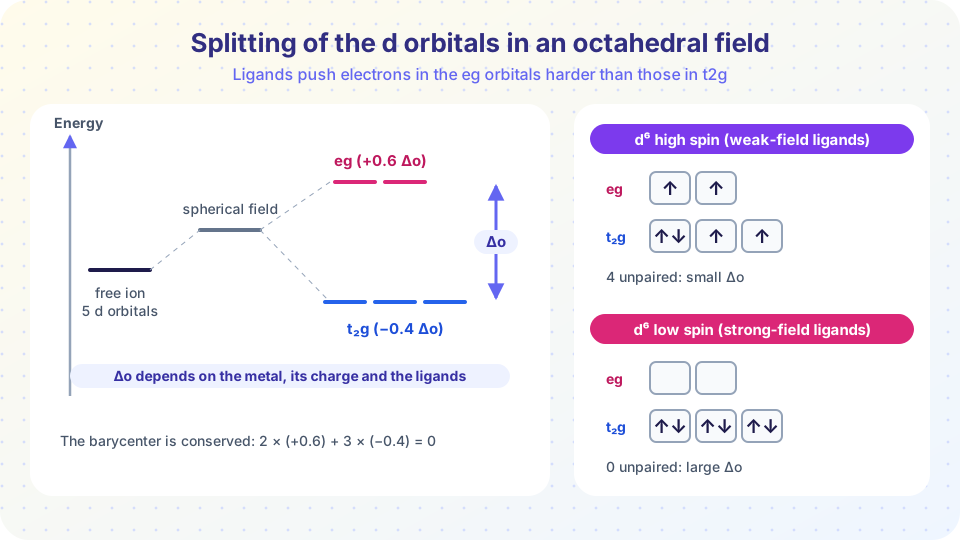
Set the metal at the origin with six ligands on the ±x, ±y and ±z axes. Two d orbitals, dz² and dx²−y², point straight at the ligands; the other three, dxy, dxz and dyz, point between them. Electrons in orbitals that point at the ligands feel stronger repulsion, so those two orbitals (the eg set) rise in energy and the other three (the t₂g set) fall. The average energy is unchanged, so the eg pair rises by +0.6 Δo and the t₂g trio falls by −0.4 Δo: 2(0.6) + 3(−0.4) = 0.
The size of Δo depends on three things:
- The ligand. The spectrochemical series, for example
I⁻ < Br⁻ < Cl⁻ < F⁻ < OH⁻ < H₂O < NH₃ < en < CN⁻ < CO, runs from small to large Δo. - The metal charge. Higher oxidation state gives larger Δo (M³⁺ larger than M²⁺ by roughly 40–80%).
- The period. Δo grows going down: 3d < 4d < 5d, by roughly 30–50% per row. Heavier metals are almost always low spin.
High spin or low spin?
Place electrons by Hund's rule and the aufbau principle. For d¹ to d³ there is no choice: they go singly into t₂g. For d⁴ to d⁷ there are two options:
- High spin (small Δo): put electrons into the eg orbitals before pairing. Pairing is costlier than climbing Δo.
- Low spin (large Δo): pair electrons in t₂g first. Climbing Δo is costlier than pairing.
The rule: if Δo > P, the complex is low spin; if Δo < P, high spin. Typical approximate values, in cm⁻¹: for Fe²⁺ (d⁶), P ≈ 17,600; [Fe(H₂O)₆]²⁺ has Δo ≈ 10,400 (high spin, 4 unpaired) while [Fe(CN)₆]⁴⁻ has Δo ≈ 33,000 (low spin, 0 unpaired). For Co³⁺, P ≈ 21,000; [CoF₆]³⁻ (Δo ≈ 13,000) is high spin but [Co(NH₃)₆]³⁺ (Δo ≈ 23,000) is low spin. Only d⁴ to d⁷ have a choice: d⁸ to d¹⁰ and d¹ to d³ are always the same either way.
Crystal field stabilization energy
The CFSE for an octahedral complex is
CFSE = (−0.4 × n(t₂g) + 0.6 × n(eg)) Δo
(plus a pairing correction for low-spin configurations). Examples: d³ has −1.2 Δo; high-spin d⁵ has 0; low-spin d⁶ has −2.4 Δo plus two extra pairs. Plotting the high-spin CFSE across the 3d series gives a double-hump curve with minima at d³ and d⁸ and zeros at d⁰, d⁵ and d¹⁰, which reappears in the hydration enthalpies and ionic radii of M²⁺ ions. You will draw it below.
Other geometries
- Tetrahedral. Four ligands sit at alternating cube corners; here the splitting is inverted (e below t₂) and
Δt ≈ 4/9 Δo, so tetrahedral complexes are almost always high spin. - Square planar. Strongly splits
dx²−y²upward; with eight d electrons (Pt²⁺, Pd²⁺, Au³⁺) the four lower orbitals fill and the high one stays empty, giving a diamagnetic square planar complex. - Jahn–Teller distortion. In an octahedral
d⁹complex such as[Cu(H₂O)₆]²⁺the eg set has three electrons in two orbitals, so the complex stretches along one axis (two long bonds, four short) to lower the energy. High-spin d⁴ and low-spin d⁷ complexes distort in the same way.
Common misconceptions
"CFT says the bonding is purely ionic." The model treats ligands as point charges, which is crude. Ligand field theory adds covalent bonding but keeps the same splitting diagram.
"High spin means high energy." High spin refers to many unpaired electrons, not energy.
"The ligand with the highest charge gives the largest Δo." CN⁻ and CO are strong-field because of π-bonding effects, not because of charge.
Try it
Compute the CFSE and the number of unpaired electrons for every d configuration, high and low spin, and plot the high-spin double-hump curve.
Press Run (or Ctrl + Enter) to see the result here.
Program input · what you'd type while the program runs
Type the answers before you press Run, one per line. Each time the program reads a line (with input()), it gets the next line from this box.
Now a spin-state predictor that compares Δo with the pairing energy. The numbers are rounded textbook values in cm⁻¹ and the rule is the simple Δo > P criterion.
Press Run (or Ctrl + Enter) to see the console output here.
No output.
Check your understanding
Quick check · 5 questions
of 5 answered You scored / 5 · perfect!
-
1. In an octahedral field the d orbitals pointing at the ligands are...
dz² and dx²−y² point along the axes at the ligands and are raised in energy. -
2. What is the CFSE of a high-spin d⁵ octahedral complex?
3(−0.4) + 2(0.6) = 0. -
3. When is a d⁶ octahedral complex low spin?
A large splitting makes it cheaper to pair electrons in t₂g than to promote them to eg. -
4. Which complex is expected to show Jahn–Teller distortion?
d⁹ has an unevenly filled eg set, so the octahedron distorts. -
5. Tetrahedral complexes are almost always high spin because...
With a small splitting, pairing energy usually wins.
Summary
- An octahedral field splits d orbitals into t₂g (−0.4 Δo) and eg (+0.6 Δo).
- Δo > P gives low spin; Δo < P gives high spin; the choice matters only for d⁴ to d⁷.
- CFSE = (−0.4 n(t₂g) + 0.6 n(eg)) Δo; high-spin CFSE has a double-hump pattern across the row.
- Tetrahedral complexes are high spin; d⁸ ions favor square planar; d⁹ shows Jahn–Teller distortion.
Next: Color and Magnetism
Track your progress
Create a free account to tick off lessons and pick up where you left off on any device.
of Inorganic Chemistry lessons completed