


















Lesson 36 of 45 · Solid State and Bioinorganic Chemistry
Chapter 8 Overview: Solid State and Bioinorganic Chemistry
An introduction to crystals and unit cells, the four kinds of solid, packing efficiency in metals, and a map of the solid-state and bioinorganic lessons.
Most inorganic compounds you will ever meet are solids: salts, oxides, ceramics, metals, semiconductors, minerals. Their properties (hardness, melting point, conductivity, color) come not only from which atoms they contain but also from how those atoms are arranged in space. This chapter first treats solids as periodic crystals and then looks at the other end of inorganic chemistry's reach, the metals inside living systems.
What you will learn
- Distinguish crystalline from amorphous solids and define lattice, basis and unit cell.
- Count atoms per cubic unit cell and compute packing efficiency.
- Use unit-cell data to calculate density or atomic radius.
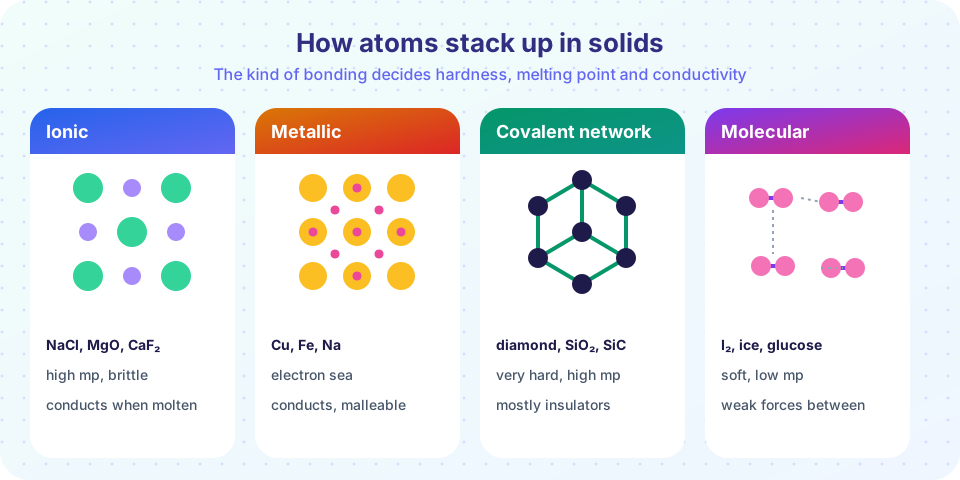
- Classify solids into four types and relate type to properties.
Key terms
Crystal lattice: an infinite array of points with identical surroundings; the crystal is the lattice plus a basis of atoms.
Unit cell: the smallest repeating unit that builds the whole crystal by translation.
Coordination number: the number of nearest neighbors around an atom or ion.
Packing efficiency: the fraction of space occupied by atoms, treated as hard spheres.
Amorphous solid: a solid without long-range order, such as glass.
Crystalline and amorphous solids
In a crystal, atoms repeat in a regular pattern in all three directions. That order gives sharp melting points and flat faces and allows X-ray diffraction: a crystal diffracts X-rays like a three-dimensional grating, and from the pattern chemists calculate positions of atoms. In an amorphous solid such as window glass, short-range order exists but long-range order does not; it softens gradually instead of melting at a single temperature.
Unit cells in cubic crystals
There are seven crystal systems (cubic, tetragonal, orthorhombic, hexagonal, rhombohedral, monoclinic and triclinic). The cubic system has three common lattices:
| Lattice | Atoms per cell | Coordination number | Packing efficiency | Example |
|---|---|---|---|---|
| Simple (primitive) cubic | 1 | 6 | 52% | α-Po |
| Body-centered cubic (bcc) | 2 | 8 | 68% | Na, Fe, Cr |
| Face-centered cubic (fcc) | 4 | 12 | 74% | Cu, Al, Au |
The count comes from sharing: an atom at a corner belongs to 8 cells (1/8 each), on a face to 2 cells (1/2), and inside the cell entirely. fcc has 8 × 1/8 + 6 × 1/2 = 4 atoms. Hexagonal close packing (hcp, Mg, Zn) has the same 74% efficiency and CN 12 as fcc (also called cubic close packed, ccp); they differ in the stacking sequence of layers (ABAB… versus ABCABC…). Between the spheres are holes: in a close-packed array of N atoms there are N octahedral holes and 2N tetrahedral holes, which ions and small atoms occupy in ionic crystals and alloys.
Atoms per unit cell
Packing efficiency
In this chapter
What is in this chapter
| Lesson | Focus |
|---|---|
| Ionic Solids and Lattice Energy | Rock salt, CsCl, zinc blende, fluorite, radius ratios, Born–Haber cycle |
| Band Theory | Metals, semiconductors, insulators, doping, LEDs |
| Bioinorganic Chemistry | Heme, cooperative binding, zinc enzymes, toxic metals |
| Chapter Review | One-picture summary and quiz |
Using the unit cell to calculate
If you know the cell edge a, the number of atoms Z per cell and the molar mass M, then the density is ρ = Z M / (N_A a³). In an fcc metal, atoms touch along the face diagonal, so 4r = a√2; in bcc they touch along the body diagonal, so 4r = a√3. The first TryIt below runs these calculations for four metals.
Common misconceptions
"A metal's atoms fill all the space." Even in the most efficient packing, 26% of the volume is empty.
"All solids are crystalline." Glasses, plastics and gels are amorphous.
"Corner atoms belong to the unit cell." Only one eighth of each corner atom belongs to a given cell.
Try it
Compute the density and atomic radius of four metals from their unit-cell edge. The edge lengths are textbook values in picometers.
Press Run (or Ctrl + Enter) to see the result here.
Program input · what you'd type while the program runs
Type the answers before you press Run, one per line. Each time the program reads a line (with input()), it gets the next line from this box.
Now compute the packing efficiency directly from geometry: the volume of the atoms in a cell divided by the cell volume.
Press Run (or Ctrl + Enter) to see the console output here.
No output.
Check your understanding
Quick check · 5 questions
of 5 answered You scored / 5 · perfect!
-
1. How many atoms belong to a face-centered cubic unit cell?
8 corners × 1/8 + 6 faces × 1/2 = 4. -
2. Which lattice has the highest packing efficiency?
fcc (and hcp) fill 74% of space; bcc 68%; simple cubic 52%. -
3. In an fcc metal, atoms touch along...
The face diagonal has length a√2 = 4r. -
4. What distinguishes a crystal from an amorphous solid?
Crystals have long-range periodic order; amorphous solids do not. -
5. In N close-packed atoms, how many tetrahedral holes are there?
There are N octahedral and 2N tetrahedral holes.
Summary
- Crystals are lattices plus a basis; the unit cell is the repeating unit.
- Simple cubic, bcc and fcc contain 1, 2 and 4 atoms per cell with packing efficiencies 52%, 68% and 74%.
- Density and radius follow from edge length, Z and molar mass.
- Solids fall into ionic, metallic, covalent network and molecular types.
Track your progress
Create a free account to tick off lessons and pick up where you left off on any device.
of Inorganic Chemistry lessons completed