


















Lesson 20 of 45 · Acids, Bases and Solvents
Chapter 4 review: acids, bases and solvents
Review chapter 4 of inorganic chemistry: Brønsted acids and pKa, Lewis acids and HSAB, and nonaqueous solvents, with a recap table and a ten-question quiz.
Chapter 4 widened the idea of an acid from "gives H⁺" to "accepts an electron pair", and showed that the solvent decides what counts as strong or weak. This page gathers the key facts, lets you compute how much of several acids ionizes, and checks the whole chapter with a mixed quiz.
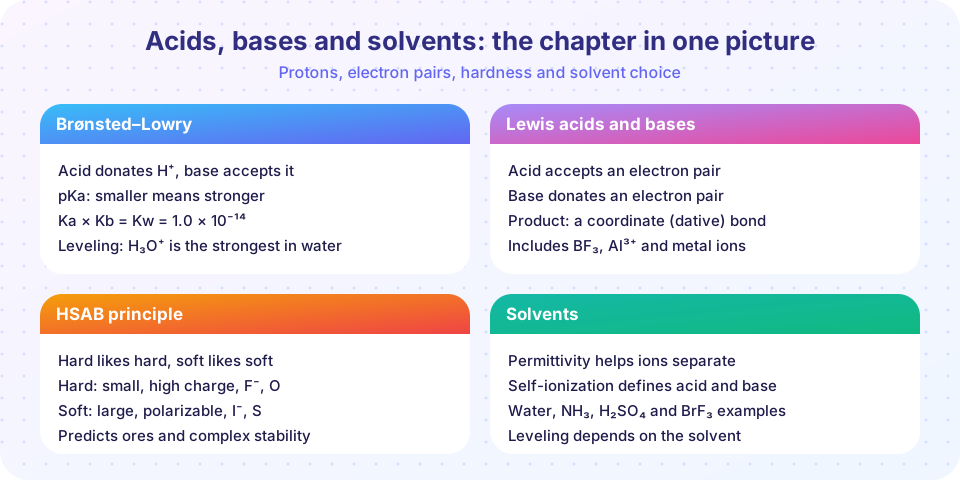
The chapter in a table
| Topic | Key facts |
|---|---|
| Definitions | Arrhenius ⊂ Brønsted-Lowry ⊂ Lewis |
| pH and pKa | pH = −log[H⁺]; smaller pKa = stronger acid; pKa + pKb = 14 in water at 25 °C |
| Direction of proton transfer | Toward the weaker acid and weaker base |
| Buffers | pH = pKa + log([A⁻]/[HA]); best within ±1 of pKa |
| Leveling | In water, no acid stronger than H₃O⁺ and no base stronger than OH⁻ |
| Lewis acids | BF₃, AlCl₃, metal cations, H⁺; form adducts with coordinate bonds |
| HSAB | Hard prefers hard, soft prefers soft; lithophile vs chalcophile elements |
| Solvents | Permittivity, protic/aprotic, self-ionization defines solvent acids and bases |
Try it
Strength versus concentration: this table computes the percent ionization of several acids at 1.0 M and at 0.001 M. Weak acids ionize much more when diluted.
Press Run (or Ctrl + Enter) to see the result here.
Program input · what you'd type while the program runs
Type the answers before you press Run, one per line. Each time the program reads a line (with input()), it gets the next line from this box.
Check your understanding
Quick check · 10 questions
of 10 answered You scored / 10 · perfect!
-
1. Which is the conjugate base of H₂PO₄⁻?
A conjugate base is formed by removing one proton: H₂PO₄⁻ loses H⁺ to give HPO₄²⁻. -
2. Which statement about pKa is true?
pKa = −log Ka, so a stronger acid has a larger Ka and a smaller pKa. -
3. What is the pH of a buffer made of equal concentrations of NH₄⁺ and NH₃ (pKa of NH₄⁺ = 9.25)?
When [A⁻] = [HA], pH = pKa. -
4. Which of these acts as a Lewis acid but not as a Brønsted acid?
BF₃ has no proton to donate but accepts an electron pair. -
5. Which pairing does the HSAB principle favor?
Both Hg²⁺ and S²⁻ are soft. The others mix hard and soft partners. -
6. Why does water level the strength of HCl and HNO₃?
Any acid stronger than H₃O⁺ transfers its proton to water completely. -
7. In liquid ammonia, which substance is a base according to the solvent-system definition?
NaNH₂ supplies NH₂⁻, the anion of the solvent. -
8. Which minerals typically contain hard acids such as Mg²⁺ and Al³⁺?
Hard acids pair with the hard base oxygen, giving oxides, carbonates and silicates. -
9. A solution has pOH = 4.0 at 25 °C. What is its pH?
pH + pOH = 14 at 25 °C, so the pH is 10. -
10. Which solvent property helps salts dissolve by weakening ion-ion attraction?
A high permittivity divides the Coulomb attraction between ions.
Summary
- Acid-base theory runs from Arrhenius to Brønsted-Lowry to Lewis, with each definition wider than the last.
- pKa values rank acids and predict the direction of proton transfer; buffers follow the Henderson-Hasselbalch equation.
- HSAB explains many metal-ligand preferences and the geochemical sorting of the elements.
- The solvent controls strength (leveling), solubility and reactivity.
Next: back to the course page, where chapter 5 begins the study of main-group chemistry.
Track your progress
Create a free account to tick off lessons and pick up where you left off on any device.
of Inorganic Chemistry lessons completed