


















Lesson 7 of 45 · Atomic Structure and Periodicity
Orbitals and quantum numbers
Understand atomic orbitals through the four quantum numbers n, l, ml and ms, see the shapes of s, p and d orbitals, and learn how many electrons each shell can hold.
An electron in an atom is described by a standing wave, and standing waves come in a limited set of patterns, just as a guitar string can vibrate in a fundamental tone and a fixed series of overtones. Each pattern has an energy and a shape. Chemists label each pattern with four quantum numbers, which together act like an address for the electron: shell, subshell, orientation and spin.
What you will learn
- The meaning and allowed values of n, l, ml and ms
- The shapes of s, p and d orbitals and their nodes
- How to count orbitals and electrons in a shell
- How to read a radial distribution plot
Key terms
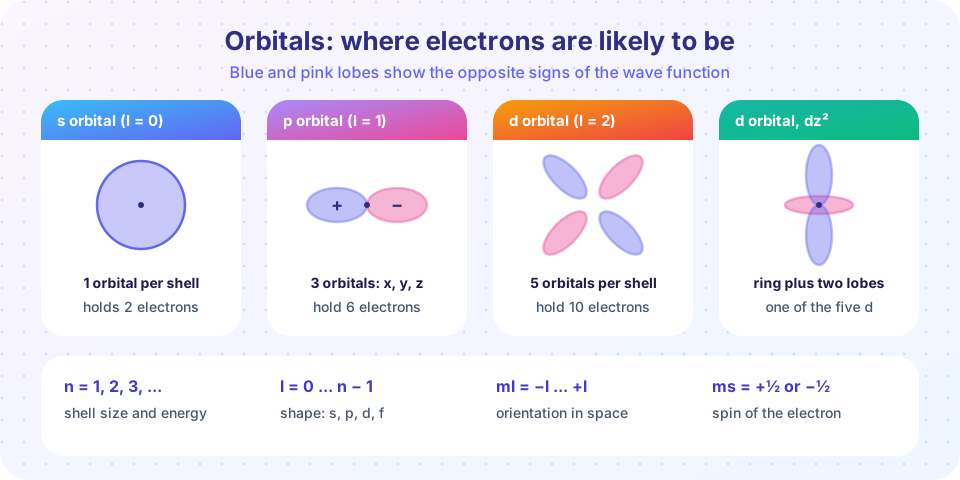
- Principal quantum number (n): 1, 2, 3, ... sets the shell and the overall size and energy.
- Angular momentum quantum number (l): 0 to n − 1 sets the shape: s (0), p (1), d (2), f (3).
- Magnetic quantum number (ml): −l to +l sets the orientation of the orbital.
- Spin quantum number (ms): +½ or −½, the two spin states of an electron.
- Node: a place where the wave function is zero and the electron is never found.
The four quantum numbers
n, the shell. n = 1 is the shell nearest the nucleus. Larger n means a larger, higher-energy orbital. The n-th shell contains n subshells.
l, the subshell. For shell n, l runs from 0 to n − 1. So shell 1 has only s (l = 0). Shell 2 has s and p (l = 0, 1). Shell 3 has s, p and d. The letters s, p, d, f come from old spectroscopic descriptions (sharp, principal, diffuse, fundamental).
ml, the orbital. For each l there are 2l + 1 values of ml, from −l to +l. An s subshell has 1 orbital, a p subshell 3, a d subshell 5, and an f subshell 7.
ms, the spin. An electron behaves as though it has a tiny magnetic moment that can point two ways. Each orbital holds at most two electrons, and the Pauli exclusion principle says that they must have opposite spins: no two electrons in an atom can share all four quantum numbers.
Counting works out neatly. The number of orbitals in shell n is n², and the shell holds 2n² electrons: 2, 8, 18 and 32 for n = 1 to 4. That is the length pattern of the periodic table's periods (2, 8, 8, 18, 18, 32, 32).
Shapes and nodes
- s orbitals are spherical. A 1s orbital has no nodes. A 2s orbital has one radial node, a spherical surface where the wave function changes sign.
- p orbitals are dumbbells along the x, y and z axes. The two lobes have opposite signs, with a nodal plane through the nucleus. A 2p orbital has no radial node; a 3p has one.
- d orbitals have two nodal surfaces. Four of the five look like cloverleaves (dxy, dxz, dyz and dx²−y²), and dz² has two lobes along the z axis plus a ring around the middle.
- f orbitals are more intricate, with three nodal surfaces, and matter for lanthanides and actinides.
A general rule: the total number of nodes in an orbital is n − 1. The number of angular nodes equals l, and the radial nodes are n − l − 1. The 3d orbital, for example, has two angular nodes and no radial node.
The sign (phase) of the lobes does not change the probability, which depends on the square of the wave function. It matters when orbitals overlap to form bonds: lobes with the same sign add, lobes with opposite signs cancel. Chapter 3 builds on this.
Radial distribution: where the electron is likely to be found
The wave function tells you the probability density at a point. What you often want is the chance of finding the electron at a distance r from the nucleus, in a thin shell. That is the radial distribution function P(r) = r² R(r)².
The result is a nice surprise. The 1s peak is at the Bohr radius, a₀ = 52.9 pm. A 2s electron is on average farther out, but it has a small inner peak near the nucleus, so it penetrates the inner shells more than a 2p electron does. Penetration is the reason that in multi-electron atoms the energy order within a shell is s < p < d < f. You will use this in the next lesson.
Common misconceptions
- "The electron orbits the nucleus like a planet." Orbitals are probability clouds; the electron has no trajectory.
- "The lobes of a p orbital are positive and negative charge." The signs belong to the wave function, not to electric charge.
- "An orbital is the same thing as a shell." A shell is all orbitals with the same n. An orbital is one specific wave function (one n, l and ml).
- "4s is always higher in energy than 3d." In a free atom, 4s fills first, but after 3d fills the 3d orbitals drop below 4s. See the next lesson.
Try it
This plot shows radial distribution functions for hydrogen 1s, 2s and 2p, in units of the Bohr radius. The code also checks numerically that each curve is normalized (the total probability is 1).
Press Run (or Ctrl + Enter) to see the result here.
Program input · what you'd type while the program runs
Type the answers before you press Run, one per line. Each time the program reads a line (with input()), it gets the next line from this box.
The second demo counts orbitals and electrons shell by shell. Move the slider and read off which subshells exist.
Check your understanding
Quick check · 5 questions
of 5 answered You scored / 5 · perfect!
-
1. Which set of quantum numbers is NOT allowed?
l must be less than n. With n = 2 the largest l is 1. -
2. How many orbitals are in a 3d subshell?
A d subshell has l = 2, so 2l + 1 = 5 orbitals. -
3. How many electrons can the n = 3 shell hold in total?
Shell n holds 2n² electrons, which is 18 for n = 3. -
4. How many radial nodes does a 3p orbital have?
Radial nodes equal n − l − 1 = 3 − 1 − 1 = 1. -
5. What does the Pauli exclusion principle say?
Two electrons in one orbital must therefore have opposite spins. The other two statements are the Aufbau principle and Hund's rule.
Summary
- Four quantum numbers (n, l, ml, ms) label every electron; no two can share all four.
- l sets the shape (s, p, d, f); each subshell holds 2l + 1 orbitals and two electrons per orbital.
- Shell n has n² orbitals and holds 2n² electrons.
- Radial distribution plots show that s electrons penetrate close to the nucleus, which shapes orbital energies.
Next: Electron configurations
Track your progress
Create a free account to tick off lessons and pick up where you left off on any device.
of Inorganic Chemistry lessons completed