


















Lesson 43 of 45 · Projects and Practice
Glossary of Inorganic Chemistry Terms (Chapters 5 to 8)
Plain-language definitions of the key terms from main-group chemistry, transition metals, coordination compounds, solids and bioinorganic chemistry.
Inorganic chemistry has its own vocabulary, and many of the words look alike (chelate, ligand, complex, coordination sphere). This glossary collects the terms from chapters 5 to 8 in alphabetical order, each in one or two sentences, with a pointer to the lesson where it is explained.
What you will learn
- Look up any term from chapters 5 to 8 quickly.
- Tell similar-sounding terms apart.
- Test yourself with a seeded flashcard generator.
A to C
- Allotropes: different structural forms of the same element, such as diamond and graphite (Groups 13 and 14).
- Amphoteric: able to react as both an acid and a base, like Al₂O₃.
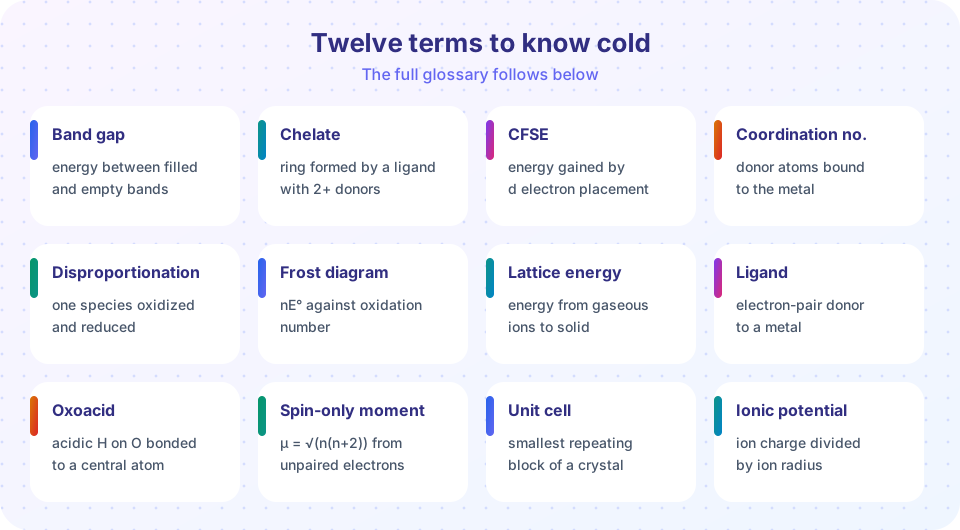
- Band gap: the energy separation between the valence band and the conduction band (Band Theory).
- Born–Haber cycle: a Hess's-law cycle used to find lattice energy (Ionic Solids).
- Catenation: bonding of an element to itself in chains and rings, strongest in carbon.
- CFSE (crystal field stabilization energy): energy lowering from placing d electrons in a split set of orbitals (Crystal Field Theory).
- Charge transfer: an electronic transition between ligand and metal orbitals, usually intense (Color and Magnetism).
- Chelate effect: extra stability of complexes with polydentate ligands, mostly an entropy effect (Ligands and Nomenclature).
- Comproportionation: two species of one element in different oxidation states react to give an intermediate state.
- Coordination number: the number of donor atoms bonded to the central metal (Chapter 7 Overview).
- Cooperativity: binding at one site changes affinity at others, as in hemoglobin (Bioinorganic Chemistry).
D to H
- d count: number of d electrons in an ion; group number minus oxidation state (d-Block Properties).
- d–d transition: promotion of an electron between split d orbitals, the cause of color in many complexes.
- Denticity: the number of donor atoms through which one ligand binds a metal.
- Diagonal relationship: similarity between an element and its lower-right neighbor, such as Li and Mg.
- Diamagnetic: repelled slightly by a magnetic field because all electrons are paired.
- Disproportionation: a species is oxidized and reduced at the same time (Redox).
- Doping: adding impurities to a semiconductor to supply electrons (n-type) or holes (p-type).
- Electron-deficient compound: has fewer electron pairs than bonds, as in diborane (Groups 13 and 14).
- Fermi level: highest occupied energy level at 0 K.
- Frost diagram: plot of nE° against oxidation number; low points are stable.
- Heme: an iron(II) complex of a porphyrin ring.
- High spin: electron arrangement with the maximum number of unpaired electrons (small Δo).
- Hypervalent: apparently more than eight electrons around a main-group atom, as in PF₅.
I to O
- Inert pair effect: reluctance of heavy p-block elements to use their ns² electrons.
- Interhalogen: a compound of two different halogens, such as ClF₃.
- Ionic potential: ion charge divided by ion radius; measures polarizing power.
- Jahn–Teller distortion: lowering of symmetry in a complex with unevenly filled degenerate orbitals.
- Latimer diagram: a list of species with the E° of each step between them.
- Lattice energy: energy released when gaseous ions form a mole of ionic solid.
- Ligand: an ion or molecule that donates an electron pair to a metal.
- Linkage isomers: complexes that differ only in which atom of an ambidentate ligand binds.
- Low spin: arrangement with the fewest unpaired electrons (large Δo).
- Madelung constant: geometric factor for the electrostatic energy of a lattice.
- Metalloprotein: a protein containing a metal ion cofactor.
- Nernst equation: relates electrode potential to concentrations, E = E° − (0.0592/n) log Q at 25 °C.
- Oxoacid: an acid with acidic hydrogens attached to oxygen atoms bonded to a central atom.
- Oxidation state: the charge an atom would have if all bonds were ionic.
P to Z
- Packing efficiency: fraction of space filled by atoms in a crystal.
- Paramagnetic: attracted into a magnetic field because of unpaired electrons.
- Passivation: formation of a protective surface layer that stops further corrosion, as on aluminum.
- Pauling's rules for oxoacids: first pKa ≈ 8 − 5n, where n is the number of non-hydroxyl oxygens.
- Pairing energy: the energy cost of putting two electrons in one orbital.
- Radius ratio: cation radius divided by anion radius, used to predict coordination number.
- Spectrochemical series: ordering of ligands by the Δo they produce.
- Spin-only moment: μ = √(n(n+2)) Bohr magnetons for n unpaired electrons.
- Transition metal: an element with a partly filled d subshell, or one forming ions with such a subshell.
- Unit cell: the smallest repeating unit of a crystal.
- Valence band / conduction band: the highest filled and lowest empty bands at 0 K.
Common misconceptions
"Ligand and complex mean the same." The ligand is one part; the complex is the metal plus all its ligands.
"Oxidation state and coordination number are interchangeable." They are independent properties.
"Diamagnetic means non-magnetic." Diamagnetic substances are weakly repelled by a field; they are not immune to it.
Try it
Search the mini-glossary in code. The dictionary holds a short form of twelve key terms; edit the search words to look up others you add yourself.
Press Run (or Ctrl + Enter) to see the console output here.
No output.
Now a definition-to-term flashcard generator with a fixed seed; try to name the term before reading the answer line.
Press Run (or Ctrl + Enter) to see the console output here.
No output.
Check your understanding
Quick check · 5 questions
of 5 answered You scored / 5 · perfect!
-
1. Which term describes a species that is simultaneously oxidized and reduced?
Disproportionation: one species gives both a more oxidized and a more reduced product. -
2. The number of donor atoms one ligand uses on one metal is its...
Denticity counts donor atoms of a single ligand; coordination number counts all donor atoms on the metal. -
3. Which term refers to energy released when gaseous ions form a solid?
Lattice energy is the stabilization of the solid relative to gaseous ions. -
4. A substance with unpaired electrons is...
Unpaired electrons give attraction into a magnetic field. -
5. Which pair of terms is NOT a synonym pair?
Oxidation state and coordination number are different properties.
Summary
- Learn terms in contrast pairs: ligand versus complex, denticity versus coordination number, oxidation state versus coordination number.
- Most terms attach to a formula or rule you can compute; link each word to its use.
- Return to the lesson links above whenever a definition feels thin.
Next: Cheat Sheet
Track your progress
Create a free account to tick off lessons and pick up where you left off on any device.
of Inorganic Chemistry lessons completed