


















Lesson 18 of 45 · Acids, Bases and Solvents
Lewis acids and the HSAB principle
Learn Lewis acid-base chemistry, coordinate bonds and adducts, and use Pearson's hard and soft acids and bases principle to predict which metals bind which ligands and ores.
The Brønsted definition ties acidity to the proton. But a great deal of inorganic chemistry has no protons in it: aluminum chloride reacts with chloride ions, boron trifluoride grabs ammonia, and every metal ion in water is surrounded by water molecules. G. N. Lewis saw that all of these are the same event, the donation of an electron pair from one species to another, and made it the basis of a wider definition. This lesson develops it and adds a powerful rule of thumb from Ralph Pearson on which acids and bases pair up best.
What you will learn
- The Lewis definition and the coordinate (dative) bond
- Common Lewis acids and bases
- How Pearson's hard and soft classification works
- How HSAB explains the distribution of elements in minerals
Key terms
- Lewis acid: an electron-pair acceptor (has an empty orbital).
- Lewis base: an electron-pair donor (has a lone pair).
- Adduct: the product of a Lewis acid and base, joined by a coordinate bond.
- Hard: small, highly charged, not very polarizable (Al³⁺, F⁻, OH⁻).
- Soft: large, low charge, highly polarizable (Hg²⁺, I⁻, CN⁻, CO).
Lewis acids and bases
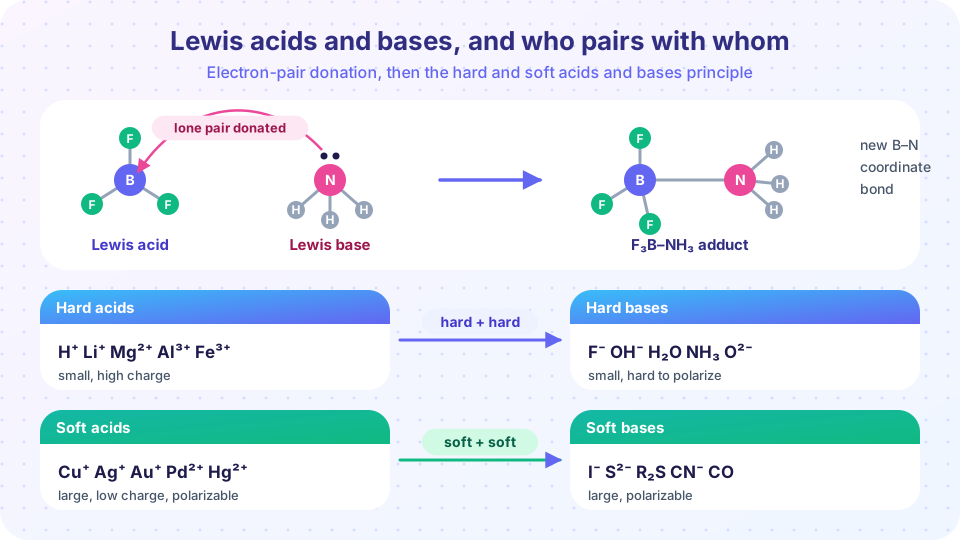
In BF₃ + :NH₃ → F₃B←NH₃, nitrogen donates its lone pair into boron's empty 2p orbital. The new B–N bond is a coordinate (dative) bond: both electrons come from one atom. Once formed, it is no different from any other covalent bond.
Lewis acids include:
- Electron-deficient molecules with an empty orbital: BF₃, BCl₃, AlCl₃.
- Metal cations, which accept electron pairs from ligands: Cu²⁺, Fe³⁺, Ag⁺, Al³⁺.
- Molecules that can expand their valence shell: SO₃, SiF₄, PF₅.
- The proton, H⁺, with no electrons at all.
Lewis bases are anything with a lone pair: H₂O, NH₃, OH⁻, F⁻, CN⁻, CO, phosphines (PR₃), halides, ethers. When a metal ion binds such species it forms a coordination compound, the subject of chapter 7: Cu²⁺ + 4 NH₃ → [Cu(NH₃)₄]²⁺.
AlCl₃ shows how a Lewis acid works in a real reaction: in the solid-state dimer Al₂Cl₆, each aluminum completes its octet by accepting a lone pair from a chlorine of its partner. Adding more chloride ion breaks it into AlCl₄⁻.
Hard and soft: Pearson's classification
Many metal ions and ligands do not bind equally well to everything. Fluoride forms very stable complexes with Al³⁺ and Fe³⁺, but almost none with Hg²⁺ or Ag⁺. Iodide behaves the opposite way. Pearson sorted acids and bases into two classes:
- Hard acids are small and highly charged with little polarizability: H⁺, Li⁺, Mg²⁺, Al³⁺, Fe³⁺, Cr³⁺, Ti⁴⁺. Hard bases are small, electronegative donors, difficult to oxidize and not easily polarized: F⁻, OH⁻, H₂O, NH₃, O²⁻, CO₃²⁻, PO₄³⁻.
- Soft acids are large, with low charge and easily distorted electron clouds: Cu⁺, Ag⁺, Au⁺, Cd²⁺, Hg²⁺, Pd²⁺, Pt²⁺. Soft bases are large, polarizable donors: I⁻, S²⁻, RS⁻, R₂S, CN⁻, CO, PR₃.
- Borderline species include Fe²⁺, Co²⁺, Ni²⁺, Cu²⁺, Zn²⁺, Pb²⁺, and bases such as Br⁻ and pyridine.
The HSAB principle: hard acids prefer hard bases, and soft acids prefer soft bases. Hard-hard interactions are mostly electrostatic (ionic-like), while soft-soft interactions have more covalent character, with orbital overlap and polarization.
HSAB is a rule of thumb, not an equation: it tells you which of two competing combinations is favored. In the reaction LiI + CsF → LiF + CsI the small, hard Li⁺ pairs with hard F⁻, and the larger, softer Cs⁺ pairs with the soft I⁻, so the products are favored.
Why the Earth looks the way it does
Victor Goldschmidt classified elements by where they are found in the Earth, and the groups line up with HSAB:
- Lithophile elements (hard acids such as Mg, Ca, Al, Ti, Li) are found with oxygen in oxides, carbonates and silicates: limestone CaCO₃, bauxite (aluminum oxides), olivine (Mg,Fe)₂SiO₄.
- Chalcophile elements (soft acids and borderline ions such as Hg, Ag, Cu, Zn, Cd, Pb) occur with sulfur: cinnabar HgS, galena PbS, sphalerite ZnS, chalcopyrite CuFeS₂.
Oxygen is the hard base that dominates the crust, but sulfide is soft. The soft metals get the soft partner. This is also why mercury poisoning is so serious: Hg²⁺ binds strongly to the soft sulfur of cysteine in proteins.
Strength and hardness are different things
Hardness says nothing about how strong an acid or base is, only about preference. A very strong acid can be soft, and a weak one hard. When both strength and hardness matter, as in metal-ligand chemistry, they compete, which is why the stability of complexes is subtle. Chapter 7 returns to it.
Common misconceptions
- "Lewis acids are just a special kind of Brønsted acid." It is the reverse: H⁺ is one example of a Lewis acid.
- "Hard means strong." Hardness describes size and polarizability, not strength.
- "HSAB is a law." It is a useful and often accurate rule of thumb, with exceptions, and it never replaced quantitative thermodynamics.
Try it
First, a table of cation charge density (charge divided by Shannon radius, in e per nm) next to Pearson's classification. Hard cations tend to have high charge density, but the match is imperfect: Na⁺ and K⁺ are hard with low values, while soft Cd²⁺ has a higher value than hard Ca²⁺. Charge density is only part of the story, because polarizability matters too.
Press Run (or Ctrl + Enter) to see the result here.
Program input · what you'd type while the program runs
Type the answers before you press Run, one per line. Each time the program reads a line (with input()), it gets the next line from this box.
Now test your HSAB intuition. Pick an acid and a base and the widget gives a rule-of-thumb prediction with a real example.
Check your understanding
Quick check · 5 questions
of 5 answered You scored / 5 · perfect!
-
1. Which species can act as a Lewis acid?
BF₃ has an empty p orbital on boron and accepts an electron pair. The others have lone pairs to donate. -
2. Hg²⁺ should bind most strongly to which base?
Hg²⁺ is a soft acid and S²⁻ is a soft base. This is why mercury occurs as the sulfide cinnabar. -
3. What is a coordinate (dative) bond?
In an adduct such as F₃B←NH₃, nitrogen supplies both electrons. Once formed, the bond is like any other covalent bond. -
4. Which statement about the HSAB principle is correct?
HSAB is a rule of thumb about preference, not an equation, and hardness is not strength. -
5. Which type of element is typically found as oxides and silicates?
Hard acids like Mg²⁺, Ca²⁺ and Al³⁺ pair with the hard base oxygen.
Summary
- A Lewis acid accepts an electron pair and a Lewis base donates one; the product is an adduct with a coordinate bond.
- Metal ions are Lewis acids and ligands are Lewis bases, which is the basis of coordination chemistry.
- Pearson's HSAB principle says hard prefers hard and soft prefers soft; it explains why metals occur as oxides or sulfides.
- Hardness describes size and polarizability, not strength.
Next: Nonaqueous solvents
Track your progress
Create a free account to tick off lessons and pick up where you left off on any device.
of Inorganic Chemistry lessons completed