


















Lesson 35 of 45 · Coordination Chemistry
Chapter 7 Review: Coordination Chemistry
Recap of complexes, ligands, naming, crystal field theory, color and magnetism, with a one-page picture, a recap table and a ten-question mixed quiz.
Coordination chemistry fits together like a chain. Ligands and coordination number set the geometry; geometry sets the d-orbital splitting; the splitting decides color, magnetism and stability. If you can walk along that chain for any new complex, you can predict most of its properties. This review gives you the whole chain on one page and tests it with ten mixed questions.
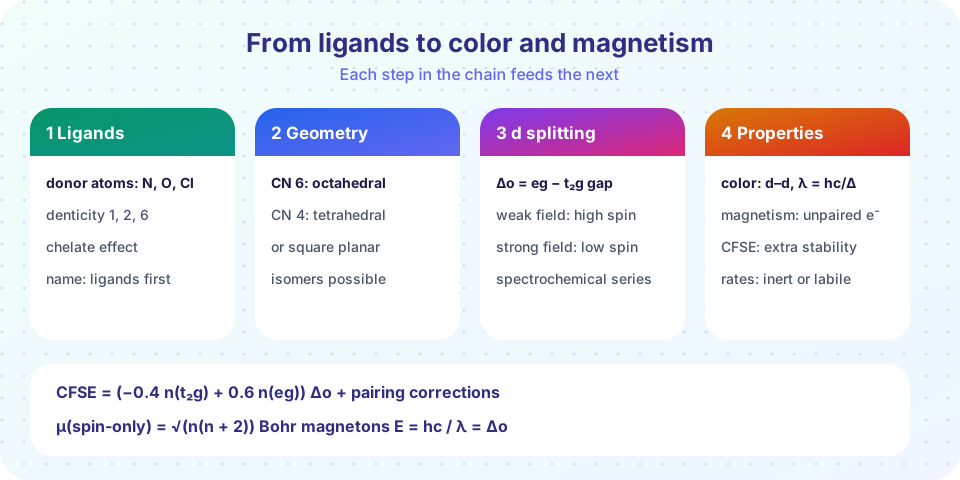
What you will learn
- Walk the chain from ligands to properties for a new complex.
- Pull together naming, CFSE, spin state, color and magnetism in one problem.
- Check yourself with ten mixed questions.
Chapter in a table
| Topic | Rule | Example |
|---|---|---|
| Oxidation state | complex charge − ligand charges | [Fe(CN)₆]⁴⁻: Fe(II) |
| CN and geometry | CN 6 octahedral; CN 4 tetrahedral or square planar (d⁸) | [PtCl₄]²⁻ square planar |
| Denticity | donor atoms per ligand; chelates are entropically favored | en, EDTA |
| Naming | ligands alphabetical, Roman numeral, "-ate" for anions | potassium hexacyanidoferrate(II) |
| Isomers | cis/trans, fac/mer, optical, linkage, ionization | [Co(en)₃]³⁺ chiral |
| CFT | t₂g −0.4 Δo, eg +0.6 Δo; Δo vs P decides spin | d⁶: Fe²⁺ high with H₂O, low with CN⁻ |
| Color | λ = 10⁷ / Δo (cm⁻¹) for d¹ and d³ | Ti³⁺ 493 nm |
| Magnetism | μ = √(n(n+2)) | Mn²⁺ 5.92 BM |
Key terms
Chelate effect: extra stability of complexes with polydentate ligands, mainly an entropy effect.
Spectrochemical series: ordering of ligands by the Δo they produce.
High spin / low spin: arrangements with the maximum / minimum number of unpaired electrons.
Charge transfer: an intense transition between ligand and metal orbitals.
A worked chain
Take K₃[Fe(CN)₆]. Name: potassium hexacyanidoferrate(III), since three K⁺ balance a 3− complex and six CN⁻ give −6, so iron is +3. Iron(III) has eight valence electrons, so d⁵. CN⁻ is a very strong-field ligand; Δo (about 35,000 cm⁻¹) exceeds P, so the complex is low spin with t₂g⁵ eg⁰. One unpaired electron gives μ ≈ 1.73 BM, observed near 2.3 BM because of orbital contribution. CFSE = −2.0 Δo plus two pairing costs. The compound forms red crystals and a yellow solution, with charge-transfer bands playing a large part. Compare with [Fe(H₂O)₆]³⁺, high spin d⁵ with five unpaired electrons (5.92 BM), which is very pale because the d–d transitions are spin-forbidden.
Common misconceptions
"Low spin always means diamagnetic." Low-spin d⁵ has one unpaired electron, and low-spin d⁷ has one.
"Square planar complexes only occur for Pt." They also occur for Pd²⁺, Au³⁺, Rh⁺, Ir⁺ and some Ni²⁺ complexes with strong-field ligands.
Try it
Compare Δo for chromium(III) with different ligands. The numbers are textbook values for the lowest d–d band, which equals Δo for d³.
Press Run (or Ctrl + Enter) to see the result here.
Program input · what you'd type while the program runs
Type the answers before you press Run, one per line. Each time the program reads a line (with input()), it gets the next line from this box.
Use these flashcards to revise.
Press Run (or Ctrl + Enter) to see the console output here.
No output.
Check your understanding
Quick check · 10 questions
of 10 answered You scored / 10 · perfect!
-
1. What is the name of K₄[Fe(CN)₆]?
Four K⁺ balance a 4− complex; with six CN⁻ (−6), iron is +2. -
2. Which ligand produces the largest Δo?
CN⁻ is at the strong-field end of the spectrochemical series. -
3. How many unpaired electrons does low-spin [Co(NH₃)₆]³⁺ (d⁶) have?
All six d electrons pair in t₂g. -
4. Which complex is most likely tetrahedral?
Small metal ion with four large, weak-field ligands favors tetrahedral geometry. -
5. CFSE of high-spin d⁷ octahedral?
t₂g⁵ eg²: 5(−0.4) + 2(0.6) = −0.8. -
6. Which statement is true?
Charge-transfer transitions are fully allowed and may be 100 to 1000 times stronger. -
7. [Cu(H₂O)₆]²⁺ is distorted because...
Unequal occupation of the eg orbitals lowers the energy by elongating the octahedron. -
8. What is the oxidation state of Co in [Co(en)₃]Cl₃?
Three Cl⁻ outside means the complex is 3+; en is neutral. -
9. Which pair are linkage isomers?
The ambidentate nitrite binds through N or O. -
10. If Δo = 20,000 cm⁻¹, what is the absorbed wavelength?
λ = 10⁷/20,000 = 500 nm.
Summary
- Follow the chain: ligands and CN give geometry, geometry gives splitting, splitting gives color, magnetism and stability.
- Count d electrons, compare Δo with P, then compute CFSE and μ.
- Names list ligands alphabetically and give the metal's oxidation state in Roman numerals.
- Charge transfer and spin-forbidden transitions explain colors that d–d theory alone cannot.
Track your progress
Create a free account to tick off lessons and pick up where you left off on any device.
of Inorganic Chemistry lessons completed