


















Lesson 39 of 45 · Solid State and Bioinorganic Chemistry
Bioinorganic Chemistry: Metals in Living Systems
Explore how iron, zinc, copper, magnesium and cobalt work in proteins: hemoglobin and cooperative oxygen binding, carbonic anhydrase, chlorophyll and toxic metals.
You are a walking coordination compound. Every breath you take delivers oxygen to iron atoms held in porphyrin rings; every second your cells use zinc to speed up reactions that would be far too slow without it; the electrical pulses in your nerves depend on sodium and potassium ions crossing membranes. Bioinorganic chemistry asks how living systems choose, move and use metal ions, and it applies everything you have learned in this course: oxidation states, ligand fields, spin states, Lewis acidity and redox potentials.
What you will learn
- Distinguish bulk and trace essential metals and describe their roles.
- Explain how heme binds oxygen and why hemoglobin binds it cooperatively.
- Describe zinc and copper proteins and the idea of the entatic state.
- Explain metal toxicity and chelation therapy.
Key terms
Metalloprotein: a protein that contains a metal ion as a cofactor.
Heme: an iron(II) complex of the porphyrin protoporphyrin IX.
Cooperativity: binding at one site changes the affinity at other sites.
Hill coefficient (n): a measure of cooperativity; n = 1 means none, and larger n means steeper binding curves.
Chelation therapy: treatment that uses a ligand to bind and remove a toxic metal.
The metals of life
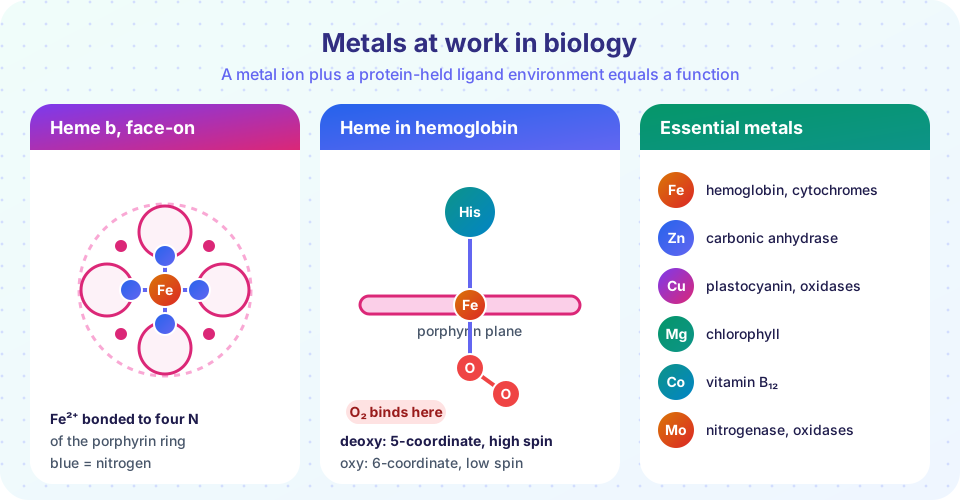
Bulk ions such as Na⁺, K⁺, Mg²⁺ and Ca²⁺ are present in large amounts and work mostly through electrostatics and weak binding: Na⁺ and K⁺ gradients across membranes (kept by the Na⁺/K⁺-ATPase pump) power nerve signals, Ca²⁺ triggers muscle contraction, and Mg²⁺ binds ATP and sits at the center of chlorophyll. Trace metals (Fe, Zn, Cu, Mn, Co, Mo) are needed in tiny amounts but are catalytically vital; they are chosen for their coordination preferences and redox potentials.
Free metal ions are rarely found in cells. Proteins hold them in precisely designed coordination spheres built from histidine (N), cysteine (S), glutamate and aspartate (O) and backbone groups, which sets geometry, Lewis acidity and redox potential.
Heme and oxygen transport
In myoglobin and hemoglobin, an Fe²⁺ ion sits in the center of a porphyrin ring, bonded to its four nitrogen atoms, with a histidine from the protein as fifth ligand. In deoxy form, iron is five-coordinate, high spin (d⁶, four unpaired electrons, a larger ion) and sits a little above the porphyrin plane. O₂ binds at the sixth site, iron becomes low-spin with a smaller radius, moves into the plane and tugs the proximal histidine, which tugs on the protein chain. That movement is the way the four subunits of hemoglobin communicate.
Cooperative binding
Myoglobin has one heme and binds oxygen along a hyperbolic curve, Y = p / (P50 + p), with P50 ≈ 2.8 mmHg: it grabs oxygen at low pressure and stores it in muscle. Hemoglobin has four hemes and binds O₂ along a sigmoid curve, described by the Hill equation
Y = pⁿ / (P50ⁿ + pⁿ)
with P50 ≈ 26 mmHg and n ≈ 2.8. In the lungs (p ≈ 100 mmHg) hemoglobin is about 98% saturated; in working tissue (p ≈ 40 mmHg) it is about 77%, so it delivers roughly a fifth of its load there and more as p falls further. A non-cooperative protein with the same P50 would load only about 79% in the lungs and deliver about 19%; cooperativity squeezes both loading and unloading into a narrow pressure range, which is a design for efficient delivery. The second TryIt plots these curves.
Carbon monoxide and other poisons
Carbon monoxide binds to heme iron about 200 to 250 times more strongly than O₂ (the Haldane ratio), so a small CO partial pressure blocks much oxygen transport. Cyanide binds the iron of cytochrome c oxidase and halts respiration. If heme iron is oxidized to Fe³⁺ (methemoglobin), it no longer binds O₂ at all.
Zinc: the Lewis acid enzyme metal
Zn²⁺ is d¹⁰, so it has no ligand field stabilization preference, is redox-inactive and can adopt flexible geometries, ideal for a Lewis acid catalyst. In carbonic anhydrase, Zn²⁺ is bound by three histidines and a water molecule. Zinc lowers the pKa of that water to about 7, so at physiological pH a Zn–OH⁻ forms and attacks CO₂ to produce HCO₃⁻. One enzyme molecule can convert on the order of a million CO₂ molecules per second, making it one of the fastest known enzymes. Zinc also appears in alcohol dehydrogenase, DNA-binding "zinc finger" proteins and many others.
Copper, iron–sulfur clusters and vitamin B₁₂
- Blue copper proteins such as plastocyanin transfer electrons between Cu²⁺ and Cu⁺. The protein forces the copper into an in-between geometry (distorted tetrahedral) that suits both oxidation states, so electron transfer is fast: an example of the entatic state.
- Iron–sulfur clusters (Fe₂S₂, Fe₄S₄) pass electrons in respiration and photosynthesis.
- Vitamin B₁₂ contains cobalt in a corrin ring and carries alkyl groups in biochemical rearrangements.
- Nitrogenase uses an iron–molybdenum cofactor to reduce N₂ to NH₃ at ambient conditions, something the Haber process needs 400 °C and 200 atm to do.
- Chlorophyll contains Mg²⁺ in a chlorin ring; magnesium is chosen for its fixed +2 state and as a Lewis acid that holds the ring flat.
Toxic metals and chelation
Metals such as lead, mercury, cadmium and arsenic are toxic partly because they bind strongly to sulfur groups (cysteine, the "soft" donor) and displace the zinc or other essential metals from proteins, an application of hard and soft acid–base ideas. Chelation therapy uses ligands that bind the toxic metal tightly: EDTA for lead, dimercaprol (British anti-Lewisite) for arsenic and mercury. Cisplatin, cis-[PtCl₂(NH₃)₂], turns the same bonding preference to advantage: after losing chloride inside the cell, its Pt²⁺ binds N7 of guanine in DNA and blocks cancer-cell replication.
This lesson is educational information about chemistry and biology. It is not medical advice, and nothing here should be used to diagnose or treat poisoning.
Common misconceptions
"The iron in hemoglobin is iron metal." It is an Fe²⁺ ion bound in a coordination complex.
"More metal is always better." Both deficiency and excess are harmful; cells tightly regulate every metal.
"Cooperativity means the sites are chemically different." The four hemes are identical; they communicate through shifts in the protein structure.
Try it
Plot the oxygen-binding curves of myoglobin and hemoglobin from their Hill parameters. The parameters are typical textbook values; real values depend on pH, CO₂ and temperature.
Press Run (or Ctrl + Enter) to see the result here.
Program input · what you'd type while the program runs
Type the answers before you press Run, one per line. Each time the program reads a line (with input()), it gets the next line from this box.
Next, an equilibrium model of carbon monoxide competition. It uses the Haldane relation [HbCO]/[HbO₂] = M × pCO / pO₂ with M ≈ 220. This is a textbook equilibrium estimate, not a clinical tool, and the numbers show only the idea of competitive binding.
Press Run (or Ctrl + Enter) to see the console output here.
No output.
Check your understanding
Quick check · 5 questions
of 5 answered You scored / 5 · perfect!
-
1. What is the oxidation state of iron in hemoglobin that can bind O₂?
Oxygen-carrying heme contains Fe²⁺; Fe³⁺ (methemoglobin) does not bind O₂. -
2. Why is zinc suited to be a Lewis acid catalyst in enzymes?
A closed d shell means no ligand-field preference and no redox side reactions. -
3. Hemoglobin's sigmoid binding curve is evidence of...
Binding at one heme raises the affinity of the others. -
4. Which metal sits at the center of chlorophyll?
Chlorophyll contains Mg²⁺ in a chlorin ring. -
5. Why are Pb²⁺ and Hg²⁺ toxic?
Soft heavy metals have high affinity for cysteine thiolates.
Summary
- Bulk ions (Na⁺, K⁺, Mg²⁺, Ca²⁺) act electrostatically; trace metals (Fe, Zn, Cu, Co, Mo) are catalytic centers.
- Heme Fe²⁺ binds O₂ reversibly; hemoglobin's cooperativity (Hill n ≈ 2.8) improves oxygen delivery.
- Zn²⁺ is a flexible, redox-inactive Lewis acid in enzymes like carbonic anhydrase; copper proteins use the entatic state for fast electron transfer.
- Toxic metals bind sulfur groups; chelating ligands such as EDTA can remove them, and cisplatin exploits Pt²⁺ binding to DNA.
Next: Chapter Review
Track your progress
Create a free account to tick off lessons and pick up where you left off on any device.
of Inorganic Chemistry lessons completed